
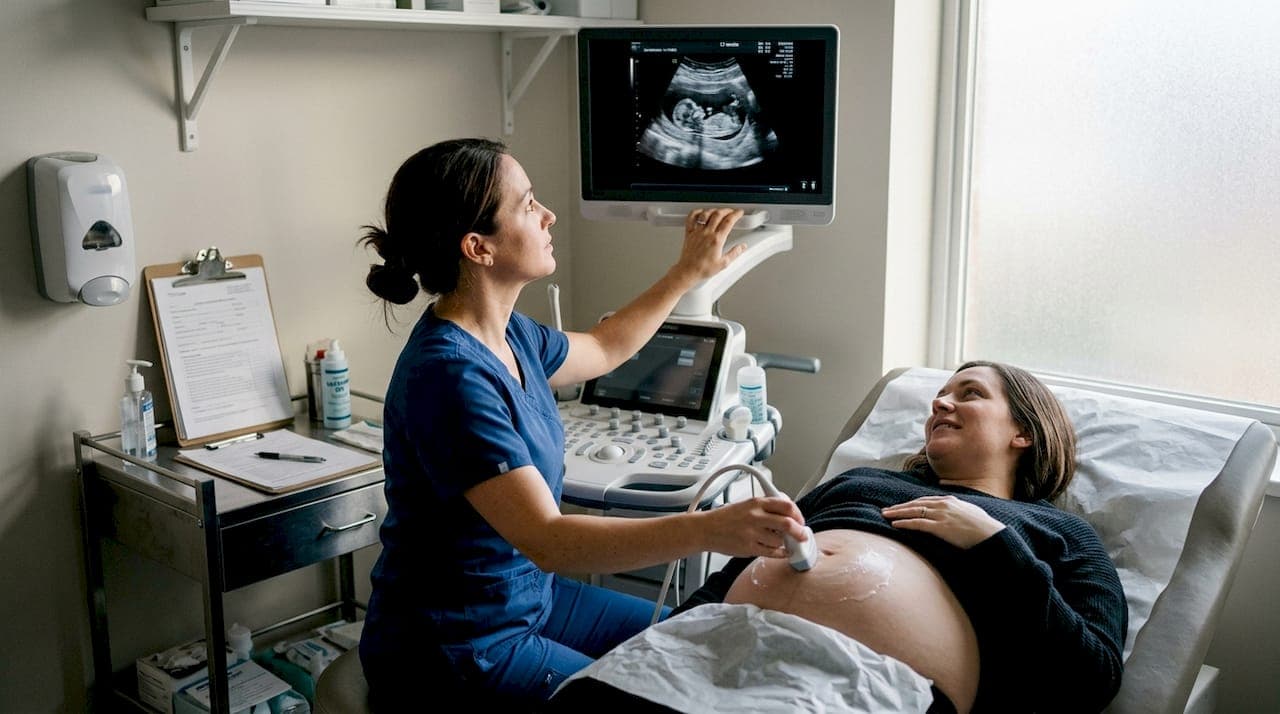
Most expectant parents assume that a quick ultrasound at 10 or 11 weeks will give them a clear, definitive answer about their baby's sex. The reality is more fascinating and more nuanced than that. Early gender reveal ultrasounds can work beautifully, but their accuracy depends on timing, fetal position, and the skill of the sonographer reading the scan. This guide walks you through exactly what these scans involve, when they're most reliable, what the science actually says about accuracy, and how to make the experience as safe and emotionally meaningful as possible.
Table of Contents
- What is an early gender reveal ultrasound?
- How early can gender be detected, and how accurate is it?
- Benefits of early gender reveal ultrasounds: Beyond curiosity
- Risks, limitations, and expert perspectives on early gender scans
- Our perspective: What truly matters in early gender reveal ultrasounds
- Experience a safe, memorable gender reveal with BabyView3D
- Frequently asked questions
Key Takeaways
| Point | Details |
|---|---|
| Not always accurate early | Ultrasounds before 14 weeks can identify gender but with higher odds of error than most expect. |
| Bonding is a real benefit | Early gender reveal ultrasounds foster emotional connection and joyful anticipation for families. |
| Medical safety first | Choose accredited providers and remember early scans do not replace necessary medical checks. |
| Consult experts if unsure | When in doubt, follow guidance from your healthcare team and trusted organizations like ACOG. |
What is an early gender reveal ultrasound?
An early gender reveal ultrasound is a scan performed specifically to predict your baby's sex before the standard anatomy scan, which typically happens between 18 and 22 weeks. Instead of waiting nearly five months, many parents want to know sooner, and technology now makes that possible.
These scans are usually performed between 11 and 14 weeks of pregnancy, though some providers offer them as early as 10 weeks. Two methods are commonly used: transabdominal ultrasound, where the probe glides over your belly, and transvaginal ultrasound, where a small probe is inserted vaginally for a closer view. The transvaginal approach often gives clearer images in very early pregnancy.
At this stage, sonographers look at a tiny structure called the genital tubercle, sometimes called the "nub." According to WebMD, the nub's angle relative to the spine in a sagittal (side profile) view tells the story: a nub angled more than 30 degrees upward suggests male, while one that points parallel or downward suggests female. After 14 weeks, direct visualization of the genitalia becomes possible, making interpretation more straightforward.
Here's how early gender reveal ultrasounds differ from your other prenatal scans:
- Primary focus: Gender prediction, not anomaly screening
- Timing: 11 to 14 weeks, earlier than the anatomy scan
- Method: Nub theory analysis or direct genital visualization
- Setting: Often boutique or private imaging centers
- Emotional purpose: Bonding, celebration, and family planning
This is not a replacement for your diagnostic scans. Think of it as an add-on experience, one that gives you a meaningful preview of your baby's identity. You can explore the full ultrasound services timeline to understand how early gender scans fit into your overall prenatal journey.
The experience itself is often deeply emotional. Seeing your baby move on screen at 12 weeks, even in a scan focused on gender, creates a real and lasting connection. That emotional value is a big reason why early gender reveal ultrasounds have grown so popular with modern families.
How early can gender be detected, and how accurate is it?
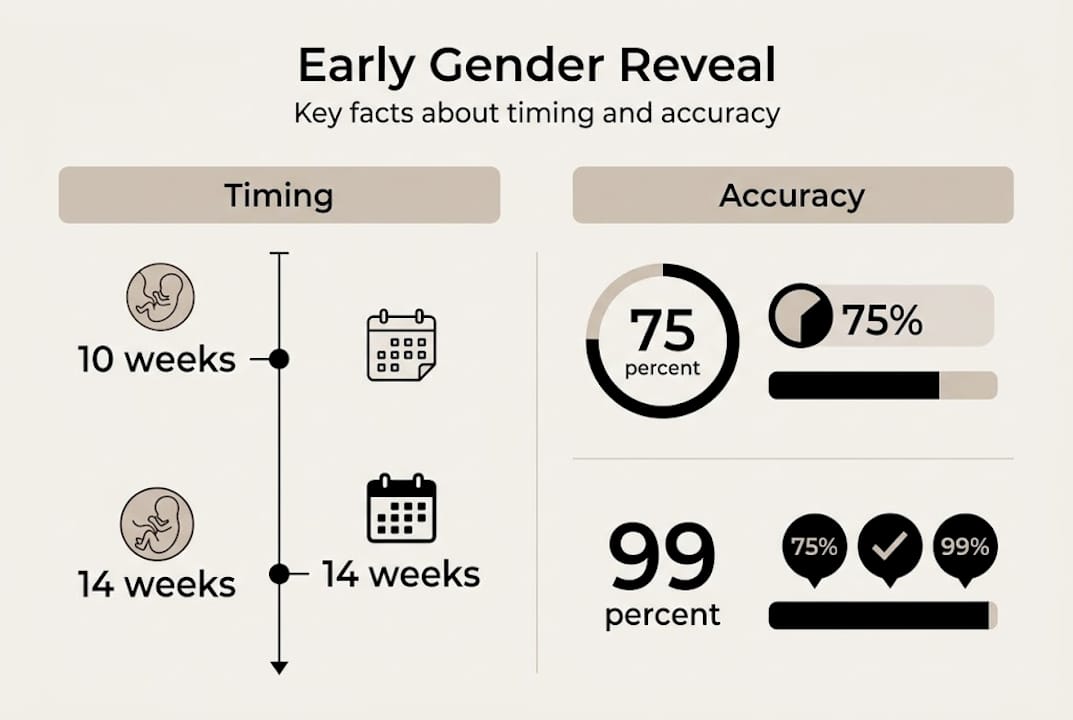
This is the question every parent asks first, and the answer depends heavily on timing. The earlier the scan, the lower the accuracy. It's not about the technology being poor. It's about fetal development. The genital structures simply haven't differentiated enough at 10 weeks to read reliably.
Here's a clear breakdown of accuracy by gestational week:
| Gestational week | Accuracy rate | Method used |
|---|---|---|
| 10-11 weeks | 70-80% | Nub theory |
| 12-13 weeks | 90-99% | Nub theory |
| 14-16 weeks | 99%+ | Direct visualization |
| 18+ weeks | Near 100% | Direct visualization |
A study of 150 pregnancies found an overall success rate of approximately 91% at 11 to 12 weeks, with accuracy improving significantly as pregnancy progressed. By 12 to 13 weeks, accuracy can reach up to 99% in optimal conditions.
Several factors influence how reliable your result will be:
- Fetal position: If your baby is curled up or facing away, the nub may not be visible in the correct plane
- Image quality: Higher resolution equipment produces more readable images
- Sonographer experience: Reading the nub angle correctly takes training and practice
- Gestational age confirmation: An inaccurate due date can throw off the week calculation
"Accuracy at 11 weeks sits around 70-80%, but by 13 weeks most skilled sonographers can predict gender with 90-99% confidence when fetal position cooperates."
Pro Tip: If you're scheduling an early gender scan at 11 weeks, ask your provider what their specific accuracy rate is at that gestational age. A reputable center will give you an honest answer rather than overpromise.
The nub theory sounds simple, but it takes a trained eye to apply correctly. That's why provider skill matters as much as timing. You can read more about ultrasound gender accuracy rates and what to realistically expect at each stage.
Benefits of early gender reveal ultrasounds: Beyond curiosity
Knowing your baby's sex early isn't just about satisfying curiosity. For many families, it's about connection, preparation, and shared joy. The emotional benefits are real and worth taking seriously.
Seeing your baby on screen at 12 or 13 weeks, even before you're visibly showing, triggers something powerful. Parents often describe it as the moment pregnancy became real. That early visual connection strengthens the bond between parent and baby in a way that's hard to put into words.

Experts and enthusiastic providers alike promote early scans for their bonding and emotional value, noting that gender scans at 14 weeks and beyond reach 99% accuracy. At the same time, medical organizations caution that these scans are not medically indicated before 18 weeks, so the decision is personal.
Here's what families gain from early gender reveal ultrasounds:
- Stronger parental bond: Seeing baby early, even briefly, deepens emotional attachment
- Family involvement: Grandparents, siblings, and close friends can share the moment
- Early planning: Names, nursery themes, and clothing choices can begin sooner
- Reduced anxiety: For parents managing pregnancy stress, a healthy scan provides reassurance
- Memorable keepsakes: Images and videos from the session become cherished mementos
The enhanced bonding experience that comes from an early gender reveal is something many families describe as one of their favorite pregnancy memories. It's not just about pink or blue. It's about feeling closer to the tiny person growing inside you.
Pro Tip: Consider inviting one or two close family members to your early gender scan. Sharing the reveal live, in the room, creates a memory that no party or social media post can fully replicate.
For anxious parents, especially those who've experienced previous pregnancy loss, an early scan that shows a healthy, moving baby can provide emotional relief that carries them through the weeks ahead.
Risks, limitations, and expert perspectives on early gender scans
Being excited about an early gender reveal is completely understandable. But making a fully informed decision means understanding what can go wrong, and what the medical community actually recommends.
The American College of Obstetricians and Gynecologists (ACOG) does not recommend early elective gender scans as a routine part of prenatal care. The standard anatomy scan at 18 to 22 weeks remains the safest and most thorough method for detecting fetal abnormalities. Early scans focused on gender simply aren't designed to catch structural issues.
Here's a comparison of medical versus boutique private scans:
| Feature | Medical diagnostic scan | Boutique gender scan |
|---|---|---|
| Primary goal | Fetal health screening | Gender prediction |
| Timing | 18-22 weeks | 11-14 weeks |
| Accreditation | Required | Varies |
| Anomaly detection | Yes | No |
| Emotional experience | Clinical | Celebratory |
Experts warn that unregulated private scans carry real risks: missed abnormalities, false reassurance, and delayed care when something does need attention. Choosing an accredited provider with certified sonographers is not optional. It's essential.
Here are the key risks to keep in mind:
- False results: An incorrect gender prediction before 14 weeks can cause emotional distress when corrected later
- False reassurance: A scan focused on gender may miss signs of concern that a diagnostic scan would catch
- Unqualified providers: Not all boutique scan centers employ certified sonographers
- Overexposure concerns: While ultrasound is generally safe, unnecessary or prolonged exposure without medical purpose is not encouraged by ACOG
"The anatomy scan at 18-22 weeks is the gold standard for fetal health. Early gender scans are a wonderful addition to your journey, but they should never replace your scheduled medical screenings."
When you're timing your ultrasound, make sure your early gender scan is booked with a provider who holds proper accreditation and employs registered sonographers. That one step protects both your peace of mind and your baby's health.
Our perspective: What truly matters in early gender reveal ultrasounds
After more than 15 years of helping families experience their pregnancies in vivid detail, we've seen what makes an early gender reveal truly meaningful, and what makes it fall flat.
Here's our honest take: the parents who get the most out of early gender scans are the ones who approach them with realistic expectations and a genuine desire to connect, not just to win a guessing game. The science is real. The emotion is real. But neither works well without the other.
We've watched parents cry happy tears at 13 weeks when they saw their baby's profile for the first time. We've also seen parents feel let down when an 11-week scan produced an inconclusive result they weren't prepared for. The difference almost always comes down to preparation and choosing the right provider.
Shop for joy, absolutely. But insist on safety and professionalism every step of the way. A gender reveal scan done right, with certified sonographers, quality equipment, and a warm, supportive environment, is one of the most meaningful rituals of modern pregnancy. Done carelessly, it's just a blurry image and a guess.
The ritual matters. Make it count.
Experience a safe, memorable gender reveal with BabyView3D
If you're considering an early gender reveal ultrasound, the provider you choose shapes everything about the experience. At BabyView3D, we've spent over 15 years combining clinical excellence with the kind of warm, celebratory atmosphere that makes this moment genuinely unforgettable.
Our certified sonographers use advanced 3D, 4D, and HD Live imaging technology to give you the clearest possible view of your baby, even in the earliest weeks. Our gender reveal ultrasound packages are designed with both safety and emotion in mind, so you never have to choose between the two. And if you want to make the moment even more special, browse our ultrasound gift items for keepsakes your family will treasure for years. Your first appointment comes with an exclusive discount. Book today and start your story.
Frequently asked questions
At what week is an early gender reveal ultrasound most accurate?
Accuracy improves significantly after week 13, reaching over 99% at 14 to 16 weeks. At 11 weeks, results are still possible but sit closer to 70 to 80%.
Is early gender ultrasound safe for my baby?
Ultrasound is considered safe when performed by trained professionals, but non-medical souvenir scans are not recommended by ACOG due to risks from unregulated providers.
Why do some gender reveal ultrasounds get the sex wrong?
Errors happen most often before 14 weeks, when fetal position and gestational age affect how clearly the genital structures can be visualized.
How does early gender reveal ultrasound differ from the anatomy scan?
Early scans focus specifically on gender prediction, while the 18-22 week anatomy scan provides a full structural assessment of your baby's health and development.