

Planning a gender reveal that feels both exciting and responsible is harder than most expecting parents expect. You want that unforgettable moment — the pink or blue confetti, the gasps from grandparents, the tears of joy — but you also want to make sure your baby is safe and your private medical images stay private. The good news is that with the right provider, the right timing, and a clear plan, you can create a gender reveal experience that your family will talk about for decades. This guide walks you through every step, from choosing your ultrasound type to organizing the party itself.
Table of Contents
- Understand ultrasound options and prerequisites
- Step-by-step guide to planning your gender reveal
- Protecting privacy and sharing ultrasound images wisely
- Troubleshooting and common mistakes
- Expert perspective: Why medical guidance elevates gender reveal planning
- Plan your ultrasound gender reveal easily with BabyView3D
- Frequently asked questions
Key Takeaways
| Point | Details |
|---|---|
| Ensure medical oversight | Always choose ultrasound providers with professional medical experience for safety and reliability. |
| Book early for best results | Scheduling ahead ensures you secure a slot and get the clearest gender reveal images. |
| Protect your privacy | Be mindful of HIPAA rules and use secure methods to share your ultrasound images. |
| Plan for backup options | Have flexible backup plans in case the scan doesn't go as expected due to baby movement. |
Understand ultrasound options and prerequisites
Now that you know why a planned ultrasound reveal matters, the next step is understanding your options and what you need before scheduling.
Not all ultrasounds are created equal, and the differences matter more than most parents realize. The three main types you will encounter are 2D, 3D, and 4D ultrasounds, each offering a very different experience and level of detail.
| Type | Image quality | Best use | What you see |
|---|---|---|---|
| 2D | Flat, grayscale | Medical diagnosis | Basic anatomy |
| 3D | Dimensional still image | Facial details | Baby's features |
| 4D | Live moving video | Emotional bonding | Real-time movement |
| HD Live | Ultra-high resolution | Premium keepsakes | Skin texture, expressions |
2D ultrasounds are the standard medical tool your OB/GYN uses. 3D adds depth, giving you a still image that looks almost like a photo. 4D adds motion, so you actually watch your baby yawn or wave in real time. HD Live technology, which studios like BabyView3D use, pushes this even further into 8K resolution, where you can see skin folds, tiny fingers, and facial expressions in stunning clarity. If you want images worth printing and framing, you need at least 3D, and ideally HD Live.
Before you book anything, you need to know the safety landscape. The ALARA principle (As Low As Reasonably Achievable) is the standard used by trained sonographers to minimize ultrasound exposure while still capturing excellent images. The FDA discourages non-medical use, but when scans are performed by trained professionals, no confirmed harms have been documented. The American Institute of Ultrasound in Medicine (AIUM) considers keepsake ultrasounds inappropriate without a medical need, but it also acknowledges that accuracy benchmarks reach 99% after 17 weeks.
Safety note: Never book a keepsake ultrasound at a facility where you cannot verify the credentials of the sonographer. Certified professionals follow ALARA guidelines and know when to stop scanning if the session is running long.
The sweet spot for gender identification is between 17 and 20 weeks. Before 17 weeks, the external genitalia have not fully differentiated, which makes results less reliable. After 20 weeks, baby's position can make visibility harder. For your OB/GYN ultrasound safety needs and for the gender reveal moment itself, scheduling in that 17 to 20 week window gives you the highest accuracy and the best image quality.
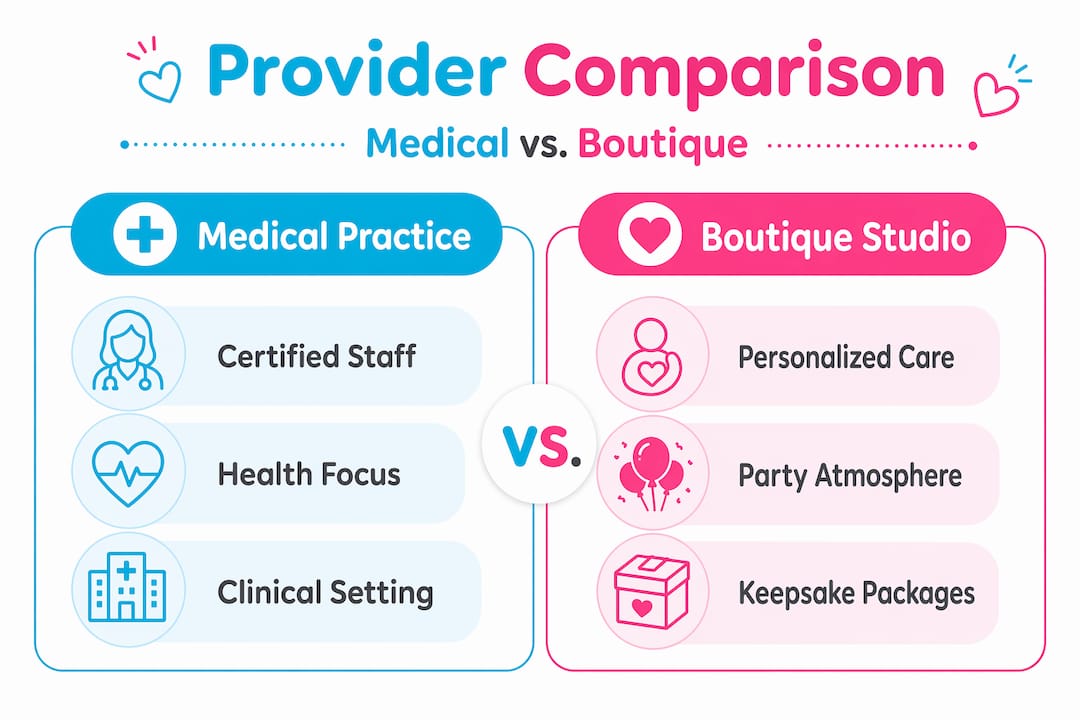
When comparing providers, the biggest decision is between a medical practice and a boutique studio. Medical practices come with physician oversight, licensed sonographers, and the ability to address any findings clinically. Review the 3D vs 4D ultrasound comparison carefully before making your choice, so you understand exactly what image format fits your gender reveal vision.

Step-by-step guide to planning your gender reveal
With your prerequisites in order, let's walk through the complete process, from selection to celebration.
Planning a gender reveal around an ultrasound involves more moving parts than a typical party. You are coordinating a medical appointment with a social event, which means timing, communication, and flexibility are everything.
Here is the step-by-step process:
- Research providers early. Look for studios with certified sonographers and verifiable credentials. Established practices offer medical oversight; book early as slots fill fast, especially in peak pregnancy seasons.
- Confirm your gestational age. Schedule your reveal scan no earlier than 17 weeks for reliable results.
- Prepare for your scan. Follow all preparation guidelines, which typically include drinking water beforehand and eating a light snack to encourage baby movement. Check the detailed ultrasound preparation steps to make sure you arrive ready.
- Decide on your reveal format. Will the sonographer write the gender on a slip of paper for a third party to organize the party? Or do you want to see it live during the scan with guests watching on a screen? Each option requires different logistics.
- Book the party venue or location. Lock in your space at least three weeks in advance. Outdoor venues need weather backup plans.
- Coordinate your vendor details. Balloons, confetti cannons, and cake bakeries all need advance notice. Most gender reveal bakers need the information at least five to seven days ahead.
- Share the gender with a trusted coordinator. If you want to be surprised yourself, designate one trusted person to receive the envelope from the sonographer and coordinate with vendors.
- Confirm day-of logistics. Contact the studio the day before to verify your appointment and ask about parking, guest policies, and image delivery timelines.
| Timeline milestone | Recommended timing |
|---|---|
| Book ultrasound appointment | 4 to 6 weeks in advance |
| Schedule gender reveal party | 3 to 4 weeks in advance |
| Confirm scan at 17 to 20 weeks | Based on your due date |
| Deliver gender info to party coordinator | 5 to 7 days before party |
| Day-of confirmation call to studio | 24 hours before scan |
According to research on prenatal practices, 85% of ultrasounds in European studies successfully disclosed fetal gender, but the remaining 15% encountered baby positioning issues. That means roughly 1 in 6 scans may not give you a clear answer on the first try.
Pro Tip: Build a backup reveal plan before your scan date. If baby is uncooperative, have a "rain check" party idea ready, like a smaller family dinner where you reveal the gender after a reschedule. Guests will understand, and you will not feel the pressure to reschedule an entire event on short notice.
Involving family and friends requires clear communication about privacy. Decide in advance who knows the gender before the party. Keeping the circle small prevents accidental leaks. Learn more about how to book a 4D ultrasound and what to expect from the booking process so nothing catches you off guard.
Protecting privacy and sharing ultrasound images wisely
After organizing the reveal details, it's crucial to make sure your baby's images are kept private and shared safely.
Your ultrasound images are more than keepsakes. They are protected health information (PHI) under HIPAA regulations (the Health Insurance Portability and Accountability Act). This means your reproductive health data, including images from your scans, has legal protections, and you should treat it with the same care you give any sensitive personal document.
The real risk many parents overlook is third-party apps. Several photo editing and sharing apps request broad data permissions that technically allow them to access metadata, location data, and image content. When you upload ultrasound images to these platforms, you may be giving companies more access than you intend.
Privacy dos and don'ts for ultrasound images:
- Do store images in a password-protected cloud service you trust, such as a private family account.
- Do ask your provider how they store and transmit your images digitally, and request a written consent policy.
- Do share images through direct messages rather than public social media posts when possible.
- Don't upload your ultrasound to apps that request access to your camera roll without reviewing their privacy policy.
- Don't tag your exact location or add geotags to images you post publicly.
- Don't share images in large group chats where screenshots can travel beyond your intended audience.
Understanding the benefits of early gender reveal for your family planning is one thing, but knowing how to protect those images long-term is equally important. Review your provider's consent policies before your appointment, and ask specifically whether your images are shared with any third parties for training, marketing, or research purposes.
Pro Tip: Create a dedicated private photo album using a service like Google Photos or iCloud with sharing restricted to specific contacts. This gives family members easy access to your baby's images without putting them on a public platform.
If you want to understand the full range of what modern imaging can show, explore the baby ultrasound features available with advanced technology. And before posting anything, check up-to-date HIPAA and ultrasound privacy guidance to make sure you are acting on current standards.
Troubleshooting and common mistakes
While privacy is important, also plan for hiccups that might arise during your ultrasound-based gender reveal.
Even the best-planned gender reveals run into obstacles. Knowing the most common issues in advance lets you stay calm when something does not go perfectly.
Common problems and how to fix them:
- Baby in a bad position. This is the most frequent issue. Baby may have their legs crossed or be facing away. Ask the sonographer to give you time to walk around, drink cold water, or reposition before trying again.
- Unclear or ambiguous result. Sometimes the image is not definitive. Do not pressure the sonographer for a guess. A wrong answer is worse than a "let's reschedule." According to prenatal research, 1 in 6 scans may not yield a clear result on the first attempt.
- Timing conflicts around holidays. Booking in November or December can lead to studio closures and vendor unavailability. Plan for six weeks of lead time if your 17 to 20 week window falls near a major holiday.
- Party vendor cancellations. Always have a secondary vendor on standby for balloons or cake. Many parents overlook this until it is too late.
- Privacy mishaps. If someone accidentally reveals the gender before your party, take a breath. The reveal moment is about celebration, not secrecy. Lean into the joy rather than the disappointment.
Statistic callout: Studies on gender identification via ultrasound show that accuracy reaches 99% at or after 17 weeks under ideal conditions. Position issues account for nearly all inconclusive results.
If you are still weighing your options for the type of scan you want, the ultrasound package options available at premium studios give you a clear look at what each tier includes so you can match your vision to a specific package.
Pro Tip: Build a 30-minute flexibility buffer into your party schedule after the scan. If the scan runs long or you need a second attempt at capturing a clear image, you will not feel rushed, and your guests will not be waiting anxiously for hours.
Expert perspective: Why medical guidance elevates gender reveal planning
Troubleshooting aside, here is what real-world experience reveals about ultrasound gender reveal planning.
There is a growing trend of parents choosing boutique "gender reveal studios" that prioritize aesthetics and ambiance over credentials. We understand the appeal. These spaces often have mood lighting, comfortable couches, and a party atmosphere. But here is the honest perspective after more than 15 years in prenatal imaging: the quality of your experience depends almost entirely on the skill of your sonographer, not the decor.
A certified sonographer working at an established OB/GYN practice knows how to read baby positioning, adjust probe angle, and optimize imaging settings to get you a clear result. They also know when to stop. That last point matters more than most parents realize. A technician who is chasing a perfect image without proper training may extend a session beyond what is appropriate under ALARA guidelines.
"The families who have the best experiences are the ones who prioritize credentials first and aesthetics second. A beautiful image means nothing if it was captured carelessly."
Booking early with established providers also dramatically reduces stress. Slots at reputable studios fill up six to eight weeks in advance during peak seasons. Waiting until week 16 to start your search often means compromising on provider quality just to find an open appointment. The parents who start researching at 10 to 12 weeks consistently report a smoother, more enjoyable experience.
The contrarian view worth sharing: spending more money at a premium studio with certified professionals is not an indulgence. It is an investment in accuracy, safety, and peace of mind. When you combine medical oversight with the latest technology for modern ultrasounds, you get images that are not just beautiful but clinically reliable. That combination is what turns a gender reveal into a genuinely memorable moment rather than a stressful guessing game.
Plan your ultrasound gender reveal easily with BabyView3D
With expert guidance, it's time to choose the right provider and finalize your gender reveal party details.
At BabyView3D, we have spent over 15 years helping families experience the exact moment of connection that makes pregnancy unforgettable. Our certified sonographers use HD Live, 4D, and 8K imaging technology to capture your baby in extraordinary detail, and every session is designed with your comfort, privacy, and emotional experience in mind.
Whether you are ready to browse ultrasound party packages that include keepsakes and visual summaries, or you simply want to view our real ultrasound reveal gallery to see what is possible, we make it easy to take the next step. First-time appointment discounts are available, so booking now means saving money while securing your preferred date. Visit BabyView3D ultrasound services and let us help you turn your gender reveal into a memory that lasts a lifetime.
Frequently asked questions
Is an ultrasound gender reveal safe for my baby?
When performed by trained professionals following the ALARA principle, ultrasound gender reveals are considered safe, though the FDA recommends limiting non-medical scans. Always verify your sonographer's credentials before booking.
How accurate are ultrasound gender reveals?
Ultrasound gender identification reaches approximately 99% accuracy after 17 weeks under good imaging conditions, though baby positioning can still affect results in some cases.
Can I share my ultrasound images on social media?
You can share images, but HIPAA protects your reproductive health data, so avoid apps with broad data permissions and favor direct sharing over public posts.
What do I do if the baby isn't in an ideal position during the scan?
Ask your sonographer for a short break to walk around or drink cold water, and if the position does not improve, plan to reschedule. Studies show 1 in 6 scans may not yield a clear result on the first try, so having a flexible party backup plan is always a smart move.