

Most expecting parents assume that all prenatal ultrasounds are the same. You show up, the technician applies gel, and you get a blurry black-and-white image to stick on the fridge. But prenatal ultrasound packages have evolved dramatically, and today's options range from basic clinical scans to immersive, high-definition 3D and 4D experiences that let you see your baby's face in stunning detail before birth. Understanding what these packages actually include, and how they differ from each other, can help you make a truly informed decision about one of the most meaningful moments of your pregnancy.
Table of Contents
- Defining prenatal ultrasound packages
- What's included in typical prenatal ultrasound packages
- Clinical vs. keepsake ultrasounds: How do they compare?
- How to choose the right prenatal ultrasound package for you
- Our experience: Why expecting parents shouldn't settle for standard prenatal scans
- Discover premium prenatal experiences with BabyView3D
- Frequently asked questions
Key Takeaways
| Point | Details |
|---|---|
| Medical vs. keepsake | Clinical ultrasounds assess your baby's health, while keepsake packages focus on memories and images. |
| Package features | Prenatal ultrasound packages may include multiple scans, HD images, and printed keepsake items. |
| Choosing wisely | Always prioritize medically necessary scans; select packages for keepsake moments after clinical needs are met. |
| Premium experiences | Premium packages offer family-friendly sessions and digital galleries to document your pregnancy journey. |
| Next steps | Explore reputable providers to combine medical reassurance with memorable keepsake opportunities. |
Defining prenatal ultrasound packages
Before anything else, it helps to understand what a prenatal ultrasound actually is at its core. A prenatal ultrasound is a medical imaging procedure requested by a health-care provider that uses sound waves to create live images of the fetus inside the uterus. A trained technician uses a handheld transducer on your abdomen or internally, the device sends sound waves into the body, and those waves bounce back to create images reviewed by a radiologist. The radiologist then sends a written report to your prenatal care provider.
That clinical foundation is important because it establishes the baseline. A prenatal ultrasound package, however, builds on that foundation. Rather than a single scan ordered purely for a medical finding, a package is a structured collection of services designed to give you both clinical value and an enriching personal experience.
Here is what separates a package from a lone clinical scan:
- Number of scans included: Packages often bundle multiple sessions at different gestational milestones, not just one appointment.
- Image technology: Packages frequently feature 3D, 4D, or even HD Live imaging instead of standard 2D black-and-white frames.
- Keepsake deliverables: Printed photos, digital galleries, USB drives, and short video clips are often part of the offering.
- Session length: Package sessions tend to be longer, giving your sonographer more time to capture perfect angles.
- Medical oversight: Premium providers use certified sonographers and maintain proper protocols.
"When you understand what ultrasound packages include, you realize these experiences go far beyond a routine hospital appointment. They are designed to celebrate your pregnancy while keeping safety and quality at the forefront."
The combination of medical credibility and personal enrichment is precisely what makes packages worth exploring. They are not a replacement for your OB-ordered scans. They are a complement, an upgrade, and often the most memorable visual record you will have from your pregnancy.
What's included in typical prenatal ultrasound packages
Now that you understand the foundation, let's look at what most packages actually offer. The gap between a basic package and a premium one is wider than most parents expect.
Basic packages generally include one scan session, a limited number of still images either printed or digital, and a brief appointment window. These are serviceable but lean heavily toward function over experience. You get confirmation that everything looks good, and maybe a couple of black-and-white printouts.
Premium packages are a completely different story. Think multiple sessions spread across your second and third trimesters, HD Live or 3D/4D imaging that captures lifelike facial features, video recordings of real-time movement, and a curated keepsake package you can share with family. Some providers even offer gender reveal packages, sibling introduction sessions, and heartbeat recordings.
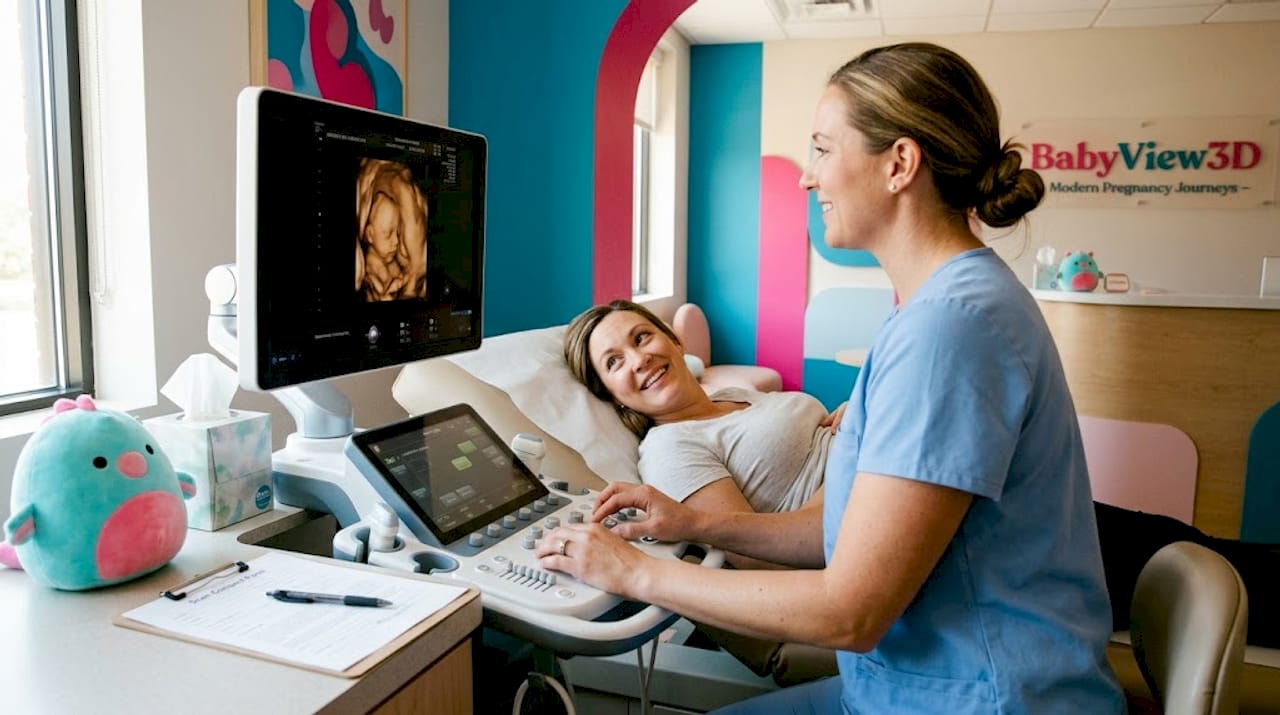
Here is a side-by-side comparison to make the differences concrete:
| Feature | Basic package | Premium package |
|---|---|---|
| Number of scans | 1 | 2 to 4 |
| Image type | 2D (black-and-white) | 3D, 4D, HD Live |
| Still images provided | 2 to 4 prints | 10 to 20+ digital and printed |
| Video recording | Rarely included | Usually included |
| Session duration | 15 to 20 minutes | 30 to 60 minutes |
| Keepsake items | Basic printouts | USB, gallery, memory book |
| Gender reveal option | Not typically offered | Often available |
| Certified sonographer | Yes | Yes |
When it comes to medical benefits of ultrasound, standard prenatal ultrasounds are part of clinical workflows with radiology review and a written report to your provider. If you need to confirm gestational age, check growth measurements, or assess a potential concern, your clinically ordered scan handles those priorities. Premium packages layer the emotional and keepsake experience on top.
Common keepsake items you might find in a premium package include:
- Printed photo collections in various sizes
- Digital download galleries accessible from any device
- Short video clips of baby moving in real time
- Gender reveal envelopes or keepsake boxes
- Heartbeat stuffed animals that play your baby's recorded heartbeat
- Customized photo frames and memory books
Pro Tip: Book your premium keepsake session between 26 and 32 weeks. During this window, your baby has developed enough fat under the skin to show soft, detailed facial features, but there is still enough amniotic fluid for clear imaging. Sessions scheduled too late in the third trimester often produce less clear images because the baby is larger and the fluid decreases.
Clinical vs. keepsake ultrasounds: How do they compare?
With package content in mind, understanding the real distinction between clinical and keepsake scans helps you plan smarter and spend your money wisely.
Clinical ultrasounds are ordered by your OB, midwife, or maternal-fetal medicine specialist. They follow strict imaging protocols, focus on specific measurements and anatomy checks, and always include that radiologist review and written report. The goal is medical information, not photography. The technician is focused on anatomy surveys, fetal positioning, placenta location, and fluid levels. The session is efficient, usually under 30 minutes, and the environment is clinical rather than welcoming.
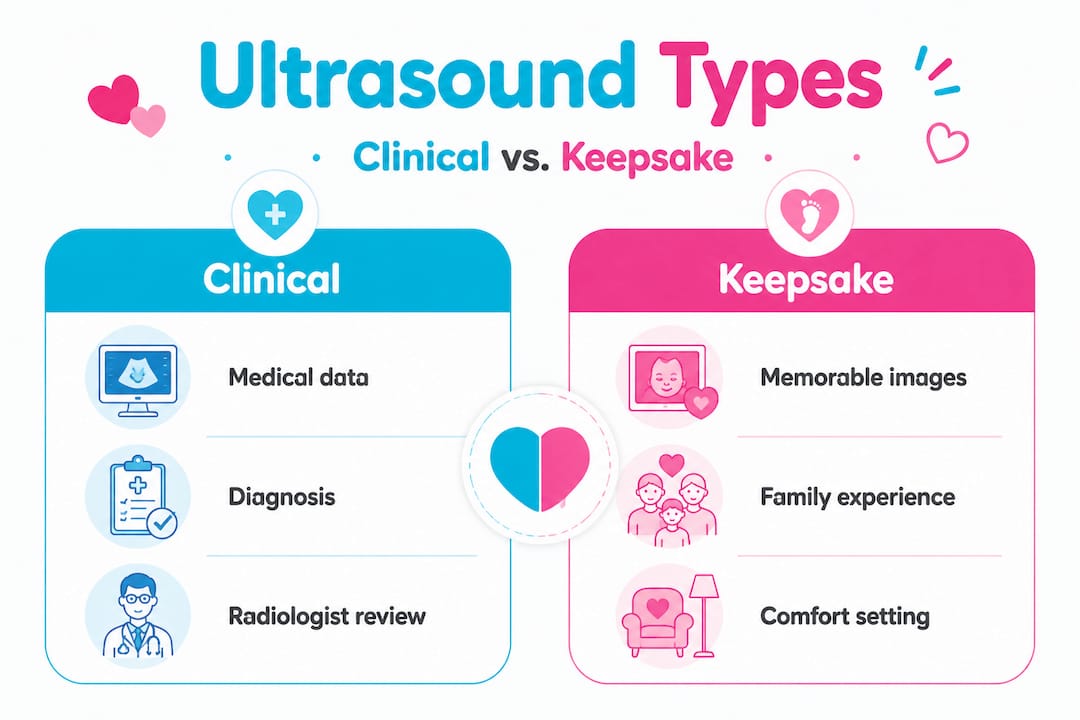
Keepsake scans, on the other hand, are designed to be enjoyed. The environment is often warm and comfortable, sometimes with dimmed lights, a large viewing screen so the whole family can watch, and a sonographer who takes time to find the best angles of your baby's face. The experience is relaxed and celebration-focused. These sessions are not designed to replace medical review but to offer something clinical scans simply do not prioritize: connection and memory.
Here is a direct comparison of what each type typically delivers:
| Aspect | Clinical scan | Keepsake scan |
|---|---|---|
| Ordered by | Health-care provider | Parent (elective) |
| Primary goal | Medical evaluation | Memory and bonding |
| Radiologist review | Always included | Not standard |
| Image type | 2D diagnostic | 3D, 4D, HD Live |
| Session atmosphere | Clinical, efficient | Relaxed, family-focused |
| Keepsake items | Rarely included | Core part of the package |
| Guest attendance | Often limited | Usually family-friendly |
| Cost | Covered by insurance | Out-of-pocket |
The practical workflow for most parents looks like this:
- Attend all clinically ordered scans. These protect your baby's health and your peace of mind. Never skip them.
- Schedule your first trimester dating scan as recommended by your provider, typically around 10 to 13 weeks.
- Complete your anatomy scan at around 18 to 22 weeks. This is a critical clinical appointment.
- Plan a keepsake session in the late second or early third trimester for the best 3D and 4D imaging results.
- Book a final session if desired in the early third trimester to see final developmental details before birth.
As HealthLink BC notes, prenatal ultrasounds in clinical workflows include radiology review with a written report sent to care providers, which is a feature keepsake sessions do not replicate. That distinction matters. Both serve important but separate purposes, and understanding ultrasound technology explained in more depth can help you appreciate why the imaging technology and session format vary so significantly between the two types.
How to choose the right prenatal ultrasound package for you
Now let's move to practical steps for making your decision. Choosing a package is not just about picking the fanciest option. It is about aligning the package with your actual priorities during each phase of your pregnancy.
Start by assessing your medical priorities. Are you in a high-risk pregnancy with specific monitoring needs? Do you need more frequent clinical check-ins? Your OB's recommendations should always come first. Once your clinical care plan is in place, you have a clear picture of how elective keepsake sessions can fit around those appointments.
Next, evaluate your keepsake goals honestly. Do you want high-resolution images to frame and display? Are you hoping to share a live video with grandparents who live across the country? Do you want a gender reveal experience? Knowing what you want from the emotional side of the experience helps you match the right package tier.
Here are the questions you should ask any ultrasound provider before booking:
- Are your sonographers certified and trained in both diagnostic and keepsake imaging?
- What imaging technology do you use? Is it 3D, 4D, or HD Live?
- How many still images and video clips are included?
- What is your policy if the baby is not in a good position for imaging?
- Do you offer rescheduling or return visits if the images are unclear?
- Is the facility designed for family attendance, or is space limited?
- What keepsake items are included versus available as add-ons?
As HealthLink BC recommends, if you want medical reassurance, always rely on clinically ordered scans reviewed within your prenatal care. Keepsake sessions are additive, not substitutes. You can explore detailed package features comparison to understand exactly what each tier delivers before you commit.
Pro Tip: Never cancel or postpone a medically recommended scan in favor of a keepsake session. Schedule your keepsake session on a separate day that does not conflict with any clinical appointments. They serve completely different purposes and should be treated independently.
Common pitfalls to avoid include booking too early (before 24 weeks, when 3D imaging can look less defined), choosing providers who do not use certified sonographers, and underestimating how quickly your third trimester fills up. Plan ahead, ideally booking your keepsake sessions in your second trimester, when you still have flexibility.
Our experience: Why expecting parents shouldn't settle for standard prenatal scans
Here is an opinion that might surprise you: the biggest regret we hear from parents after their baby arrives is not that they spent too much on keepsake experiences. It is that they waited too long, or skipped it entirely, assuming the clinical scans would be enough to remember.
A clinical scan generates a blurry, hard-to-read image that only trained eyes can fully interpret. Your family members do not see a baby in those images. They see gray static. A premium 3D or HD Live session, on the other hand, produces images where even grandparents who have never seen an ultrasound in their lives can immediately recognize the baby's nose, lips, and expressions.
We have spent over 15 years watching families walk into sessions as anxious, excited, sometimes overwhelmed parents-to-be, and walk out with something they were not expecting: genuine, tearful connection with their child before birth. That experience changes how people approach the rest of their pregnancy. It is not a luxury. It is a meaningful moment that becomes a foundation.
The other thing we believe strongly: documenting your pregnancy thoroughly is something you do for your child as much as for yourself. Those images become part of your family story. They sit in albums, they appear in first-birthday slideshows, they get passed down. A standard scan printout fades. A high-quality 3D keepsake photograph does not.
We also want to be direct about a concern some parents have regarding safety. Elective ultrasounds performed by certified professionals using calibrated, modern equipment are safe. The key words there are "certified" and "calibrated." Quality matters. Provider credentials matter. The experience you read about on our site reflects more than a decade of commitment to doing this the right way.
Discover premium prenatal experiences with BabyView3D
If you are ready to go beyond the basics, BabyView3D brings together certified sonographers, advanced HD Live technology, and a family-first environment designed to make your prenatal experience truly unforgettable.
With centers located across the United States and more than 15 years of experience, BabyView3D offers a range of explore ultrasound packages built for exactly what expecting parents need: clinical confidence, stunning image quality, and memories you will keep forever. You can view sample keepsake images from real families to see the kind of detail our technology captures, or learn more about BabyView3D and take advantage of our limited first-appointment discount. Your baby is growing right now. Do not wait to see them.
Frequently asked questions
Are prenatal ultrasound packages safe for my baby?
Prenatal ultrasounds are considered safe when performed by qualified providers and are part of standard medical care, as noted by HealthLink BC, which describes them as painless procedures reviewed by a radiologist. Always choose certified providers who use properly calibrated equipment.
Can I get keepsake images from a standard clinical ultrasound?
Clinical ultrasounds focus on medical data first, so while you may receive a small number of images, the quality and quantity are limited. Premium keepsake packages include more images and dedicated memory items designed specifically for families.
How many ultrasound scans are typically included in a package?
Basic packages usually include one session, while premium packages often include multiple scans at different gestational milestones, along with digital galleries, videos, and printed keepsakes.
Should I choose a keepsake session instead of a clinical scan?
Never substitute a keepsake session for a medically recommended scan. As HealthLink BC states, if you want medical reassurance, always rely on clinical ultrasounds ordered and interpreted within your prenatal care. Keepsake sessions are a meaningful addition, not a replacement.