

Most expectant parents walk into their first ultrasound appointment thinking it's mainly about confirming a due date. That's understandable, but it's only a fraction of what an ultrasound appointment actually does. These visits assess your baby's organs, growth, placenta placement, and amniotic fluid levels. They also do something no other prenatal test can quite replicate: they put your baby on screen, moving, and suddenly real. This guide walks you through the entire ultrasound appointment process, from preparation to results, so you arrive informed, calm, and ready to soak in every moment.
Table of Contents
- What happens during a prenatal ultrasound appointment
- Types of prenatal ultrasound scans and what to expect
- Why routine ultrasound scans are essential for your baby's health
- How to prepare for your ultrasound appointment for the best experience
- What happens after your ultrasound scan: results and follow-up explained
- The ultrasound appointment beyond diagnostics: a meaningful connection moment
- Experience memorable ultrasounds with BabyView3D
- Frequently asked questions
Key Takeaways
| Point | Details |
|---|---|
| Ultrasound appointment process | Expect appointments to last 30-60 minutes including check-in and scanning. |
| Types of ultrasounds | Transabdominal and transvaginal ultrasounds serve different timing and imaging clarity needs. |
| Health importance | Routine ultrasounds detect major fetal anomalies and assess growth and organ health. |
| Preparation matters | Proper hydration and clothing help improve image quality and comfort during scans. |
| Results timeline | Official ultrasound results typically arrive within 1-3 days after specialist review. |
What happens during a prenatal ultrasound appointment
Understanding the ultrasound appointment workflow from start to finish removes a lot of the guesswork. Here is what the typical process looks like, in order:
- Arrival and check-in. Plan to get there 15 minutes early. You will fill out paperwork covering your medical history, current pregnancy details, and insurance information. Arriving late compresses your scan time, which is the last thing you want.
- Preparation in the exam room. A sonographer (the trained technician who performs the scan) will explain what they are about to do. If you need a full bladder for your scan type, this is when they confirm you followed those instructions.
- The scan itself. The sonographer applies a warm gel to your belly and moves a handheld probe called a transducer across your skin. The gel eliminates air between the probe and skin, which would otherwise block the sound waves. For early pregnancies, a transvaginal probe may be used instead.
- Real-time imaging and measurement. As the probe moves, images appear on a monitor. The sonographer takes precise measurements of the baby's head, abdomen, and femur (thigh bone), and checks the heartbeat, organ development, and position.
- Questions and emotional time. Most sonographers welcome questions during the scan. This is your moment. Ask what you are seeing. Many facilities now offer pregnancy ultrasound steps as a visual guide so you can follow along.
- Wrap-up. You wipe off the gel, and the sonographer compiles preliminary notes. Keepsake images or video clips are often printed or shared at this stage.
Prenatal ultrasound appointments typically last 30 to 60 minutes, with the actual scan taking 15 to 45 minutes. That window includes check-in, prep, and any review at the end.
Pro Tip: Review the pre-appointment recommended preparations before your visit so nothing surprises you. Small details like what to wear and when to start drinking water make a bigger difference than most people expect.

Types of prenatal ultrasound scans and what to expect
Understanding the types of ultrasounds helps you know how to prepare and what to expect during your scan.
| Feature | Transabdominal ultrasound | Transvaginal ultrasound |
|---|---|---|
| How it works | Probe on the belly surface | Small probe inserted vaginally |
| Bladder prep | Full bladder required | Empty bladder preferred |
| Best timing | After 10 to 12 weeks | Up to 10 weeks or unclear images |
| Image clarity early on | Limited before 10 weeks | Significantly better |
| Comfort level | Generally comfortable | Mild pressure, not painful |
| Duration | 20 to 30 minutes | 15 to 20 minutes |
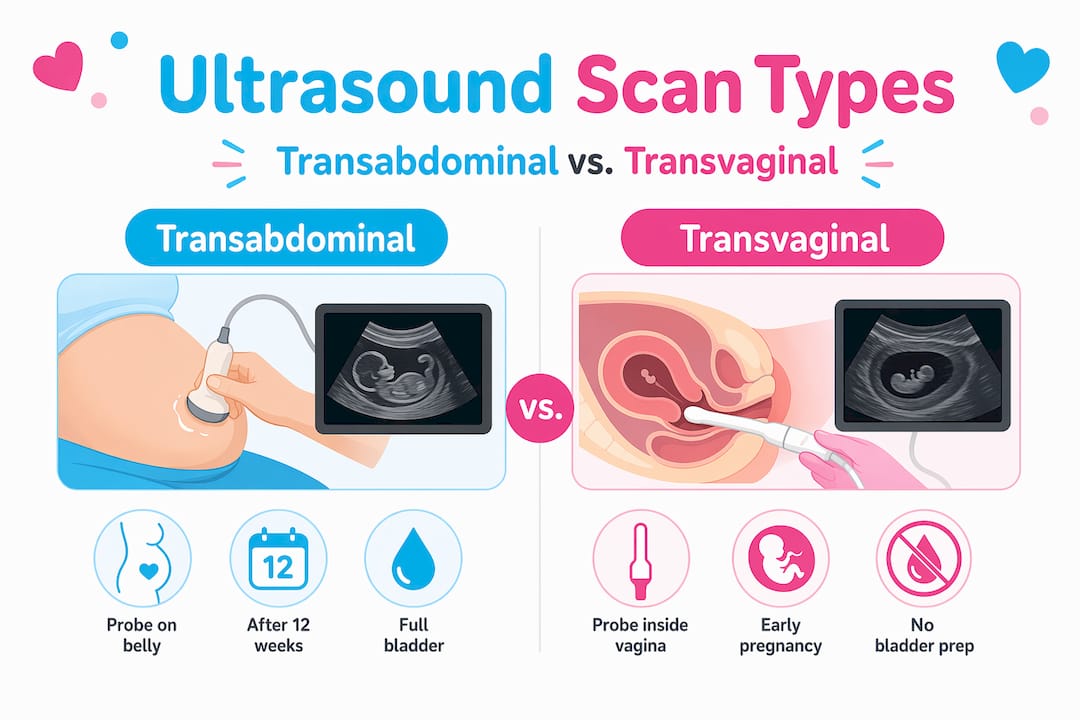
Transabdominal ultrasounds are standard after 10 to 12 weeks while transvaginal scans offer improved image clarity in the first trimester when abdominal imaging is not yet reliable.
Here is what to keep in mind for each type:
- Transabdominal: Drink about 32 ounces of water roughly an hour before and avoid emptying your bladder until after the scan. The full bladder acts as a window for the sound waves.
- Transvaginal: Go to the restroom before the appointment. The probe is covered with a sterile sheath and gel. Most patients report mild pressure rather than pain.
- Both types use the same sound wave technology. Neither involves radiation of any kind.
- You may need both types in the same visit if one method does not produce a clear image.
You can review the full range of ultrasound types explained if you want to know which scan is scheduled for your specific trimester.
Pro Tip: If you are anxious about the transvaginal scan, tell your sonographer before they begin. They can walk you through every step and pause at any point. You are always in control.
Why routine ultrasound scans are essential for your baby's health
With the importance clear, let's look at how these scans go far beyond taking a picture of your baby.
A routine prenatal ultrasound checks a specific set of critical health markers:
- Fetal heartbeat and heart rate
- Organ development, including the brain, spine, kidneys, and heart chambers
- Placenta location, which identifies conditions like placenta previa early
- Amniotic fluid levels, which indicate how well the baby processes fluids
- Baby's position, especially important in the third trimester
- Growth measurements compared to gestational age
"The anatomy scan performed between 18 and 22 weeks is one of the most medically important appointments of your pregnancy. It gives your care team a detailed look at nearly every major system in your baby's body."
The second-trimester ultrasound detects about 70% of major fetal anomalies, allowing care teams to plan interventions before birth. That statistic carries real weight. Early detection of a heart defect, for example, means the delivery team can have a pediatric cardiologist on standby or arrange a specialized birth location.
What makes ultrasounds stand apart from other prenatal tests is that they carry no radiation risk. They use high-frequency sound waves that bounce off tissue and return as data, which is then converted into the image on screen. You can learn more about the importance of anatomy scans and what each trimester's scan is specifically designed to assess.
How to prepare for your ultrasound appointment for the best experience
Proper preparation enhances your ultrasound both medically and emotionally. Here is a practical ultrasound appointment checklist you can follow:
Physical preparation:
- Wear a two-piece outfit. A shirt you can lift and pants with an elastic waistband are ideal. You do not want to be in a dress or a one-piece jumpsuit when the sonographer needs access to your belly.
- Follow the water instructions specific to your scan type. Drinking 32 ounces of water about one hour before a transabdominal scan significantly improves image quality. If you feel uncomfortably full, let the sonographer know.
- Bring a light sweater or cardigan. Ultrasound rooms are kept cold to protect the equipment, and you may be lying still for 30 to 45 minutes.
- Eat a light meal beforehand. An empty stomach can make the cold gel and room temperature feel worse, and some babies are more active after their parent eats.
Emotional and logistical preparation:
- Write your questions down before you leave home. The excitement of seeing your baby on screen genuinely makes people forget everything they planned to ask.
- Confirm your appointment time 24 hours in advance. Schedules shift, and you want to avoid showing up at the wrong time with a full bladder.
- Understand that the baby may not cooperate. If your baby's face is hidden or a key measurement is unclear, you may need a follow-up scan. This is routine, not alarming.
- Review prenatal ultrasound preparation tips beforehand so you walk in knowing exactly what to expect.
Pro Tip: Take a screenshot of the scan time and address the night before. On appointment day, excitement (and nerves) make it surprisingly easy to head to the wrong location or mix up AM and PM.
What happens after your ultrasound scan: results and follow-up explained
Knowing what occurs after the ultrasound demystifies the process and helps you be an informed participant in your pregnancy care.
After the sonographer finishes imaging, here is how the results process typically unfolds:
- Immediate observations: The sonographer may point out what they saw during the scan, including your baby's position, heartbeat, and any obvious landmarks. However, they are generally not authorized to interpret medical findings on the spot.
- Specialist review: Sonographers review images with maternal-fetal medicine specialists after the scan. Preliminary findings may be shared right away, but the official report typically arrives within 24 to 48 hours, sometimes longer if a subspecialist review is needed.
- Your doctor delivers results: Your OB or midwife receives the written report and will contact you to discuss findings. Do not read silence as bad news. Providers often call only when there is something specific to discuss, but if you have not heard within three days, calling the office is completely reasonable.
- Follow-up scans: If the baby was in a position that blocked key measurements, or if fluid levels were borderline, a follow-up scan will be scheduled. This is common and does not signal a problem.
You can check the typical prenatal ultrasound result timeline to understand exactly when and how your results flow from the imaging center to your care provider.
The ultrasound appointment beyond diagnostics: a meaningful connection moment
Here is a perspective that clinical guides rarely address: an ultrasound appointment is not just a medical test. It is often the first moment a baby becomes real to a parent.
Parents who walk in anxious about measurements or anomalies walk out talking about how the baby waved, or yawned, or kept hiding behind a hand. That shift, from worried to attached, happens consistently in the ultrasound room. And it matters. Research on prenatal bonding consistently shows that seeing a baby move in real time accelerates parental attachment in ways that test results and heartbeat monitors alone do not.
We have seen this across thousands of families. The parents who get the most out of their ultrasound appointments are not the ones who know the most about anatomy. They are the ones who came prepared, asked questions, and treated the appointment as both a checkup and a milestone. When you know what the sonographer is measuring and why, you stop watching a confusing black-and-white image and start watching your baby.
There is also something important about facility quality that people underestimate until it is too late. A rushed, understaffed imaging center gives you results but not an experience. A facility where the sonographer has time to show you what they are seeing, explain each measurement, and let you absorb the moment, that is a different visit entirely. Full bladder preparation not only improves imaging quality but also enhances keepsake photo results that strengthen parental emotional connections. The technical and the emotional are not separate here. They reinforce each other.
If you want the appointment to feel as significant as it actually is, find a provider who treats it that way. At BabyView3D, that is the entire philosophy.
Experience memorable ultrasounds with BabyView3D
If you are ready to turn your next prenatal appointment into something you will genuinely remember, BabyView3D was built for exactly that.
Our certified sonographers use 3D, 4D, and 8K HD Live imaging technology to capture your baby in extraordinary detail. Every session is designed to feel unhurried, warm, and focused on your family's experience. Whether you are coming in for a first look or a detailed anatomy session, our ultrasound services combine clinical quality with the kind of emotional care that routine imaging centers rarely offer. You can also browse our ultrasound keepsake products to take the experience home with you in prints, videos, and more. First-time visitors currently enjoy a special introductory offer. Visit the BabyView3D home page to book your appointment and see what families across the United States have been saying for over 15 years.
Frequently asked questions
How long does a typical prenatal ultrasound appointment last?
A prenatal ultrasound appointment usually lasts between 30 and 60 minutes including check-in and paperwork, with the actual scan taking 15 to 45 minutes depending on the type and complexity.
Is it safe to have multiple ultrasound scans during pregnancy?
Yes. Ultrasounds use high-frequency sound waves with no radiation involved, making them safe for repeated use throughout all three trimesters.
Why do I need to have a full bladder before my ultrasound?
A full bladder creates an acoustic window that improves image clarity for transabdominal scans after 12 weeks of pregnancy, especially useful when imaging structures deep in the pelvis.
When will I get the results of my ultrasound scan?
Your sonographer may share preliminary findings immediately after the scan, but the official written report typically reaches your doctor within 24 to 48 hours after specialist review.
Can I bring family members to my ultrasound appointment?
Most facilities welcome two or three guests including children, but room size limits larger groups. Bringing a couple of support people keeps the room comfortable for everyone while still sharing the moment.