
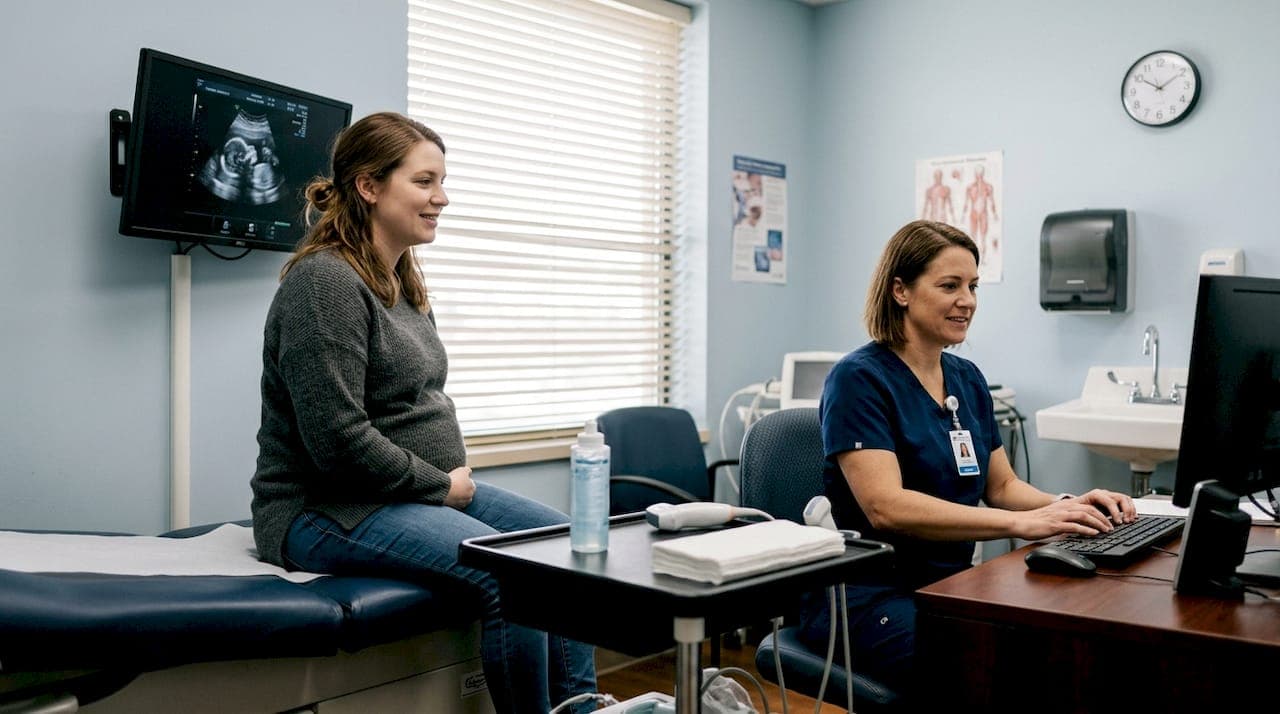
Most expectant parents assume every prenatal ultrasound happens at their OB/GYN's office or the local hospital. That assumption leaves a lot of options on the table. The world of prenatal imaging has expanded significantly, with specialized studios offering 3D, 4D, and even 8K resolution scans designed specifically to help families bond with their baby before birth. Knowing where ultrasounds are performed, who performs them, and what each setting offers gives you real power to shape your prenatal experience. This guide walks you through every type of ultrasound location, when each is used, and how to choose the right one for your family.
Table of Contents
- What is an ultrasound scan and why does location matter?
- Types of ultrasound scan locations: From hospital to boutique studio
- When to expect each type of ultrasound scan: A trimester-by-trimester breakdown
- Safety, trust, and bonding: Choosing the right ultrasound scan location
- A fresh perspective: What expectant parents should really prioritize when choosing an ultrasound location
- Create your memorable ultrasound experience with BabyView3D
- Frequently asked questions
Key Takeaways
| Point | Details |
|---|---|
| Know your options | Ultrasound scans are done at many locations, including hospitals, OB offices, and specialized studios. |
| Safety comes first | Choose locations with trained professionals and follow guidelines to keep ultrasound exposure minimal and safe. |
| Bonding is possible | Elective 3D/4D ultrasounds at reputable studios offer memorable experiences, but should complement—not replace—medical scans. |
| Ask the right questions | Check the provider’s credentials, technology, and collaboration with your healthcare team before booking any scan. |
What is an ultrasound scan and why does location matter?
An ultrasound scan uses high-frequency sound waves to create images of your baby inside the womb. There are no X-rays involved and no radiation exposure. A device called a transducer sends sound waves through your skin, and the returning echoes are converted into real-time images on a screen. Simple, safe, and remarkably informative when done correctly.
But not all ultrasounds are created equal, and not all locations offer the same experience. Prenatal ultrasounds in the US are performed at different types of facilities, each serving a distinct purpose. A hospital scan during a complication looks and feels very different from a bonding session at a specialized 3D studio with your whole family in the room.
There are two broad categories to understand:
- Medical ultrasounds: Ordered by your doctor, performed by credentialed sonographers or radiologists, and designed to monitor your baby's health and development.
- Elective or bonding ultrasounds: Scheduled by parents for the experience itself, using advanced 3D/4D technology to create keepsake images and videos that capture your baby's expressions and movements.
Facility type directly impacts three things: safety, expertise, and emotional experience. A diagnostic clinic has the equipment to detect abnormalities. A boutique 3D studio has the lighting, the ambiance, and the technology to turn a scan into a memory your family will treasure forever.
"Ultrasound is safest when used with medical justification by trained professionals. The ALARA principle, or As Low As Reasonably Achievable, guides responsible use of ultrasound energy during every scan."
You can learn more about how imaging technology has evolved by visiting the BabyView3D blog on ultrasound technology, which covers everything from 2D basics to HD Live imaging.
Pro Tip: Always ask any provider two questions before booking: What credentials do your sonographers hold? And what ultrasound system do you use? The answers tell you everything about the quality and safety of the experience ahead.
Types of ultrasound scan locations: From hospital to boutique studio
Not every ultrasound happens in the same place, and understanding your options helps you make choices that fit both your medical needs and your family's goals.
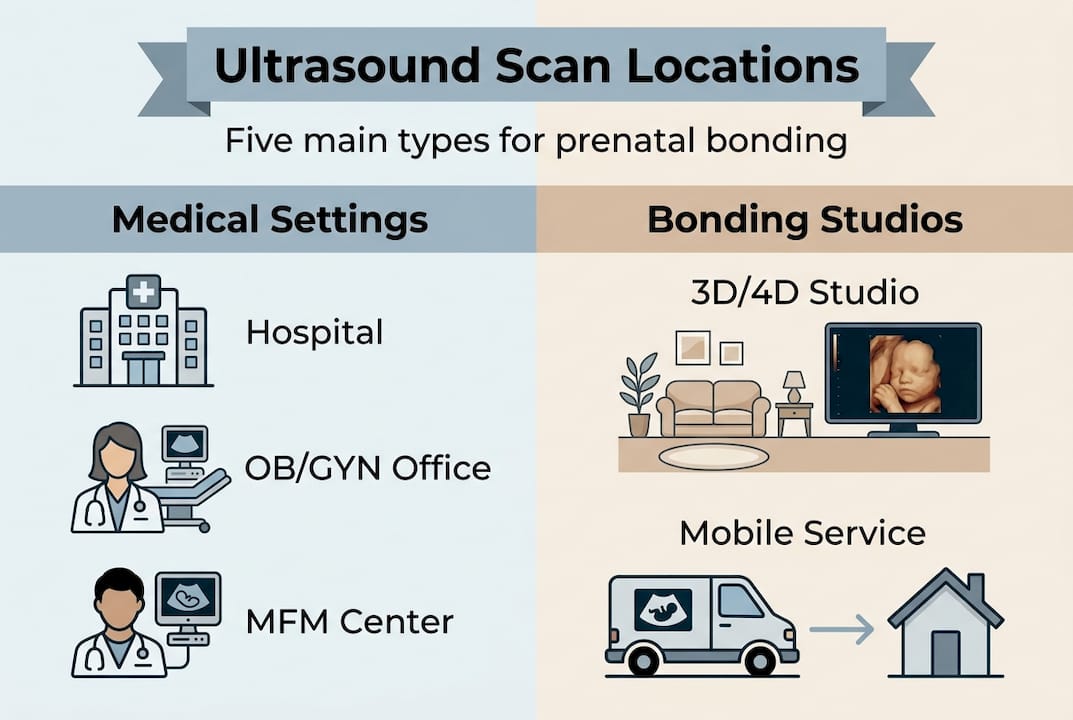
The five main types of ultrasound scan locations include:
- Hospitals and labor and delivery units: These handle emergency scans, high-risk monitoring, and scans tied directly to your care during labor.
- OB/GYN offices: Your primary prenatal care provider usually performs dating scans, heartbeat checks, and routine monitoring throughout pregnancy.
- Maternal-fetal medicine (MFM) centers: Specialists here handle complex cases including twins, fetal anomalies, and advanced diagnostic imaging for high-risk pregnancies.
- Diagnostic imaging clinics: Independent radiology and ultrasound centers perform anatomy scans and other detailed diagnostic imaging ordered by your doctor.
- 3D/4D bonding ultrasound studios: Elective settings focused on the experience. These studios use advanced technology like HD Live and 8K imaging to give families an intimate, detailed first look at their baby.
Each setting operates differently in terms of purpose, staffing, technology, and atmosphere. Here is a quick comparison:
| Feature | Medical setting | 3D/4D bonding studio |
|---|---|---|
| Primary purpose | Diagnosis and monitoring | Bonding and keepsake imaging |
| Personnel | Credentialed sonographers, MDs | Trained ultrasound technicians |
| Technology | Diagnostic-grade equipment | HD Live, 3D/4D, 8K imaging |
| Environment | Clinical, efficient | Relaxed, family-friendly |
| Insurance coverage | Usually covered if medically indicated | Typically out-of-pocket |
| Guests allowed | Limited | Often welcome |
It is worth noting that elective 3D/4D studios are not universally regulated the same way hospitals are, and not all providers at elective studios hold medical credentials. Reputable studios, however, staff certified professionals and follow ACOG safety guidelines voluntarily. Choosing a studio with a strong safety culture is non-negotiable.
When you are ready to see what a premium bonding studio offers, BabyView3D's ultrasound services showcase the full range of scan packages available, including HD Live and keepsake options.
When to expect each type of ultrasound scan: A trimester-by-trimester breakdown
Pregnancy is divided into three trimesters, and each one typically calls for different types of scans at different locations. Knowing the timeline helps you plan both your medical care and your bonding experiences.
First trimester (weeks 6 to 13): Your first scan usually happens at your OB/GYN's office to confirm the pregnancy, establish a due date, and check the heartbeat. If you are considered higher risk, a nuchal translucency scan between weeks 11 and 14 may be done at a specialist or MFM center to screen for chromosomal conditions.
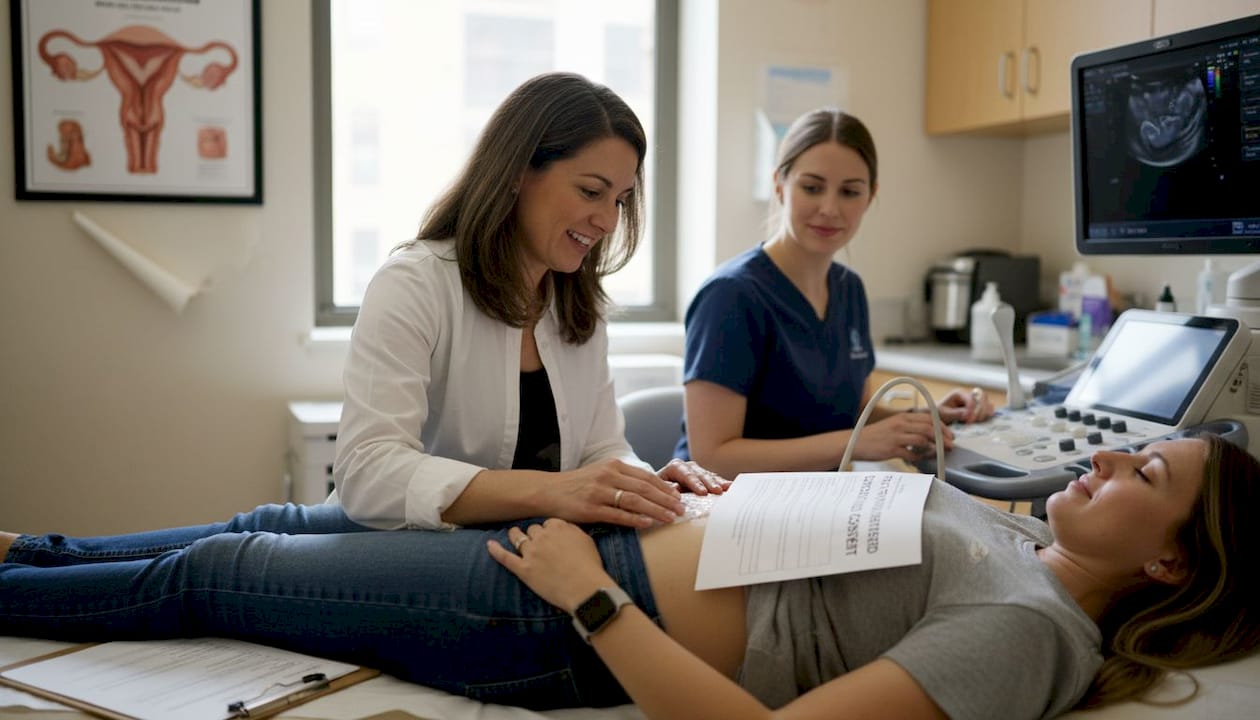
Second trimester (weeks 14 to 27): This is the most scan-rich period. The anatomy scan, or level 2 ultrasound, typically happens between 18 and 22 weeks at a hospital, diagnostic clinic, or OB office. It checks your baby's organs, spine, and overall development in detail. This trimester is also the sweet spot for elective 3D/4D bonding scans. Your baby has enough fat under their skin to show beautiful facial detail, but they still have room to move and pose.
Third trimester (weeks 28 to 40): Medical scans in the third trimester are usually reserved for high-risk cases involving growth concerns, fluid levels, or placental issues, and are typically done at MFM centers or hospitals. Elective 3D/4D scans can still be done in the early third trimester, though baby's position matters more as space gets tighter.
| Trimester | Typical location | Main purpose |
|---|---|---|
| First (6 to 13 weeks) | OB/GYN, MFM center | Dating, confirmation, NT screening |
| Second (18 to 22 weeks) | Hospital, diagnostic clinic | Anatomy scan, structural review |
| Second/early third | 3D/4D bonding studio | Bonding, keepsake imaging |
| Third (28+ weeks) | MFM center, hospital | Growth monitoring, high-risk care |
The anatomy scan at 18 to 22 weeks is the most common routine scan, though patients with obesity or high-risk conditions may need additional imaging at different times. Always follow your doctor's guidance on medical scan timing.
Pro Tip: Book your elective 3D/4D session between weeks 26 and 30 for the best balance of image quality and baby visibility. Your baby's features are most developed, and you still have a good chance of catching some amazing facial expressions.
For more detailed guidance on scan timing and what to expect at each stage, the BabyView3D blog is a great resource to bookmark throughout your pregnancy.
Safety, trust, and bonding: Choosing the right ultrasound scan location
Choosing an ultrasound location is not just about convenience. It is about matching the right setting to the right purpose and making sure every person in that room is qualified to be there.
Here are the key questions to ask any ultrasound provider before you book:
- Who performs the scan? Are they a registered diagnostic medical sonographer (RDMS) or otherwise credentialed?
- What equipment do they use? Newer machines produce safer and more accurate images.
- How long is each session? Longer is not always better. Shorter, purposeful sessions align with prudent ultrasound use.
- Can results be shared with your OB? A good studio will support that connection, not discourage it.
- Do they follow the ALARA principle? Any provider who cannot answer this question confidently is a red flag.
The ACOG ultrasound safety opinion is clear that ultrasound energy should only be applied with medical justification and by trained operators. At the same time, research shows that bonding ultrasounds can enhance maternal and paternal attachment when used thoughtfully and within safe guidelines.
"The goal is not to choose between a safe scan and a meaningful one. The best studios prove you can have both."
Red flags to watch for in any elective studio include operators who cannot explain their credentials, sessions that feel rushed or excessively long, and facilities that discourage you from informing your OB about the visit. Reputable studios actively encourage you to keep your medical provider in the loop.
Pro Tip: Ask the studio whether they can provide a digital copy of your scan images in a format your OB or midwife can review. Great studios make that sharing easy.
The ultrasound options at BabyView3D are designed with exactly this balance in mind, pairing advanced imaging technology with certified professionals in a setting that puts your family's safety and comfort first.
A fresh perspective: What expectant parents should really prioritize when choosing an ultrasound location
Here is something most guides skip over entirely: the most impressive 3D/4D technology in the world means very little if the person operating it does not truly understand prenatal imaging. Parents often get dazzled by glossy marketing about 8K resolution and HD Live imaging, and those features genuinely matter. But they matter most when combined with a trained operator who knows how to position the probe, read the image, and keep the session within safe time limits.
The studios worth trusting are not just selling a visual experience. They are partnering with your prenatal care team. Over 15 years in this field, we have seen that the families who leave most satisfied are not those who got the sharpest image. They are the ones who felt genuinely cared for, whose sonographer took time to explain what they were seeing, and who walked out knowing their OB would have access to every image captured.
Technology is the vehicle. Trust is the destination. Explore our insights on prenatal tech to see how the two can work together without compromise.
Create your memorable ultrasound experience with BabyView3D
If you are ready to see your baby in stunning detail before they arrive, BabyView3D brings together over 15 years of experience, certified sonographers, and the most advanced prenatal imaging technology available including HD Live, 3D/4D, and 8K imaging to create a session your family will never forget.
Every session is designed with your baby's safety and your family's joy as equal priorities. Whether you are looking for your first bonding scan or a late-pregnancy keepsake, you can see available scan services to find the right package for your stage of pregnancy. Want to see what real moments look like before you book? View real BabyView3D moments from families just like yours and picture what is possible.
Frequently asked questions
Is a 3D/4D ultrasound safe for my baby?
When performed by trained professionals following the ALARA principle, 3D/4D ultrasounds are considered safe, but elective keepsake scans are discouraged by the FDA and ACOG due to risks from non-medical operators and prolonged exposure without clinical justification.
Can I bring family or record video during an ultrasound session?
Many bonding studios actively welcome family guests and include video keepsakes as part of their packages, while hospital or clinical settings often limit guests and may restrict recording, so always confirm policies before your appointment.
Will insurance cover a 3D/4D ultrasound?
Insurance typically only covers medically indicated scans ordered by your provider. Elective 3D/4D scans not tied to a medical reason are considered out-of-pocket expenses.
Who should perform my ultrasound scan?
All ultrasounds, especially medical ones, should be performed by credentialed professionals. For elective studios, look for registered sonographers and facilities that follow ALARA safety practices to ensure your baby's well-being throughout the session.