

You're lying on the exam table, gel on your belly, watching a grainy image on the screen, when the sonographer says something like "biparietal diameter is measuring well" and you nod like you completely understand. Most expectant parents have been there. Ultrasound appointments are exciting but the terminology can make you feel like you're listening to a foreign language. The good news is that learning the key terms is easier than you think, and once you do, every scan becomes a richer, more meaningful experience. This guide breaks down the most important ultrasound words in plain language so you can walk into your next appointment feeling informed and confident.
Table of Contents
- Why ultrasound terminology matters
- Core ultrasound terms every parent should know
- Types of ultrasound scans and what the terms mean
- Understanding your ultrasound report
- Our take: What most guides miss about ultrasound terms
- Connect with BabyView3D for a confident ultrasound experience
- Frequently asked questions
Key Takeaways
| Point | Details |
|---|---|
| Understand key terms | Knowing basic ultrasound language helps you feel confident during scans. |
| Different scans, different words | Each type of ultrasound comes with its own vocabulary and focus. |
| Reports made simple | Learning how to read your report eases stress and helps you track baby’s growth. |
| Empower your experience | Asking questions and understanding terminology builds trust in your prenatal care. |
Why ultrasound terminology matters
Think about the last time someone explained something to you in a language you didn't fully understand. You probably smiled, nodded, and felt a quiet unease afterward. That's exactly what happens during many prenatal ultrasound appointments, and it's more common than you might expect. Confusion during ultrasounds is common among expecting parents, which means you are absolutely not alone if you've left a scan with more questions than answers.
But here's what changes when you do understand the terms:
- You feel more in control. Instead of waiting for someone to tell you if things are "fine," you can follow along and understand why.
- You ask better questions. Knowing what "placental location" means lets you ask specifically about it rather than just asking "is everything okay?"
- You connect more deeply with your baby. When a sonographer points to a measurement and you understand what it represents, the moment becomes more personal.
- You communicate more clearly with your care team. Providers can give you more useful information when you can use the same vocabulary they do.
- You make more informed decisions. Understanding findings helps you process recommendations calmly rather than reacting from fear.
There's also an emotional dimension here that often gets overlooked. Prenatal care involves a lot of waiting, wondering, and hoping. When you understand what's being measured and why, that anxiety has less room to grow. You replace guesswork with knowledge, and that shift is powerful.
"Knowing what to listen for during a scan is one of the most practical things an expecting parent can do to feel fully present in the experience."
You don't need to become a medical expert. You just need enough context to participate. Exploring different ultrasound experiences can also give you a sense of what to expect before you even arrive, helping you show up prepared and relaxed.
Core ultrasound terms every parent should know
Understanding the importance is great, but breaking down the words you'll actually hear makes all the difference. Here are the essential terms, defined in plain language:

| Term | What it means | Why it matters |
|---|---|---|
| Gestational age | How far along the pregnancy is, counted from the last menstrual period | Sets the timeline for all other measurements |
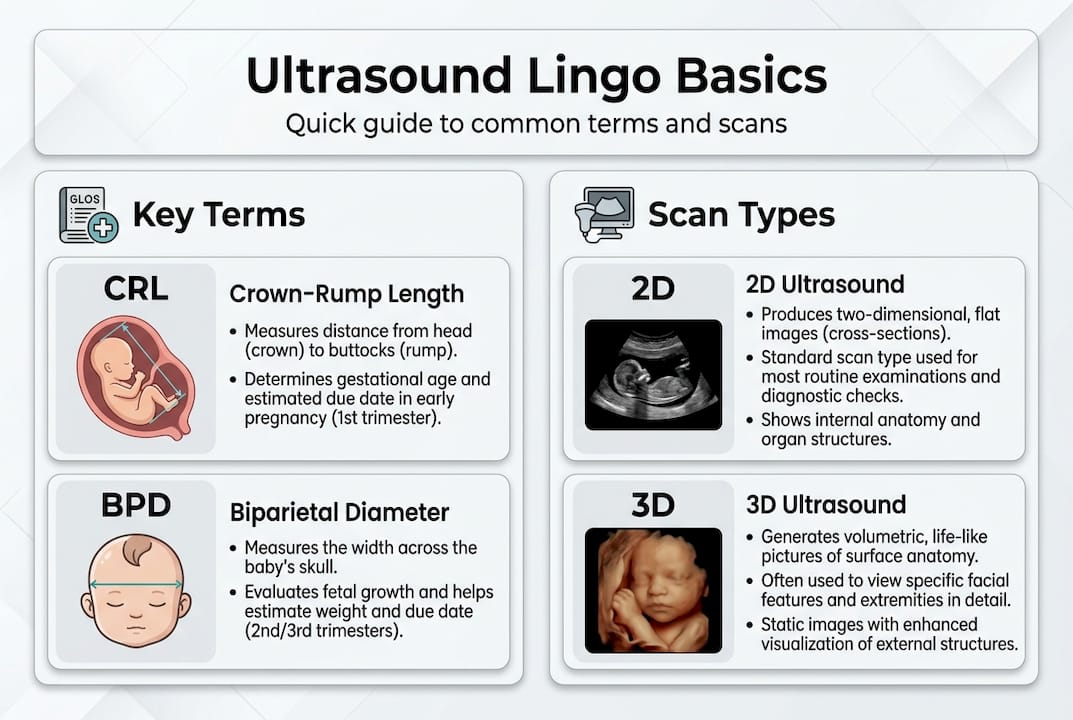
| CRL (crown-rump length) | Length of the baby from head to bottom | Used to confirm gestational age in early pregnancy |
| Fetal heartbeat | The rhythm and rate of your baby's heart | A key indicator of fetal health and development |
| Placenta | The organ connecting baby to the uterine wall | Its position affects delivery planning |
| Doppler | A technique that measures blood flow using sound wave frequency | Checks circulation in the umbilical cord and placenta |
| Gestational sac | The fluid-filled structure surrounding the embryo in early pregnancy | One of the first signs of pregnancy on an ultrasound |
These aren't just terms to memorize. Each one tells a story about how your baby is growing. For example, your baby's CRL measurement in the first trimester is so accurate that it can pinpoint gestational age within a few days. Standard terms like 'gestational sac' and 'CRL' are used in most reports, so recognizing them immediately puts you ahead of the curve.
Here's a quick list of additional terms you may encounter:
- BPD (biparietal diameter): Width of the baby's head, used to track growth
- AFI (amniotic fluid index): Measures the amount of amniotic fluid surrounding the baby
- EDD (estimated due date): Calculated based on measurements taken during the scan
- Nuchal translucency: Fluid at the back of the baby's neck, measured in early scans to screen for certain conditions
Pro Tip: Ask your sonographer to narrate what they're measuring as they go. Most are happy to explain, and it turns your appointment into a learning experience rather than a passive one.
Exploring the available ultrasound service types before your appointment also helps you understand which terms are most relevant to the type of scan you're scheduled for.
Types of ultrasound scans and what the terms mean
With a base understanding of terms, let's look at how they apply to different ultrasound types you might encounter. Not all ultrasounds are the same, and the scan type determines which terminology you'll hear most.
- 2D ultrasound: This is the traditional flat, black-and-white image most people picture. It focuses on standard measurements like CRL, BPD, and AFI. The report will be heavy on numbers and abbreviations.
- 3D ultrasound: This creates a three-dimensional still image using multiple 2D frames captured from different angles. You'll hear terms like surface rendering (the process of building the image from layered data) and volume acquisition (capturing a 3D data set).
- 4D ultrasound: Adds the dimension of real-time motion to the 3D image. You can watch your baby yawn, stretch, or suck their thumb. Terms like frame rate and real-time rendering describe how the live feed is captured and displayed.
- Doppler ultrasound: Specialized to measure blood flow in the umbilical cord and placenta using the shift in sound wave frequency. Terms include resistive index and systolic/diastolic ratio, which describe the quality of blood flow.
| Scan type | Key terms | Primary purpose |
|---|---|---|
| 2D | BPD, CRL, AFI, EDD | Measurements and standard monitoring |
| 3D | Surface rendering, volume acquisition | Detailed still images of baby's features |
| 4D | Real-time rendering, frame rate | Motion capture and baby behavior |
| Doppler | Resistive index, S/D ratio | Blood flow and circulation monitoring |
3D and 4D ultrasounds use specialized technology and terminology that go beyond what a standard 2D scan covers, giving families a far more detailed and emotional look at their baby's development. Understanding which scan you're getting ahead of time means you'll recognize the language being used and appreciate what you're seeing on the screen.
Understanding your ultrasound report
After your scan, reading the actual report can raise new questions. Here's how to make sense of what you receive.
An ultrasound report is typically divided into a few key sections. Knowing what each part covers helps you read it without feeling overwhelmed.
- Patient and pregnancy details: Your name, gestational age, and the reason for the scan. Always verify this section is accurate.
- Measurements: This is the data-heavy section. You'll see abbreviations like BPD, HC (head circumference), AC (abdominal circumference), and FL (femur length). These are compared against standard growth charts.
- Observations: Written descriptions of what the sonographer saw, such as placenta position, amniotic fluid levels, and fetal presentation (which way the baby is positioned).
- Impression or recommendations: The sonographer's or radiologist's summary of findings, often written in more clinical language. This is where terms like within normal limits or follow-up recommended appear.
- EDD: The estimated due date as calculated from the measurements taken.
Ultrasound reports summarize key findings with both technical and plain language, but that mix can still be confusing if you've never seen one before. A helpful strategy is to read the report alongside the glossary of terms you're building from guides like this one.
Most abbreviations follow a pattern: initials stand for the anatomical measurement being taken. Once you know that "HC" means head circumference, you can decode similar abbreviations on your own. Understanding the report language breakdown before your follow-up visit helps you arrive with targeted questions instead of general confusion.
Pro Tip: Print or save your report and keep a running list of terms you didn't recognize. Bring it to your next appointment and ask your provider to walk through it with you. Providers genuinely appreciate engaged, curious patients.
Our take: What most guides miss about ultrasound terms
Most online resources on ultrasound terminology fall into one of two traps. They either oversimplify to the point of being useless, or they pile on so many definitions that parents finish reading more confused than when they started. Neither approach serves you.
Here's what we've learned from over 15 years of supporting families through prenatal imaging: the goal of understanding terminology is never memorization. It's partnership. When you know the words, you stop being a passive observer during your scan and start being an active participant in your own prenatal care.
The parents who get the most out of their ultrasound sessions aren't the ones who studied the hardest. They're the ones who felt comfortable enough to ask questions, to say "can you show me that again," and to build a relationship of trust with their care team. That confidence comes from familiarity, and familiarity comes from exactly the kind of practical knowledge this guide offers.
Connecting terminology to your personal experience, your specific baby, your unique pregnancy, is what transforms information into meaning. When you explore our ultrasound experience with that foundation in place, every image on the screen tells you something real and something yours.
Connect with BabyView3D for a confident ultrasound experience
If you're ready to bring this knowledge into practice with your next ultrasound, here's how we can support you.
At BabyView3D, our certified sonographers don't just point at a screen and rattle off numbers. They walk you through every measurement, explain what each term means for your baby's development, and make sure you leave feeling informed rather than overwhelmed. We offer 3D, 4D, and 8K HD Live sessions designed to be as emotionally meaningful as they are technically precise. Whether this is your first scan or your fifth, you deserve a session where clarity and connection go hand in hand. Explore our ultrasound services or learn more about BabyView3D to find the right package for your family.
Frequently asked questions
What does CRL mean on my ultrasound report?
CRL stands for crown-rump length, which measures your baby from the top of the head to the bottom to estimate how far along the pregnancy is. It is one of the most accurate dating tools available in the first trimester, with CRL used in most standard ultrasound reports.
Is a Doppler ultrasound safe during pregnancy?
Doppler ultrasounds are widely considered safe and are routinely used to check blood flow in the umbilical cord and placenta without any known risk to the baby. Specialized ultrasound technology like Doppler is a standard part of modern prenatal monitoring.
What should I ask during my ultrasound session?
Ask your provider to explain any term you don't recognize, show you each key measurement on the screen, and describe what the results mean for your specific pregnancy. Since confusion during ultrasounds is so common, most sonographers are well prepared to walk you through the session step by step.
How can I prepare for understanding my ultrasound report?
Review common abbreviations like BPD, CRL, AFI, and EDD before your appointment, and keep a short reference list with you. Ultrasound reports use a mix of technical and plain language, so even a basic familiarity with the most common terms makes a significant difference in how much you understand when you read it.