

Not all ultrasounds are created equal, and if you think the grainy black-and-white image from your first prenatal visit is as good as it gets, you're in for a surprise. Modern 4D ultrasound technology has completely changed what parents can see and feel during pregnancy. Studies show 91% sensitivity and 98% specificity for detecting congenital heart disease, which means this technology goes far beyond making memories. This guide covers the science, the real medical value, safety facts from top organizations, and exactly what your session will look like from start to finish.
Table of Contents
- How 4D ultrasound works: The basics explained
- Medical value and diagnostic accuracy of 4D ultrasound
- Is 4D ultrasound safe? What top guidelines say
- What to expect at your 4D ultrasound session
- Our take: What most parents don't realize about 4D ultrasound
- See your baby like never before with BabyView3D
- Frequently asked questions
Key Takeaways
| Point | Details |
|---|---|
| 4D ultrasound defined | 4D ultrasound uses advanced imaging to show real-time video of your developing baby. |
| Stronger diagnosis | 4D ultrasound can help detect some fetal anomalies more accurately than standard 2D. |
| Safety assured | Major medical guidelines confirm 4D ultrasound is safe when used for medical reasons. |
| Best for bonding | 4D ultrasound creates vivid memories by letting parents see and connect with their baby before birth. |
| Balance is key | 4D ultrasound is memorable but should be used responsibly under expert guidance. |
How 4D ultrasound works: The basics explained
Now that you know 4D is more than traditional ultrasound, let's break down exactly how it works and what makes it special.
4D ultrasound is an advanced form of ultrasonography designed for real-time fetal imaging. While standard 2D ultrasound sends sound waves into the body and captures flat, two-dimensional "slices," 4D technology adds a critical fourth dimension: time. Think of it this way. A 3D ultrasound gives you a beautiful still photograph of your baby's face. A 4D session gives you a live video where you can watch your baby yawn, stretch, smile, and even suck their thumb as it happens.
The difference in the viewing experience is enormous. With 2D, sonographers are trained to interpret the abstract shapes they see on screen, because most parents honestly cannot tell what they are looking at. With 4D, you don't need any training. You see a real, recognizable face with visible features, moving in real time.
Here's a quick comparison to make the differences crystal clear:
| Feature | 2D Ultrasound | 3D Ultrasound | 4D Ultrasound |
|---|---|---|---|
| Image type | Flat, grayscale slices | Lifelike still images | Real-time video |
| Movement shown | No | No | Yes |
| Facial features visible | Rarely | Sometimes | Clearly |
| Emotional impact | Low | Moderate | Very high |
| Diagnostic capability | Standard | Enhanced | Maximum |
| Common use | Routine prenatal care | Special imaging | Detailed visualization |
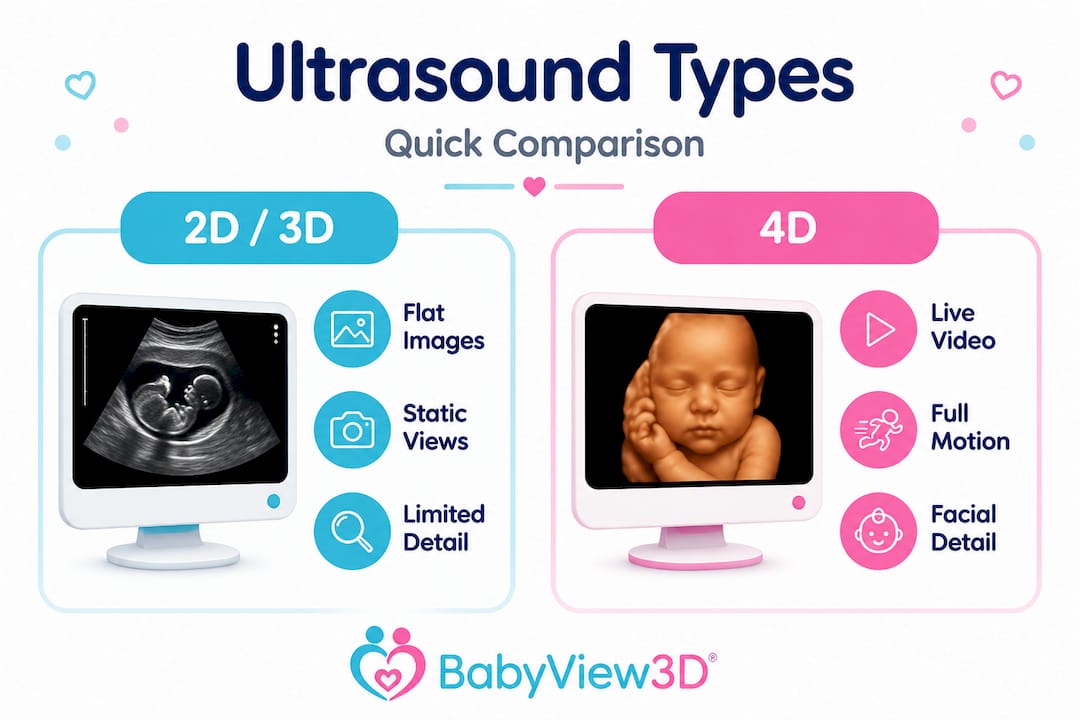
What you actually see during a 4D ultrasound session varies depending on your baby's position, but most parents walk away having watched their baby's face in motion. Common highlights include seeing the baby's lips move, watching tiny fingers curl, and catching spontaneous facial expressions. These are the moments that turn an appointment into a memory.
What parents typically see in a 4D session:
- Detailed facial features including eyes, nose, lips, and cheeks
- Real-time movements like kicks, stretches, and yawns
- Baby's hands and fingers in motion
- Facial expressions such as frowning, smiling, or sucking
- Overall body positioning and limb activity
Pro Tip: The ideal window for the most vivid 4D images is between 26 and 32 weeks of pregnancy. At this stage, your baby has developed enough body fat to give features definition, but there's still enough amniotic fluid surrounding the face for clear imaging. Too early and features are less defined. Too late and baby fills the uterus, making clear shots harder to capture.
Medical value and diagnostic accuracy of 4D ultrasound
Understanding the technology is important, but what really makes 4D ultrasound stand out are the real health insights it can reveal.
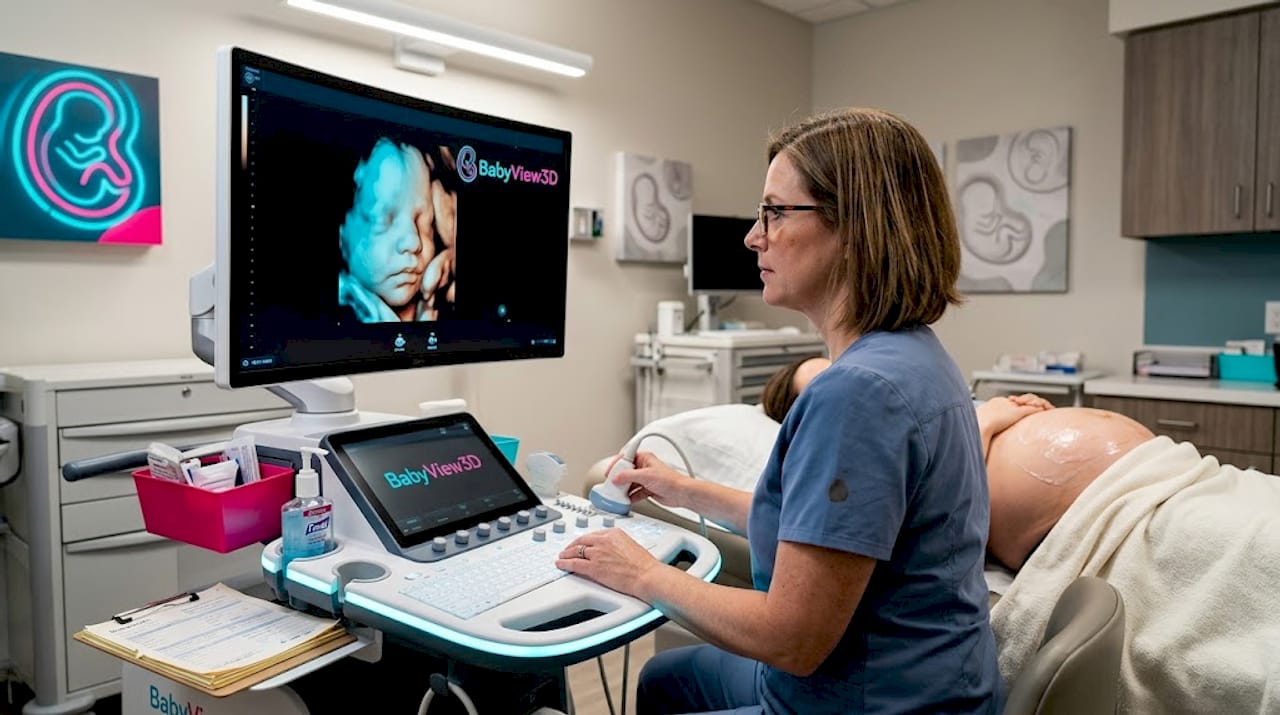
Many people assume 4D is purely for keepsakes, but the clinical picture is far more nuanced. Some medical professionals value 4D imaging as a diagnostic adjunct, meaning it adds useful visual information that 2D alone can sometimes miss. The ability to see structures in motion and from multiple angles simultaneously makes certain anomalies easier to spot and assess.
The numbers behind this technology are striking. Research shows high diagnostic accuracy for specific fetal anomalies, giving clinicians a powerful tool for detailed visualization.
| Anomaly Type | Sensitivity | Specificity |
|---|---|---|
| Congenital heart disease | 91% | 98% |
| CNS (central nervous system) anomalies | 96.4% | High |
| Facial anomalies (cleft lip, etc.) | Excellent | Excellent |
| Limb anomalies | Enhanced vs. 2D | Enhanced vs. 2D |
"When evaluating fetal facial structures or cardiac movement patterns, 4D provides a level of real-time clarity that still imaging simply cannot replicate."
What does this mean for you as a parent? It means that sessions done through certified providers who also monitor fetal health can offer more than emotional reassurance. Discovering structural concerns earlier gives families more time to prepare, consult specialists, and plan for any interventions that might be needed after birth.
Access to medical ultrasound services through experienced certified sonographers adds an important layer of confidence. Experienced providers know what typical development looks like and when to refer parents to their OB for follow-up. This is not a replacement for standard prenatal care, but it genuinely enhances your window into your baby's development.
It's also worth knowing that 4D is particularly strong when it comes to detecting fetal anomalies of the face and limbs. The real-time motion allows a sonographer to rotate the viewing angle and observe structural symmetry in ways that a frozen 2D image cannot easily show. A cleft lip, for example, is much easier to identify when you can see lip movement and adjust the angle of view during the scan.
Is 4D ultrasound safe? What top guidelines say
Medical value is just one side. Let's look at what experts say about safety and responsible use.
The short answer is yes, 4D ultrasound is considered safe. But the longer answer is important for any parent making an informed decision. Organizations like the American College of Obstetricians and Gynecologists (ACOG) and the American Institute of Ultrasound in Medicine (AIUM) have reviewed the available evidence and concluded that ultrasound carries no associated risk when used appropriately for medical benefit.
The key phrase is "used appropriately." Ultrasound, including 4D, uses sound wave energy. The safety record is excellent, but like any medical tool, it should be used with purpose and care, not as casual entertainment with unlimited session time.
The guiding principle in medical imaging is called ALARA, which stands for "as low as reasonably achievable." In simple terms, it means you should get the information you need using the minimum amount of energy and session time required. Responsible providers follow this principle closely, keeping session lengths appropriate and energy output within recommended ranges.
"Ultrasonography should be performed only when there is a valid medical indication, and the lowest possible ultrasonic exposure setting should be used to gain the necessary diagnostic information." — ACOG Committee Opinion
Dos and don'ts for parents considering 4D ultrasound:
- Do choose a provider with certified, registered sonographers
- Do ask how long the session will last and how exposure is managed
- Do coordinate with your OB so all imaging is part of your overall prenatal plan
- Do use the session to bond AND stay informed about your baby's development
- Don't book unlimited repeat sessions purely for entertainment without medical rationale
- Don't assume all commercial ultrasound studios follow the same safety standards
- Don't use 4D imaging as a substitute for your scheduled prenatal appointments
You can ask for ultrasound expert advice before your session if you have concerns about safety or timing. A qualified team will always be transparent about session duration, technology settings, and what to expect during the process.
What to expect at your 4D ultrasound session
If you're considering this experience for your family, here's exactly what you can expect from a typical session.
Walking into a 4D ultrasound studio is nothing like a clinical hospital visit. The environment is usually warm and welcoming, designed to help you relax and enjoy the moment. Many studios encourage you to bring partners, siblings, or grandparents, turning the appointment into a family event. Here is a step-by-step breakdown of how a typical session unfolds.
-
Booking and preparation. You schedule your appointment, typically between 26 and 32 weeks as discussed. Ahead of time, drink plenty of water in the days leading up to your session, because good hydration directly improves the clarity of amniotic fluid and image quality.
-
Arrival and setup. You arrive, check in, and settle into a comfortable room. The technician reviews your pregnancy stage and explains what you'll see on the large display screen.
-
The scan begins. A gel is applied to your belly, and the sonographer moves the transducer across your abdomen. Within moments, your baby appears on screen in real time.
-
Watching your baby live. This is where the experience becomes emotionally powerful. You watch your baby move, react, and rest. Real 4D images from sessions like these show the level of facial detail and movement that parents get to witness firsthand.
-
Keepsakes and recording. Most providers record the session and provide images or video clips you can share with family. Some offer printed photos, digital downloads, or even framed prints.
-
Wrap-up and next steps. The sonographer discusses what was observed. If anything looks worth discussing with your OB, a good provider will tell you directly.
Studies confirm that 4D is a valuable adjunct for anomaly visualization, particularly for structures like the face and limbs, while also creating a genuinely moving experience for families.
Pro Tip: Eat a light snack or drink a small glass of orange juice about 30 minutes before your appointment. The natural sugar can gently encourage your baby to move, making it much more likely you'll catch those priceless facial expressions and kicks during your session.
Our take: What most parents don't realize about 4D ultrasound
With the basics, science, and safety now clear, let's dig deeper into what most parents don't hear about 4D ultrasound.
After more than 15 years of working with families through prenatal imaging, here's what we've observed again and again: parents who come in expecting a "fun photo session" leave with something far deeper. And parents who dismiss elective imaging as unnecessary sometimes miss a window they can never get back.
The mainstream conversation about 4D ultrasound tends to split into two camps. Camp one says it's a wonderful keepsake experience. Camp two says it's medically unnecessary and potentially irresponsible. Both camps are missing the point.
What 4D ultrasound actually represents, when done right, is a bridge between emotional connection and clinical awareness. The moment you see your baby's face move, something shifts inside you. Bonding research consistently shows that early parental attachment has long-term positive effects on outcomes for both parent and child. The visual experience of a 4D session accelerates that bond in a way no description can fully capture.
But here's the part most parents don't hear: the medical observations made during a well-conducted 4D session can prompt important conversations. We have seen families who came in purely for the experience and left with a referral to discuss something their OB hadn't noticed in a routine 2D scan. Not because 4D is a diagnostic replacement, but because a different angle, a real-time view, and an experienced set of eyes add information.
The responsible approach is to treat 4D as exactly what it is: a powerful supplement to your regular prenatal care. Use it for the emotional connection. Use it for the memories and prenatal memory keepsakes that families treasure for decades. But also respect the technology enough to do it through certified professionals who take the clinical side seriously.
Don't let anyone convince you that wanting to see your baby's face is frivolous. And don't let the excitement of the experience cause you to skip your regular OB visits in favor of elective scans. Both things can be true at the same time: this can be wonderful and meaningful and it should be done responsibly.
See your baby like never before with BabyView3D
If this guide has sparked something in you, the next step is simple.
At BabyView3D, we have spent over 15 years creating premium prenatal imaging experiences for families across the United States. Our certified sonographers use the latest HD Live 4D technology, including stunning 8K resolution imaging, to give you the clearest possible view of your baby before birth. Every session is designed around your family's comfort and emotional experience, from the moment you arrive to the keepsakes you take home. You can explore 4D ultrasound services and find a location near you, or see sample 4D images from real sessions to get a feel for what's possible. First-time appointments include exclusive discounts, so there's never been a better time to book your session.
Frequently asked questions
What is the main difference between 2D, 3D, and 4D ultrasound?
2D shows flat grayscale slices, 3D creates lifelike still images, and 4D produces real-time fetal video so you can watch your baby move as it happens.
Is 4D ultrasound safe for my baby?
Yes. Leading medical organizations confirm that ultrasound is safe with no associated risk when used responsibly by trained professionals for a valid purpose.
When is the best time during pregnancy for a 4D ultrasound?
Most experts recommend 26 to 32 weeks, when your baby has enough facial definition for clear images and there is still sufficient amniotic fluid for optimal visibility.
Does insurance cover 4D ultrasound?
Insurance typically covers ultrasound only when there is a medical indication. Elective 4D sessions for bonding or keepsakes are usually an out-of-pocket expense.
Can 4D ultrasound detect all birth defects?
No. While 4D shows high sensitivity for some anomalies like congenital heart disease and CNS conditions, it is not a complete diagnostic tool and cannot guarantee detection of every structural difference.