
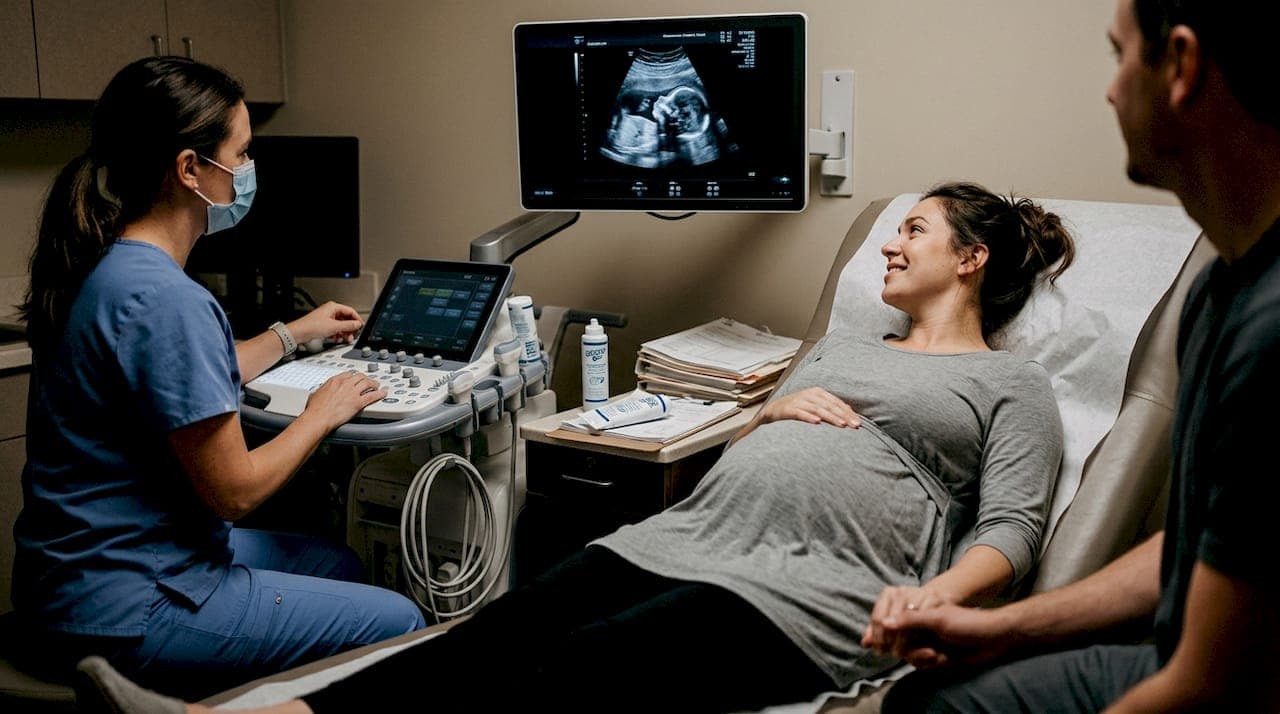
Most parents expect their prenatal ultrasound to show a grainy, hard-to-read image that only a trained technician can interpret. HD Live imaging completely changes that expectation. Instead of fuzzy outlines, you see lifelike skin texture, tiny fingers curling, and real-time facial expressions. This guide walks you through what high-definition live imaging actually is, how it works, why it's different from standard scans, what the research says about safety, and how to make the most of your session. By the end, you'll know exactly what to expect and how to choose the right experience for your family.
Table of Contents
- Understanding high-definition live imaging: The basics
- What makes HD Live imaging unique: Features and advantages
- Comparing HD Live with traditional 2D/3D ultrasounds
- Is HD Live imaging safe? What parents need to know
- Why HD Live imaging is about more than just the wow factor
- See your baby like never before with BabyView3D
- Frequently asked questions
Key Takeaways
| Point | Details |
|---|---|
| What is HD Live imaging? | HD Live imaging gives you a true-to-life view of your unborn baby with remarkable clarity thanks to advanced ultrasound technology. |
| Unique benefits | It helps parents bond and capture cherished memories while also aiding in identifying certain anomalies. |
| Safe when used properly | Medical groups agree HD Live is safe when performed prudently and by experienced providers. |
| Not standard for all prenatal care | HD Live imaging is an elective supplement and not a replacement for routine diagnostic ultrasounds. |
| Choose experts | Select a reputable provider who explains technology, safety standards, and timing for best results. |
Understanding high-definition live imaging: The basics
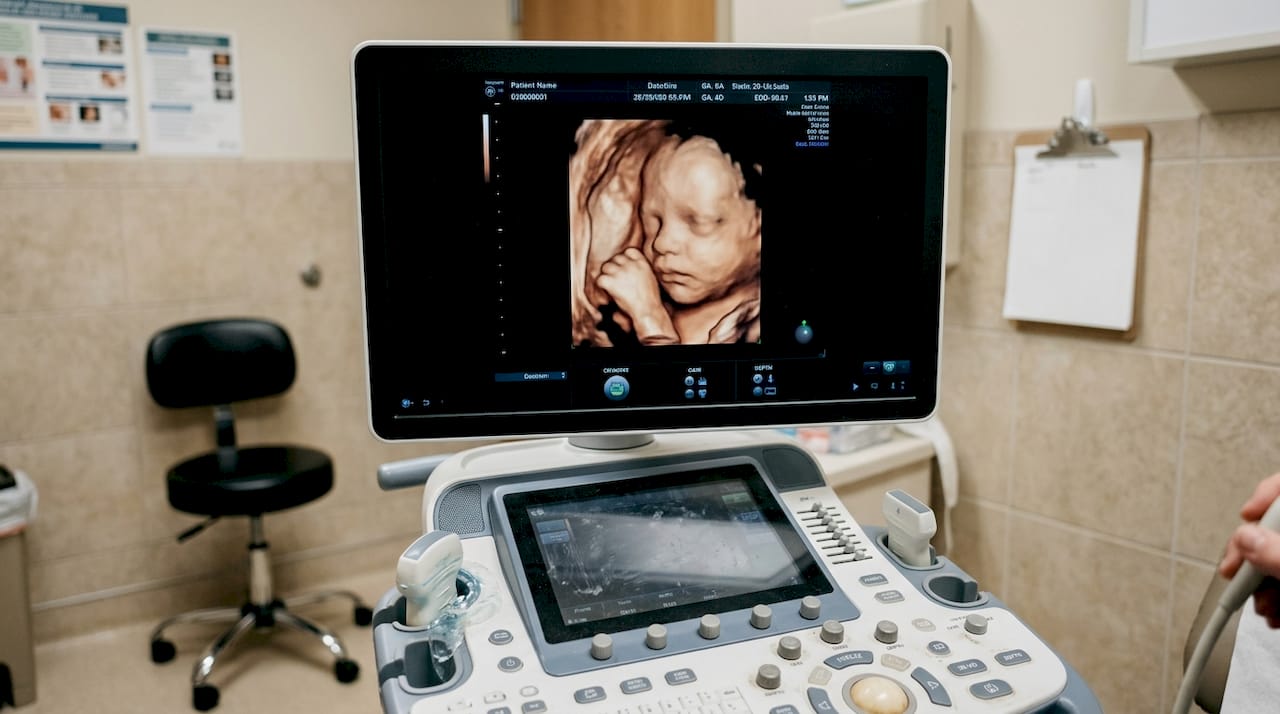
High-definition live imaging, often called HD Live ultrasound, is a specialized prenatal imaging technology that produces remarkably realistic, three-dimensional views of your unborn baby in real time. Unlike a standard 2D scan, which captures flat cross-sections of the baby, HD Live uses advanced software to render (create a visual model from raw data) light and shadow effects that mimic how natural light falls on skin. The result looks less like a medical image and more like a photograph.
To understand what makes this possible, it helps to know a few key terms. 3D ultrasound captures a still, three-dimensional image of the baby. 4D ultrasound adds the dimension of time, so you see movement as it happens. HD Live takes 4D a step further by applying a virtual light source that the sonographer can move, creating depth and texture that earlier technologies couldn't produce.
Two additional tools make HD Live even more powerful:
- STIC (spatiotemporal image correlation): This technology captures the baby's heartbeat and blood flow in a looping 3D sequence, letting clinicians study the heart in motion.
- HDlive Flow: A technique that maps blood movement through vessels in vivid color, making vascular structures easier to see.
Thanks to these tools, HD Live imaging uses go well beyond keepsake photos. Research confirms that HD Live excels in assessing facial anomalies, limb details, and vascular structures when combined with STIC and HDlive Flow for blood flow visualization.
What do parents actually see? Expect to watch your baby yawn, stretch, suck a thumb, or open and close tiny fists. Skin folds, ear shape, and eyelid detail are all visible at the right gestational age. It's a genuinely moving experience that standard scans simply can't replicate.
Pro Tip: Before booking, ask the imaging center whether their equipment specifically supports HD Live or 4D capability. Not all ultrasound machines offer the same level of rendering quality, and the difference in image clarity is significant.
What makes HD Live imaging unique: Features and advantages
Now that you understand the technology, let's look at what it actually delivers for parents and, in some cases, for clinicians.
The most immediate benefit is emotional. Seeing your baby's face in lifelike detail, rather than a blurry outline, creates a powerful sense of connection. Many parents describe it as "meeting" their child for the first time. Partners who may feel less physically connected to the pregnancy often report that an HD Live session bridges that gap in a way that standard scans don't. The experience also produces shareable, frameable images that become treasured keepsakes.
Here's what HD Live lets you see that traditional scans often miss:
- Detailed facial features including nose shape, lip fullness, and cheek contour
- Hand and foot movements, including finger separation
- Real-time expressions like smiling, frowning, and yawning
- Body position and overall size in a realistic, three-dimensional context
From a clinical standpoint, the advantages of HD Live ultrasound extend to anomaly detection. Specialists can use HD Live to evaluate suspected cleft lip, limb abnormalities, or surface-level structural concerns with greater visual precision than 2D imaging allows.
That said, it's important to set realistic expectations. HD Live is primarily for elective bonding experiences; clinical use can enhance anomaly detection but it is not standard in routine screening per ACOG and ISUOG guidelines.
Expert insight: HD Live imaging is a powerful supplement to diagnostic care, not a replacement. Always complete your scheduled diagnostic scans, and treat HD Live sessions as an enriching addition to your prenatal journey.
Pro Tip: Schedule your HD Live session between 26 and 32 weeks of pregnancy. During this window, your baby has developed enough fat beneath the skin to show realistic facial features, but still has enough room in the womb for clear imaging angles.
Comparing HD Live with traditional 2D/3D ultrasounds
You might be wondering how HD Live stacks up against the ultrasounds you may already know about. The differences are more significant than most parents realize, and each modality has its own strengths.
Standard 2D ultrasound is the workhorse of prenatal care. It produces flat, grayscale images that trained clinicians use to measure growth, check organ development, and detect many structural concerns. It's fast, widely available, and covered by insurance. What it doesn't offer is visual realism. Most parents need help interpreting what they're seeing.
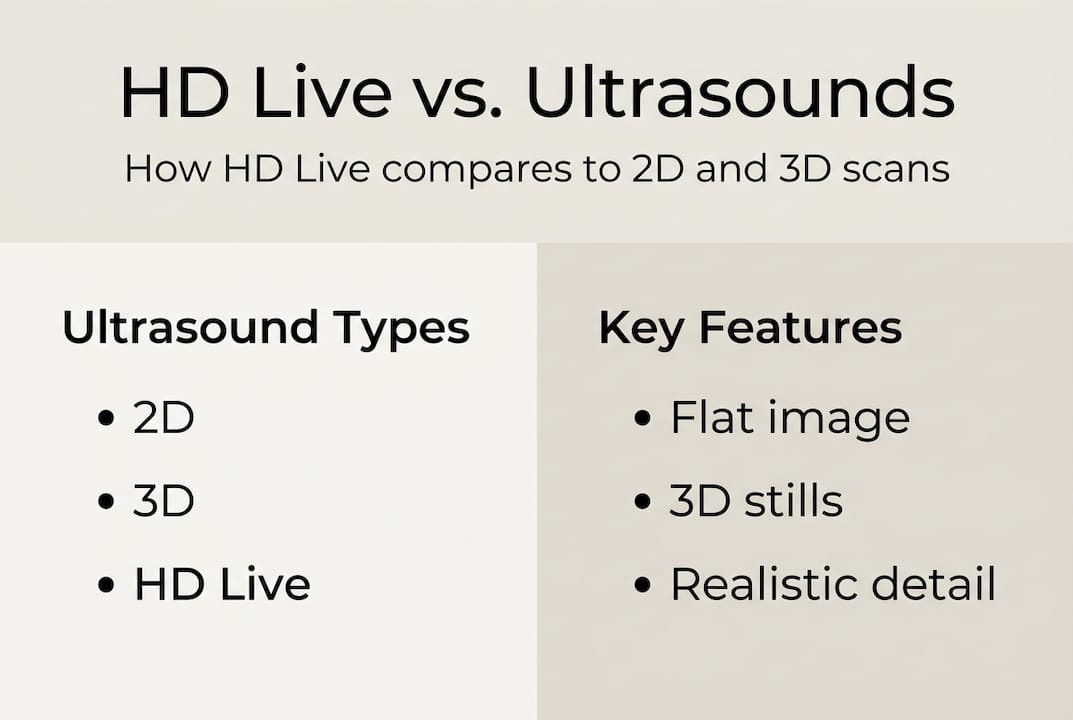
3D ultrasound adds depth, producing a still, sculptural image of the baby's surface. It's more visually intuitive than 2D but lacks movement. The images can look slightly waxy or flat depending on the equipment.
HD Live combines real-time 4D movement with advanced light rendering, producing images that look genuinely lifelike. You can explore 2D vs. HD Live imaging in more detail, but the table below gives you a quick side-by-side view.
| Modality | Visual realism | Bonding value | Clinical utility | Typical cost |
|---|---|---|---|---|
| 2D ultrasound | Low | Moderate | High (diagnostic standard) | Covered by insurance |
| 3D ultrasound | Moderate | High | Moderate | Out of pocket |
| HD Live (4D) | Very high | Very high | High (supplemental) | Out of pocket |
When should you choose each option? Your standard 2D scans are non-negotiable for medical reasons. A 3D scan is a solid choice if you want a keepsake image without the higher cost of HD Live. HD Live is the right pick when you want the most immersive, emotionally resonant experience possible, or when a clinician wants a closer look at surface-level structures. You can browse ultrasound service options to see what's available at different stages of pregnancy.
Research confirms that HD Live combined with STIC and HDlive Flow adds meaningful diagnostic value in specific clinical scenarios, making it more than just a premium visual upgrade.
Is HD Live imaging safe? What parents need to know
Safety is the first question every responsible parent asks, and it deserves a direct answer. HD Live imaging uses the same sound wave technology as all diagnostic ultrasounds. There is no radiation involved. The key safety principle governing all prenatal ultrasound is called ALARA, which stands for "as low as reasonably achievable." This means using the minimum exposure needed to get a clear, useful image.
ACOG and AIUM consider advanced ultrasounds safe under the ALARA principle; they recommend ultrasound be used prudently for diagnostic benefit, not solely for entertainment purposes.
ACOG guidance: Ultrasound examinations performed only to view the fetus, to create keepsake videos, or to learn the sex of the fetus are not considered medically indicated and should be avoided if possible.
This doesn't mean elective sessions are inherently harmful. It means that reputable providers limit session length, avoid unnecessary repeat scans, and use equipment properly. A responsible facility will never pressure you to extend a session beyond what's needed for a quality experience.
Here's how to choose a provider you can trust:
- Verify credentials. Look for registered diagnostic medical sonographers (RDMS) or equivalent certified professionals.
- Ask about session length. Reputable providers cap elective sessions at a reasonable duration and follow ALARA protocols.
- Check equipment. Confirm the facility uses current, well-maintained ultrasound technology.
- Ask about policies. A trustworthy provider will have clear guidelines and won't perform scans solely for entertainment without proper oversight.
- Read reviews. Look for consistent feedback about professionalism, safety practices, and image quality.
You can learn more about clinical benefits and limitations to understand where responsible elective imaging fits within your overall prenatal care plan.
Why HD Live imaging is about more than just the wow factor
After years of working with expectant families, we've noticed something consistent: parents who come in expecting a cool visual experience often leave having felt something much deeper. Seeing your baby's face in lifelike detail, watching a yawn or a stretch in real time, changes something. It makes the pregnancy feel more real in a way that words and even heartbeat monitors don't fully capture.
For many couples, the HD Live session is the moment both partners feel equally connected to the baby. That matters. Prenatal bonding isn't just sentimental. Research links early parental attachment to better outcomes for both parents and children after birth.
But we also believe in honest expectations. No scan, regardless of how advanced, can guarantee diagnostic certainty. HD Live is not a substitute for your scheduled medical scans, and it should never be treated as one. The clinical benefits and limitations of any imaging technology are real, and a good provider will always be upfront about them.
Treasure the experience for what it genuinely offers: clarity, connection, and a moment of peace. That's not a small thing. That's the beginning of a relationship.
See your baby like never before with BabyView3D
Ready to experience HD Live for yourself? At BabyView3D, we've spent over 15 years helping families create memories that last a lifetime. Our certified sonographers use the latest HD Live, 3D, and 4D technology to give you the clearest, most emotional view of your growing baby possible.
Every session is designed with your comfort and your baby's safety in mind. We follow strict safety protocols, limit session lengths, and use premium equipment at all our locations across the United States. Whether you want a full gallery of images, a video keepsake, or simply a moment to connect, our HD Live imaging services have a package for you. Browse our real-life HD Live images to see what's possible, then book your session today.
Frequently asked questions
How early can you do a high-definition live scan?
Most clinics recommend HD Live scans between 26 and 32 weeks, when the baby has enough facial fat to show realistic features and enough space for clear imaging.
Is HD Live imaging covered by insurance?
HD Live ultrasounds are elective and not part of standard diagnostic protocols, so insurance rarely covers them. Most families pay out of pocket, and many providers offer package pricing.
Are high-definition live images safe for repeated use?
HD Live imaging is considered safe when performed according to ALARA guidelines, but unnecessary repeat scans should be avoided. One or two well-timed sessions are typically sufficient.
What should I look for in a reputable HD Live imaging provider?
Prioritize certified sonographers, transparent safety policies, and facilities that use current HD Live-capable equipment. Reading verified client reviews also helps you gauge the quality of the experience before you book.