
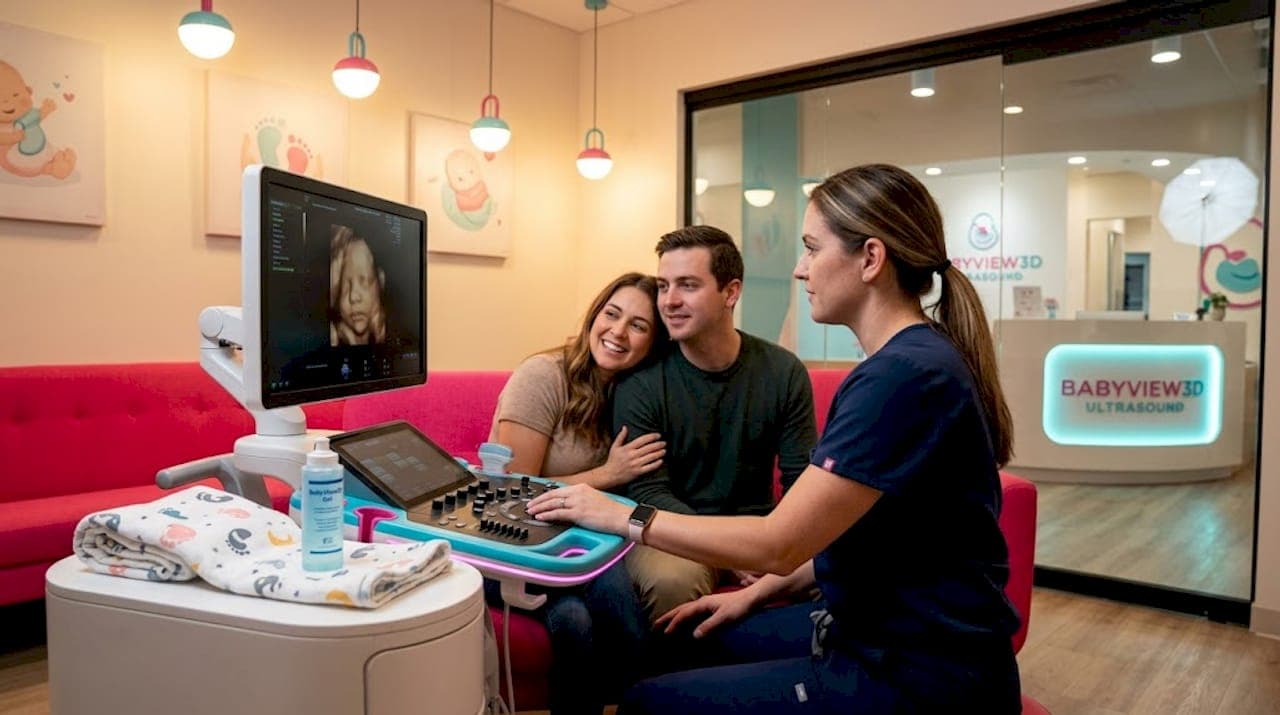
Many expectant parents walk into a prenatal appointment expecting one kind of ultrasound and come out unsure about what they actually experienced. Defining family-focused ultrasound means understanding that this is a category of its own. It is not the quick diagnostic scan your OB orders at 20 weeks. It is a dedicated, emotionally driven experience designed to let you actually see your baby, share that moment with the people you love, and walk away with memories that last far beyond pregnancy.
Table of Contents
- Key Takeaways
- Defining family-focused ultrasound: what it actually means
- What a typical session actually looks like
- The emotional impact you did not expect
- Practical decisions: cost, payments, and choosing your studio
- My perspective on what this really means for families
- Experience this with Bbview3d
- FAQ
Key Takeaways
| Point | Details |
|---|---|
| Not a medical procedure | Family-focused ultrasounds are elective and non-diagnostic, designed purely for bonding and emotional connection. |
| Better imaging options | 3D, 4D, and HD Live technology gives families stunning detail far beyond what standard 2D OB scans deliver. |
| The session is family-friendly | Studios are designed with soft lighting, comfortable seating, and welcoming staff so the whole family feels at home. |
| Flexible and accessible | Most studios accept HSA, FSA, cash, and card, making the experience financially accessible for many families. |
| Rescans are often included | Many elective studios offer free or discounted rescans if the baby is not cooperating, something medical clinics rarely do. |
Defining family-focused ultrasound: what it actually means
There is a real difference between a medical OB ultrasound and a family-focused elective one. Medical ultrasounds are diagnostic and scheduled at three standard intervals: early pregnancy to confirm viability, around 20 weeks for anatomy screening, and between 30 and 32 weeks for growth assessment. They serve a clinical function. The room is often small, the visit is short, and the technician is focused on checking measurements rather than narrating what is happening on screen.
Family-centered ultrasound flips that model entirely. The goal is not diagnosis. It is connection. You are not there to check a box on a medical chart. You are there to meet your baby on a level that standard prenatal care simply does not offer.
The imaging technology that makes it different
Here is where the experience genuinely separates itself from a clinical scan. Standard OB offices use 2D imaging, which produces flat, gray cross-sections. They are functional but not particularly emotional for most parents.
Family-focused studios use a layered set of technologies:
- 2D imaging establishes the baseline view and confirms baby's position
- 3D imaging creates a lifelike, still image of your baby's facial features and body
- 4D imaging adds real-time movement so you can watch your baby yawn, stretch, or wave
- HD Live renders texture and depth into the image, producing a near-photographic quality view of your baby's face
The difference between a 2D scan at a medical office and an HD Live session at a family-focused studio is not subtle. Parents who have experienced both often describe the elective session as the moment pregnancy became real to them.
The studio environment and who runs these sessions
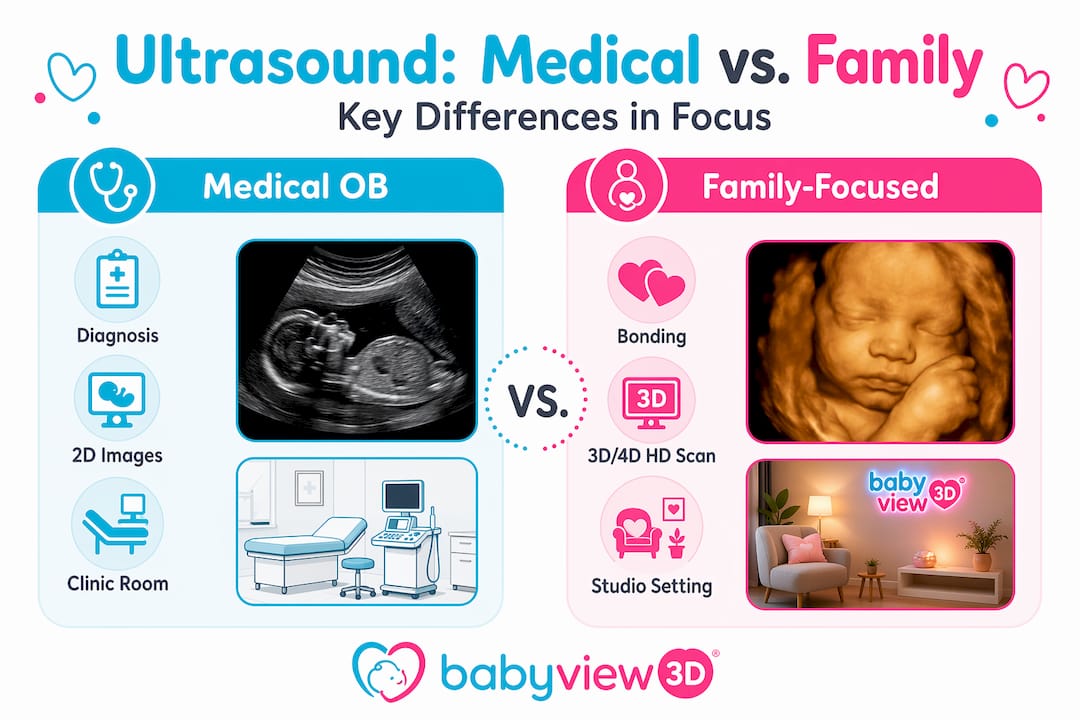
Family-focused ultrasound studios are staffed by registered sonographers trained in maternal-fetal imaging. This is not a lesser standard. The technicians bring real expertise from clinical backgrounds and apply it in a low-pressure, family-friendly setting. The studio itself is designed to feel welcoming. Think soft lighting, wide screens you can see from across the room, comfortable chairs for guests, and staff who are genuinely happy you are there.
| Feature | Medical OB Ultrasound | Family-Focused Ultrasound |
|---|---|---|
| Purpose | Diagnostic | Bonding and emotional experience |
| Imaging type | Primarily 2D | 2D, 3D, 4D, HD Live |
| Environment | Clinical | Home-like, warm, family-friendly |
| Time with technician | Limited | Extended, relaxed |
| Guests allowed | Rarely | Welcomed and encouraged |
| Keepsakes | Rarely offered | Photos, videos, digital files |
What a typical session actually looks like
Knowing what to expect before you walk in makes the experience noticeably better. A well-run elective ultrasound session typically follows a clear, 10-step process from the moment you arrive to the moment you leave with your memories in hand.
- Check-in and paperwork. You arrive, sign consent forms, and review the menu of services or add-ons you have selected.
- Review your goals. The sonographer asks what you are hoping to see and capture.
- Positioning. You get settled on the table with your guests seated nearby and able to see the main screen.
- 2D scan. The technician begins with a standard 2D view to locate the baby and assess position.
- 3D imaging. The session moves into 3D to capture detailed facial views.
- 4D viewing. Real-time 4D footage shows movement. This is where most families get emotional.
- HD Live rendering (if included in your package) adds the photographic depth and texture.
- Large-screen presentation. Everything you see is displayed on a wide screen the whole room can watch together.
- Upgrades and keepsakes. You select from optional add-ons: printed photos, digital video files, and heartbeat animals that record your baby's heartbeat.
- Media delivery. You leave with your photos, videos, or downloads ready to share.
Pro Tip: Drink cold water or have a small snack about 30 minutes before your session. Babies are often more active when your blood sugar has recently been topped off, which means better movement to capture on 4D.
If the baby is not cooperating and stays in an awkward position, many studios offer a rescan policy at no charge or at a steep discount. Medical offices almost never offer this. Ask about the policy before you book.
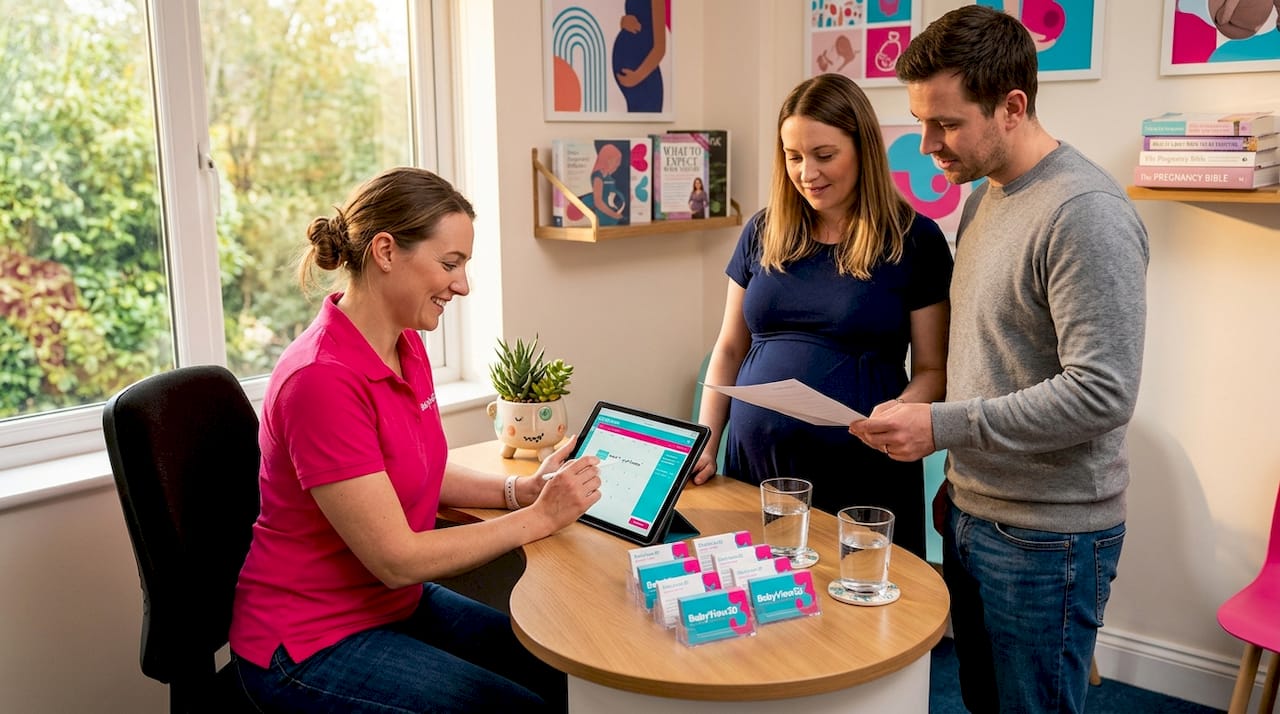
The emotional impact you did not expect
The importance of family-focused ultrasound goes beyond getting good photos. What parents consistently report is that the experience changes how they feel about the pregnancy itself.
Seeing a baby's face in 3D or watching them move in real time creates a specific kind of emotional shift. Anxiety that had been sitting quietly underneath the surface of a pregnancy often drops noticeably after a session. You move from thinking abstractly about "the pregnancy" to thinking concretely about this baby, with their personality already showing up on screen.
Tasha Crump, a sonographer and studio owner, describes emotional support and patience as the foundational values that separate elective studios from clinical environments. The appointment is unhurried. Nobody is checking the time. Your sonographer is not moving to the next patient. That alone changes the dynamic entirely.
Studios are also intentionally designed to reduce anxiety. The use of soft lighting and comfortable seating in baby-themed rooms creates a sensory experience that is calming rather than clinical. Partners, grandparents, and siblings can all be present, making the moment a genuine family memory.
The reach of this type of care extends further than you might think. Programs using ultrasound imaging in pregnancy resource centers have had remarkable results. Focus on the Family reports that nearly 60% of women facing unexpected pregnancies chose to continue their pregnancies after seeing their baby on an ultrasound screen. The image alone carries that much weight.
The benefits of family ultrasound connect on several levels:
- Emotional bonding between parents and baby before birth
- Reduced pregnancy anxiety through visual reassurance
- Inclusion of extended family in a shared, meaningful moment
- Memory creation that outlasts pregnancy itself
- Stronger partnership between parents as they experience the session together
Practical decisions: cost, payments, and choosing your studio
Family-focused ultrasound sessions are self-pay, which means insurance is not involved. That is actually a feature, not a limitation. You are not waiting on referrals, pre-authorizations, or coverage disputes. You book when you want, for the package you choose.
Pricing typically ranges from around $75 for a basic gender or early bonding scan up to $200 or more for a premium HD Live package with digital media delivery. Studios often bundle services into tiered packages so you can choose the level of experience that fits your budget. If you want to learn more about how prenatal ultrasound packages are structured, comparing package tiers before you book helps avoid surprise add-on costs.
Most independent studios accept multiple payment methods including cash, card, check, and HSA or FSA funds. Using your HSA account for a bonding session is an underused option that makes the experience more affordable for families already managing prenatal expenses.
When choosing a studio, focus on these factors:
- Sonographer credentials. Look for registered diagnostic medical sonographers with OB experience.
- Equipment quality. Ask specifically whether the studio uses HD Live technology. Not all studios have it.
- Rescan policy. A studio confident in their work will offer a free rescan if imaging is poor.
- Guest policy. Some studios limit guests. If bringing family is a priority, confirm the limit before booking.
- Studio atmosphere. Read reviews that describe the environment, not just the images.
Pro Tip: Book your 3D or 4D session between 26 and 32 weeks. The baby has enough fat under the skin for detailed facial imaging, but is not yet so large that movement is restricted.
My perspective on what this really means for families
I've been around the prenatal imaging world long enough to see what happens when families confuse clinical scans with this type of experience. They walk into an elective studio expecting efficiency and leave having cried, laughed, and called three relatives before they reached the parking lot. That disconnect is the whole point.
What I've found is that the medical ultrasound system was never designed to serve the emotional needs of families. It was designed to catch problems early. That is its job, and it does that job well. But it was never meant to be the moment you really meet your baby. Family-centered ultrasound was built to fill that gap, and it does so in ways that a clinical scan never can.
The thing I wish more parents understood is that choosing an elective session is not a luxury indulgence. It is a deliberate investment in the emotional foundation of your family. I've seen parents who were genuinely disconnected from their pregnancies transform in a single session after seeing their baby's face for the first time in 3D.
My advice: do not wait until the third trimester to book. The 26 to 32-week window gives you the richest images, and it leaves you with time to go back if you want a second session. One session is memorable. Two sessions, at different points in pregnancy, is something families talk about for years. Choose a studio where the sonographers know their craft and treat you like your experience matters. Because it does.
— LENIER
Experience this with Bbview3d
If what you've read here resonates, Bbview3d was built exactly for this. With over 15 years of experience and certified sonographers at studios across the United States, Bbview3d delivers family-centered ultrasound services using HD Live, 4D, and 8K imaging technology. You get extended session time, a warm and welcoming environment, and keepsake options including digital video, printed photos, and heartbeat animals.
First-time appointment discounts are available, and flexible package options let you choose the experience that fits your family. HSA and FSA payments are accepted. If you are ready to see your baby in detail that takes your breath away, browse the Bbview3d service options and book the session your family deserves.
FAQ
What is family-focused ultrasound?
Family-focused ultrasound is a non-diagnostic elective service designed to give expectant parents and their families a bonding experience with their unborn baby using 3D, 4D, and HD Live imaging technology.
How is it different from a regular OB ultrasound?
Medical OB ultrasounds are diagnostic tools performed at three routine intervals to assess fetal health. Family-focused ultrasounds are elective, longer in duration, and designed for emotional connection rather than clinical screening.
When is the best time to book a family-focused ultrasound session?
The 26 to 32-week window is optimal for 3D and 4D imaging because the baby has developed enough facial fat for detailed imaging while still having room to move freely.
Does insurance cover elective ultrasound sessions?
Elective ultrasound sessions are self-pay services and are not covered by standard health insurance. However, many studios accept HSA and FSA payments, which can reduce your out-of-pocket cost significantly.
What if my baby does not cooperate during the session?
Many family-focused studios have a rescan policy that offers free or discounted rescans when poor fetal positioning prevents good imaging, something standard medical clinics rarely provide.