
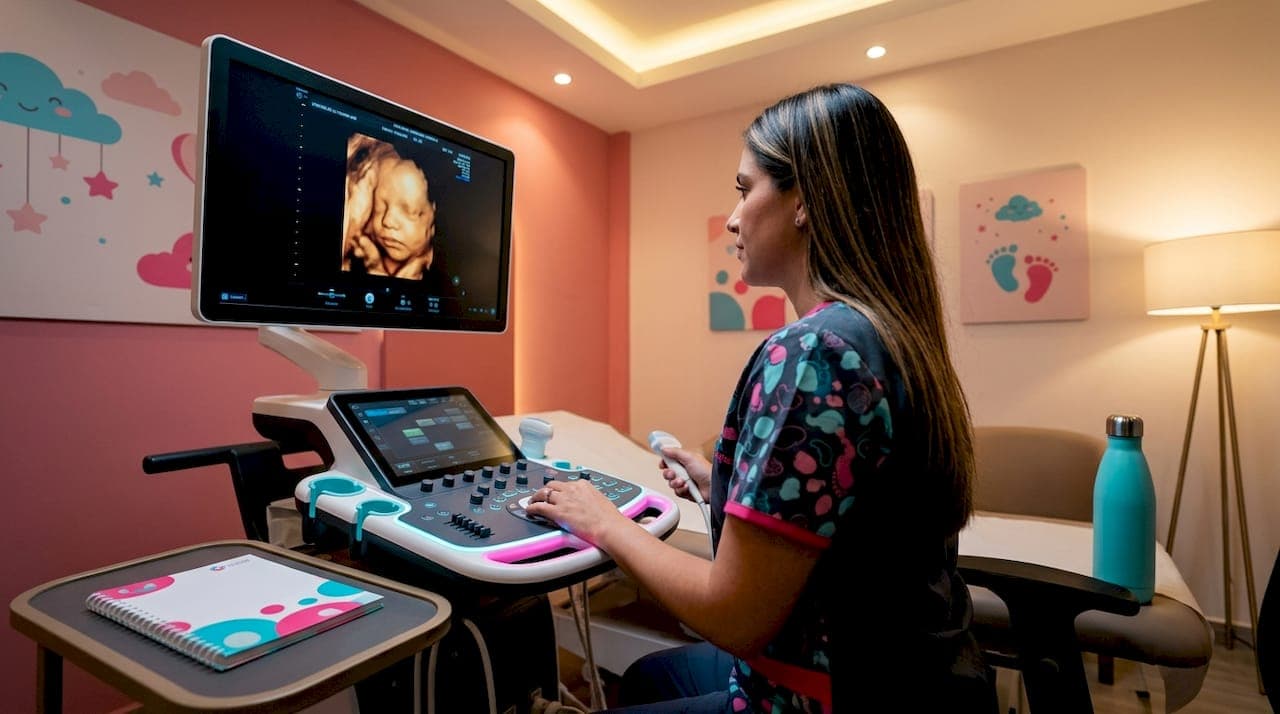
Most expectant parents assume that any ultrasound will give them a reasonably clear picture of their baby. That assumption leaves a lot of parents genuinely unprepared for the difference they actually see when they experience the role of HD Live technology for the first time. This is not a minor upgrade from standard imaging. It is a fundamentally different way of seeing your baby before birth, one that combines the emotional weight of a real first glimpse with real clinical value for your care team. This article breaks down exactly what HD Live is, why it matters, and what you can expect from your first session.
Table of Contents
- Key takeaways
- What is HD Live technology and how does it work
- Emotional benefits of HD Live ultrasound for parents
- Medical importance of HD Live in prenatal diagnosis
- Comparing HD Live with other prenatal imaging options
- Preparing for your HD Live ultrasound session
- My perspective on what HD Live actually changes
- See your baby in detail with Bbview3d
- FAQ
Key takeaways
| Point | Details |
|---|---|
| HD Live uses virtual lighting | Adjustable light sources reveal facial features and depth that standard ultrasound cannot show. |
| It strengthens parental bonding | Life-like images of your baby's face and movements increase joy and emotional connection before birth. |
| Clinical value is significant | Improved image clarity helps providers detect structural abnormalities earlier and more accurately. |
| Preparation affects image quality | Staying well hydrated before your scan directly improves the clarity of what you and your provider see. |
| It outperforms 3D and 4D imaging | HD Live adds realistic shading and texture that make images feel three-dimensional in a way 4D alone cannot. |
What is HD Live technology and how does it work
Standard 2D ultrasound uses sound waves to create flat, gray cross-section images of your baby. Those images are medically useful, but they look nothing like a face. 3D ultrasound added surface rendering to give depth. 4D added real-time motion. HD Live takes the next step by introducing something neither of those technologies had: a virtual light source.
That virtual light source is the key to understanding how HD Live works. The sonographer can move it to different positions around the image, which creates highlights and shadows across the baby's face and body exactly the way natural light would. The result looks less like a medical scan and more like a photograph of a sleeping newborn.
Here is what makes HD Live different from its predecessors:
- 2D ultrasound produces flat, grayscale cross-sections useful for basic measurements
- 3D ultrasound renders surface images with depth but without motion or realistic shading
- 4D ultrasound adds real-time movement to the 3D rendering but still lacks nuanced lighting
- HD Live combines 3D surface rendering, real-time movement, and adjustable virtual lighting for lifelike detail
One thing parents often worry about is safety. Ultrasonography is the imaging modality of choice during pregnancy, recommended over X-rays or CT scans due to its non-invasive, radiation-free nature. HD Live uses the same sound wave technology as any standard prenatal ultrasound. There is no additional risk compared to a routine scan.
Pro Tip: Ask your sonographer to slowly rotate the virtual light source during your session. Watching the shadows shift across your baby's face in real time is one of the most remarkable moments you will have before birth.
Emotional benefits of HD Live ultrasound for parents
There is a specific moment that parents describe over and over again after their HD Live session. They can see their baby yawn. Or smile. Or press a tiny hand against their cheek. That is not the experience of watching a fuzzy gray blob move across a screen.

Many parents report increased joy and reassurance after seeing their baby's face and expressions through HD Live imaging. That emotional response is not trivial. Studies on maternal-fetal bonding consistently show that visual connection during pregnancy contributes to stronger attachment after birth.
Here are specific moments HD Live makes possible that standard ultrasound cannot:
- Seeing facial features clearly for the first time, including the shape of the nose, lips, and eyelids
- Watching real-time expressions like yawning, sucking, and subtle smiling movements
- Observing limb movements in enough detail to see fingers spread or a foot kick
- Sharing the experience with partners and family in a way that actually makes sense visually
The impact of that clarity on non-pregnant partners is worth noting separately. Partners often describe standard ultrasound images as confusing. With HD Live, they do not need an expert to interpret what they see. They see a baby. That shared recognition changes the emotional experience of pregnancy for the whole family.
"Seeing her face for the first time on that screen, every feature, every tiny expression, made her completely real to us. We cried in that room and could not stop talking about it for weeks." — Parent review from an HD Live session
Pro Tip: Bring your partner or a close family member to your HD Live session. The experience of seeing the baby's face together creates a shared memory that deepens the bond for everyone in that room.
Medical importance of HD Live in prenatal diagnosis
The emotional benefits are real, but the clinical case for HD Live is equally strong. Enhanced imaging allows clinicians to monitor growth more accurately and plan interventions earlier when structural issues are present.
The table below shows how HD Live compares to traditional ultrasound in key clinical areas:
| Clinical area | Traditional 2D ultrasound | HD Live ultrasound |
|---|---|---|
| Facial structure assessment | Limited, flat view | Detailed surface rendering with shadows |
| Limb and digit evaluation | Approximate outline | Clear definition of individual structures |
| Cleft lip/palate detection | Difficult to confirm | Significantly improved detection rate |
| Soft tissue assessment | Poor differentiation | Realistic texture and depth visibility |
| Parent comprehension of findings | Often requires interpretation | Visually self-explanatory |
Philips TrueVue and similar HD Live technologies allow clinicians to manipulate the virtual light source to highlight specific anatomical structures during diagnosis. That capability matters when a provider needs to examine a specific area of concern. What might look ambiguous in a flat 2D image becomes much clearer when you can adjust the lighting angle to cast shadows across the structure in question.
For parents managing high-risk pregnancies, this added clarity is not just comforting. It is medically meaningful. Earlier and more accurate detection of potential issues means more time to prepare, consult specialists, and make informed decisions about care.
Pro Tip: If you have concerns about specific developmental areas, ask your provider whether HD Live imaging can be used to assess that structure more clearly before your appointment. Not every clinic offers it for diagnostic purposes, but many do.
Comparing HD Live with other prenatal imaging options
Understanding the difference between your options makes it easier to ask the right questions. Here is how the major prenatal imaging types stack up:
| Feature | Standard 2D | 3D | 4D | HD Live |
|---|---|---|---|---|
| Image type | Flat cross-section | Static 3D surface | Moving 3D surface | Moving 3D with lighting |
| Facial detail | Minimal | Moderate | Moderate | High |
| Real-time motion | No | No | Yes | Yes |
| Virtual lighting | No | No | No | Yes |
| Emotional impact | Low | Moderate | High | Very high |
| Clinical clarity | Standard | Improved | Improved | Best available |
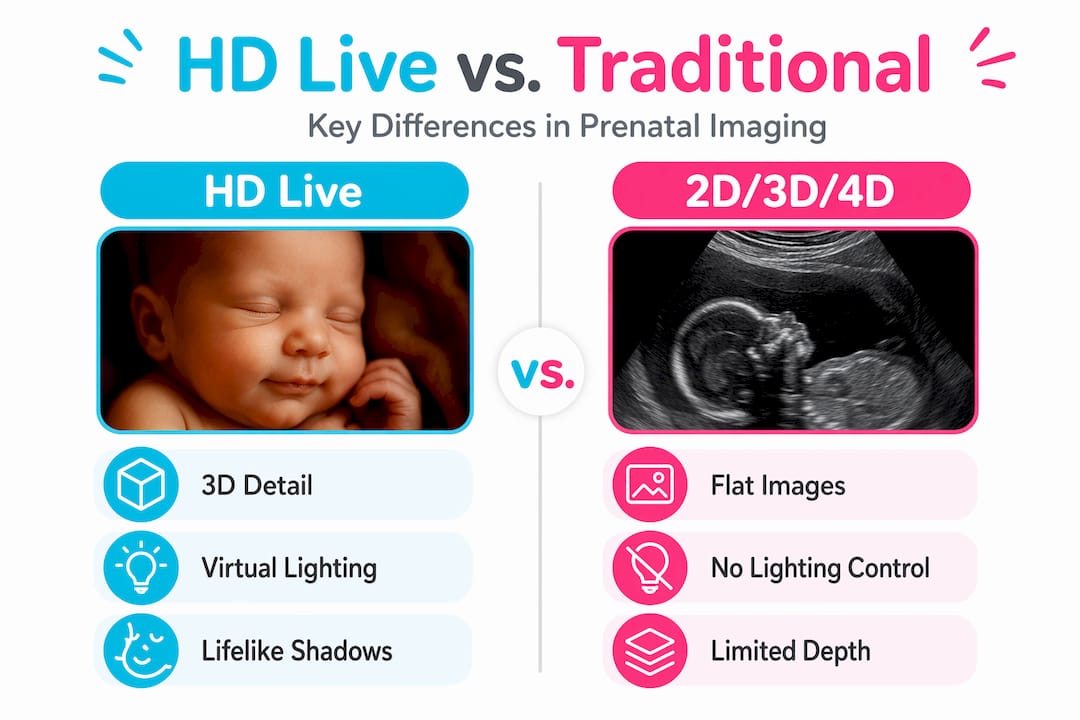
As 4D ultrasound adds the time element to 3D imaging, HD Live goes further by improving depth and natural appearance through light source manipulation. That distinction matters because parents sometimes assume 4D is the gold standard. It was, until HD Live.
A few things worth knowing when choosing between these options:
- HD Live is not always available at standard OB/GYN offices. Specialty prenatal imaging centers are more likely to offer it.
- The best window for HD Live imaging is generally between 26 and 32 weeks of pregnancy, when the baby has enough fat deposits to show detailed facial features but is not yet too crowded in the womb.
- Cost varies, but the experience and clinical detail you gain over a standard 4D session is a meaningful difference for most families.
You can explore prenatal ultrasound packages to understand what different service tiers typically include and what questions to ask before booking.
Preparing for your HD Live ultrasound session
Knowing what to do before your scan makes a real difference in what you see during it. The good news is that preparation is simple.
- Stay hydrated. Hydration increases amniotic fluid clarity, which directly improves how well the baby's features appear on screen. Drink extra water in the 24 hours before your appointment.
- Wear comfortable, loose clothing so the sonographer can access your abdomen easily without delay or discomfort.
- Eat a light snack beforehand. A small amount of sugar in your system can encourage the baby to move and show more expression during the scan.
- Come with questions. Your sonographer is a resource. If there is a specific feature you want to see or a concern you want addressed, say so at the start.
- Plan for keepsakes. Most HD Live sessions offer printed images, digital files, and short video clips. Decide in advance what you want so you do not miss the option at checkout.
For a detailed walkthrough of what to expect from start to finish, the step-by-step 3D ultrasound guide at Bbview3d covers the full process in plain language.
My perspective on what HD Live actually changes
I have worked in prenatal imaging long enough to have watched parents react to 2D scans, 3D scans, 4D scans, and HD Live scans. The reactions are not the same. Not even close.
With 2D, parents nod and smile and ask politely what they are looking at. With HD Live, they cry. Without warning, without prompting. They see a baby, not a scan.
What I find most underappreciated about the role of HD Live technology is the effect it has on the second parent in the room. The one who is not pregnant often struggles to connect with the pregnancy in the same physical, visceral way. HD Live closes that gap. Seeing a recognizable face, a yawn, a stretch, that moment of recognition is genuinely equalizing.
I also want to address the misconception that HD Live is just a luxury upgrade for keepsake photos. That framing undersells its medical value. In my experience, when parents can see a potential finding clearly on screen, they engage with the clinical conversation in a completely different way. They ask better questions. They retain more. They leave more prepared.
HD Live bridges clinical needs with emotional experiences, and I think that dual value is exactly why it has become the standard to reach for, not just a premium add-on.
If you are on the fence about whether to book an HD Live session, my honest take is this: you will not regret seeing your baby's face. You will not forget it either.
— LENIER
See your baby in detail with Bbview3d
Bbview3d has spent over 15 years helping families experience exactly what this article describes: the moment a fuzzy scan becomes a face you recognize. Their certified sonographers use HD Live and 8K resolution technology to create images that go beyond any standard prenatal imaging you have seen before. Whether you are looking for a memorable bonding session or want the clearest possible view for peace of mind, their prenatal imaging services include packages designed for every stage of pregnancy. You can also browse the image gallery to see real examples of what HD Live imaging looks like before you book. First-time appointment discounts are available, so this is a good time to take that step.
FAQ
What is HD Live technology in prenatal ultrasound?
HD Live ultrasound uses a virtual adjustable light source layered over 3D and 4D imaging to create realistic, shadow-detailed images of the baby's face and body. The result looks far more lifelike than any standard prenatal scan.
Is HD Live ultrasound safe during pregnancy?
Yes. HD Live uses the same sound wave technology as standard ultrasound, which is safe during pregnancy and lactation and is recommended as the imaging method of choice for fetal evaluation.
When is the best time to get an HD Live scan?
Most sonographers recommend scheduling between 26 and 32 weeks of pregnancy. At this stage, the baby has enough facial fat to show clear features but still has enough room to move freely for expressive moments.
How does HD Live differ from a regular 4D ultrasound?
4D ultrasound adds motion to 3D imaging, but HD Live goes further by adding virtual lighting that creates depth, shadow, and texture. The images look significantly more realistic and are easier for parents and clinicians to interpret.
Can HD Live ultrasound help detect birth defects?
HD Live improves the visibility of facial and structural features, which supports earlier and more accurate detection of conditions like cleft lip. It does not replace diagnostic imaging but aids providers in monitoring growth and planning care when issues are suspected.