

You've probably spent weeks imagining your baby's face. A 3D ultrasound gives you the chance to actually see it, in real detail, before your due date arrives. Knowing what to expect at your 3D ultrasound helps you walk in prepared rather than anxious. This guide covers everything from the best time to book your session to what you'll see on screen, how long it takes, what can go wrong, and how to get the clearest images possible. By the end, you'll know exactly how to make the most of this experience.
Table of Contents
- Key Takeaways
- What to expect at your 3D ultrasound: how to prepare
- Step by step: what happens during your 3D ultrasound
- Common challenges and how to handle them
- What you will see and feel during your session
- My take on what makes a 3D ultrasound truly memorable
- See your baby before they arrive with Bbview3d
- FAQ
Key Takeaways
| Point | Details |
|---|---|
| Best timing window | Schedule between 26 and 32 weeks for the clearest views of your baby's facial features. |
| Hydration matters early | Drink around 2 liters of water daily for at least two weeks before your appointment. |
| Baby cooperation varies | Fetal positioning affects image quality; reputable studios often offer free rescans if needed. |
| Sessions run 10 to 40 minutes | How long your session lasts depends on your package and how cooperative your baby is. |
| It's a bonding experience | 3D ultrasounds are not diagnostic tools but offer a powerful emotional connection before birth. |
What to expect at your 3D ultrasound: how to prepare
Getting the most out of your session starts long before you arrive at the studio. A few smart moves in the weeks leading up to your appointment can make a noticeable difference in image clarity.
Timing your appointment right
The optimal window is 26 to 32 weeks of gestation. At this stage, your baby has developed enough fat under the skin to show soft, rounded facial features, and there's still enough amniotic fluid surrounding them for clear imaging. Before 26 weeks, facial features can look skeletal. After 32 weeks, the baby drops lower into the pelvis and has less room to move, which makes positioning harder. If you're carrying multiples, your provider may suggest scheduling a bit earlier.
Start hydrating well before your appointment
This is the tip most parents hear once and forget. Drinking around 2 liters daily for at least two weeks before your session improves amniotic fluid clarity. More fluid means better sound-wave transmission, which translates directly to sharper images. A single large glass of water the morning of your appointment won't do the job. Hydration works over time, not all at once.
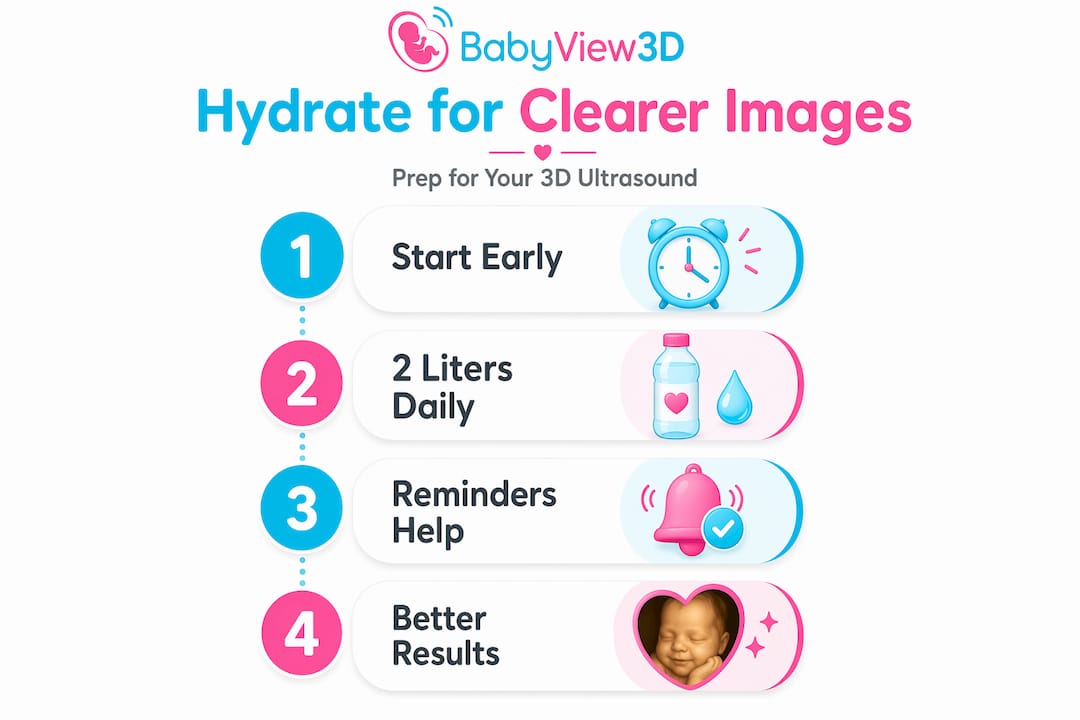
Pro Tip: Set a daily water reminder on your phone starting two weeks out. Think of it as your first act of preparation for one of your pregnancy's most memorable moments.
Other things to know before you go
Here's a quick checklist to walk in fully prepared:
- Bring someone with you. Most studios welcome partners, siblings, and grandparents. Check the studio's guest policy in advance.
- Eat a light snack about 30 minutes before your session. A bit of sugar can encourage fetal movement and shift the baby into a better position.
- Wear comfortable, two-piece clothing. You'll need easy access to your abdomen without having to fully undress.
- Schedule during active hours. If you've noticed your baby tends to move around after meals or at certain times of day, try to book around those windows.
- Keep medical safety in mind. The FDA discourages non-medical, keepsake-only ultrasound sessions performed repeatedly or for extended periods without clinical justification. Choosing a studio staffed by certified sonographers who follow safety protocols is non-negotiable.
You can also read more about ultrasound appointment basics to build context before your session.
Step by step: what happens during your 3D ultrasound
Understanding the flow of a session removes the guesswork and lets you actually enjoy the moment instead of wondering what comes next. Here's how a typical elective 3D ultrasound session goes from start to finish.
-
Check-in and consent. You'll sign paperwork confirming you understand this is a non-diagnostic, elective session. The sonographer will briefly explain that 3D/4D ultrasounds use the same sound-wave technology as standard 2D scans with no radiation exposure.
-
Getting comfortable. You'll recline on a padded table and the sonographer will apply warm ultrasound gel to your abdomen. The room is usually dimly lit and designed to feel relaxing rather than clinical.
-
Initial 2D scan. Before switching to 3D imaging, the sonographer performs a quick 2D scan to locate the baby's position and orientation. This step is crucial. It tells the technician which direction to aim for the best angle on the face.
-
Switching to 3D and 4D rendering. Once the baby is located, the sonographer transitions to 3D/4D imaging, lasting around 10 to 40 minutes depending on baby cooperation and your chosen package. You'll see images building in real time on a large screen positioned so your whole family can watch.
-
Adjustments and repositioning. If your baby is facing away or has a hand blocking the face, the sonographer will try different transducer angles and may ask you to shift positions or take a short walk. Properly trained sonographers adjust technique, not power output, to get better images safely.
-
Image capture and delivery. Once clear views are achieved, the sonographer captures still photos and video clips. Depending on your package, you may receive digital files, printed photos, a USB drive, or even a heartbeat recording.
Pro Tip: Ask beforehand what format your images and videos will be delivered in. Some studios send digital files within 24 hours; others hand you everything at the end of your session. Knowing this in advance saves the "when do we get the photos?" question at checkout.
Common challenges and how to handle them
No matter how well you prepare, your baby has opinions of their own. Here's what can complicate your session and what you can realistically do about it.
- Baby covering the face. Hands, arms, and feet often drift in front of facial features. It's one of the most common frustrations parents encounter.
- Unfavorable positioning. A baby facing toward your spine, or pressed deep into the pelvis, gives the sonographer very little to work with from the front.
- Placenta placement. An anterior placenta (one attached to the front wall of the uterus) acts like a curtain between the transducer and your baby, reducing image clarity.
- Amniotic fluid levels. Low fluid reduces the acoustic "window" through which sound waves travel. This is another reason long-term hydration matters more than last-minute efforts.
- Maternal anatomy. Body type and tissue density can affect how sound waves travel and return. This is beyond anyone's control and not a reflection of how the session is being run.
"Babies often hide their face behind hands or the placenta. Reputable studios often provide complimentary rescans if images are unclear, giving families a genuine second chance at a clear session."
If your baby isn't cooperating, a short break can help. Getting up to walk around the hallway, drinking cold water, or lying on your side for a few minutes often encourages a position change. The key is patience. Rushing the sonographer to keep pushing through a bad angle rarely produces better results.
What you will see and feel during your session
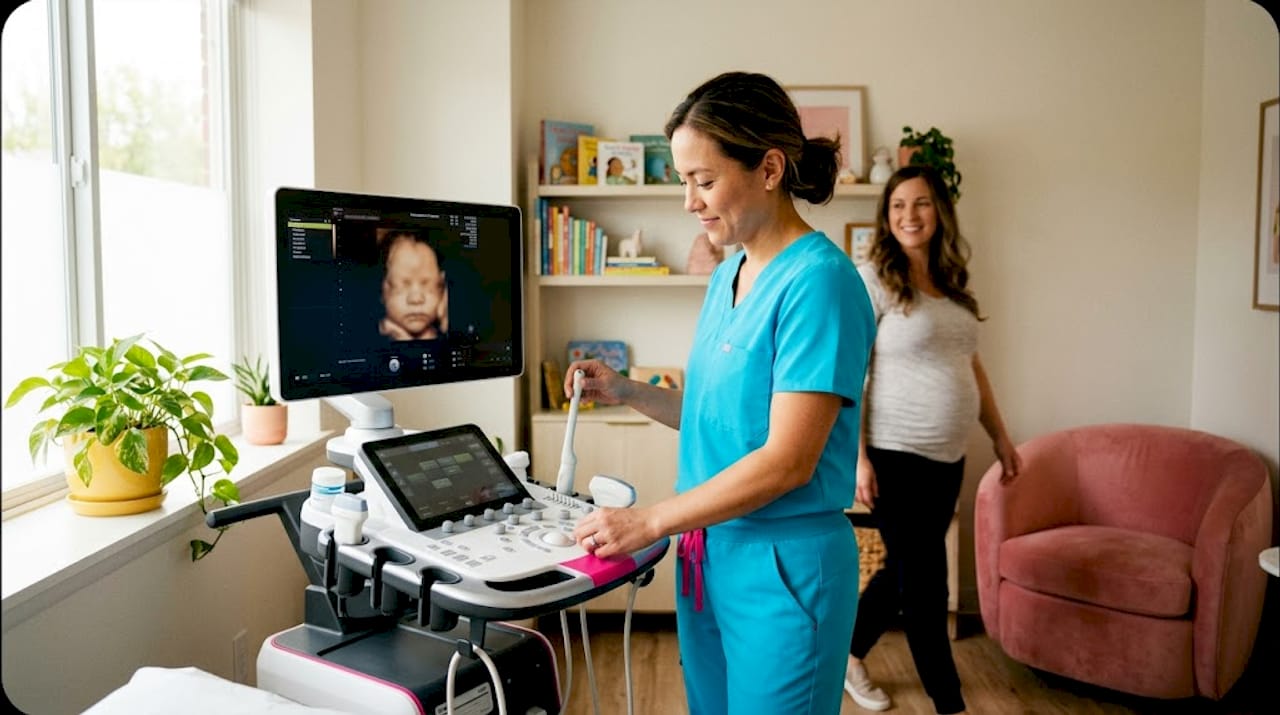
This is the section most parents are actually here for. The 3D ultrasound experience is unlike anything else in pregnancy, and knowing what to look for makes it even richer.
What you'll actually see on screen
Parents often see facial features and real-time movements like yawns, smiles, and stretches during 3D sessions. The images are rendered in warm amber or sepia tones that show depth and texture. You might catch your baby rubbing their eyes, sucking their thumb, or opening their mouth. These aren't posed. They're happening in real time.
Here's a quick comparison of what you see with each imaging type:
| Feature | 2D ultrasound | 3D ultrasound |
|---|---|---|
| Image appearance | Flat, gray, cross-section | Lifelike surface rendering with depth |
| Facial detail | Outline only | Cheeks, nose, lips, and eyelids visible |
| Movement display | Visible but abstract | Real-time with recognizable gestures |
| Emotional impact | Informative | Often deeply moving |
| Primary purpose | Diagnostic | Bonding and keepsake |
The emotional side of your appointment
Most parents aren't prepared for how emotional the moment actually is. Seeing your baby's face for the first time in three dimensions, watching them yawn or stretch, creates a connection that feels immediate and real. Partners and siblings in the room often react just as strongly. It's worth having tissues nearby, not as a cliché, but as a genuine practical suggestion.
Keepsake options typically include:
- Printed still images in various sizes
- Digital photo files for sharing and printing
- Video recordings of the session
- Heartbeat recordings embedded in stuffed animals or keepsake items
- Gender reveal moments captured on video
One thing to hold clearly: 3D ultrasounds are adjuncts, not substitutes for your diagnostic prenatal care. They will not replace the anatomy scan your OB orders. Think of them as the emotional chapter of your pregnancy story, not the medical one.
My take on what makes a 3D ultrasound truly memorable
I've been around prenatal imaging for a long time, and the one thing I'd push back on is the idea that a 3D ultrasound is just a novelty. It's not. I've watched families walk out of sessions with a genuinely different relationship with their unborn child. The parent who wasn't fully bonded yet. The grandparent meeting their grandchild's face for the first time. These moments are real, and they matter.
That said, I always encourage people to be honest about their expectations. If your baby isn't cooperating, no studio on earth can force a clear image. What separates a good experience from a frustrating one is usually the quality of the staff. Certified, experienced sonographers know how to follow ALARA principles and work patiently within those limits to get you the best result possible.
My biggest piece of advice? Don't fixate on getting a perfect photo. Show up hydrated, bring the people you love, eat something beforehand, and let the session unfold. The babies who refuse to show their faces have made some of the most memorable sessions I've ever witnessed, because the laughter, the frustration, and the eventual reveal make for a story families tell for years.
— LENIER
See your baby before they arrive with Bbview3d
If you're ready to turn this appointment from something you're nervous about into something you'll remember forever, Bbview3d is built exactly for that. With over 15 years of experience, certified sonographers, and HD Live 3D and 4D imaging technology, every session is designed to give you the clearest, most emotionally powerful look at your baby possible. Explore the full range of ultrasound service packages to find the option that fits your family, or browse the session gallery to see exactly what's possible. First-time appointments include a limited discount, so there's no better time to book.
FAQ
When is the best time to schedule a 3D ultrasound?
The best window is 26 to 32 weeks of pregnancy. At this stage, your baby has enough facial fat for detailed features and enough amniotic fluid for clear imaging.
How long does a 3D ultrasound session last?
Sessions typically last between 10 and 40 minutes depending on the package you choose and how cooperative your baby is on the day.
What should I do if my baby won't show their face?
Try getting up to walk, drinking cold water, or switching positions. Many reputable studios will offer a rescan if images are unclear due to unfavorable fetal positioning.
Is a 3D ultrasound safe for my baby?
Yes, when performed by trained professionals. Ultrasound uses sound waves with no ionizing radiation and is considered safe under proper supervision following ALARA safety guidelines.
Can I bring family members to my 3D ultrasound session?
Most elective studios welcome family-friendly groups to share the experience. Check your studio's specific guest policy when you book, as some limit the number of guests per room.