

An ultrasound photo collage is a curated arrangement of prenatal scan images, organized to tell your baby's story before birth. Knowing how to create ultrasound photo collages the right way means choosing the right tools, preserving your prints with archival materials, and adding personal touches that turn medical images into family keepsakes. The difference between a collage that fades in two years and one your grandchildren will hold comes down to materials, image quality, and a little creative planning. This guide covers all three.
What tools and materials do you need for a lasting collage?
The right tools determine whether your collage survives decades or deteriorates in a drawer. For physical collages, acid-free, archival-quality paper and adhesives are non-negotiable. Ultrasound prints are made on thermal paper, which yellows and fades faster than standard photo paper when exposed to acids, light, or humidity.
For digital collages, tools like Canva, Adobe Express, and Mixbook offer pre-built templates sized for printing. These platforms let you drag and drop images, add text captions, and export high-resolution files ready for professional printing. Canva's free tier handles most basic layouts; Mixbook specializes in printed photo books with premium paper options.

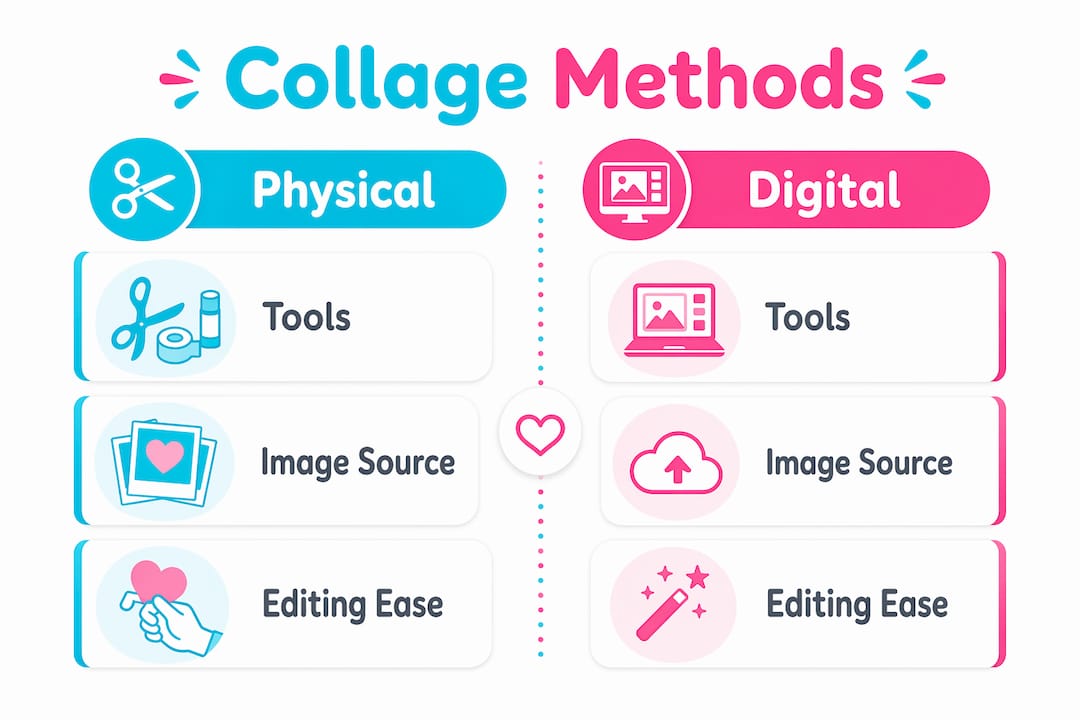
Digital vs. physical collage: a quick comparison
| Feature | Digital collage | Physical collage |
|---|---|---|
| Ease of editing | High, editable anytime | Low, changes are permanent |
| Longevity | Depends on backup habits | Depends on archival materials |
| Sharing | Instant via email or social media | Requires scanning or photographing |
| Emotional impact | Strong, especially with video | Very strong, tactile and displayable |
| Cost | Low to moderate | Moderate to high |
Pro Tip: Always request digital image files directly from your sonographer. High-resolution digital files produce far sharper prints than smartphone photos of thermal paper prints, which lose contrast and detail.
For physical builds, you will also need UV-protective frame glass, acid-free mounting corners or photo-safe adhesive strips, and a flat storage box for any prints you are not yet displaying. These supplies are available at craft stores like Michaels and online through Gaylord Archival.
How do you select and organize your ultrasound images?
Image selection is where most parents get stuck. The instinct is to use only the clearest, most detailed scans. That instinct is wrong. Even blurry early-stage prints carry enormous emotional weight as the first visual evidence your baby existed. Memory-keeping experts consistently highlight their value in family albums.
A strong collage includes at least three types of scans:
- Early confirmation scan (6–10 weeks): the first glimpse, often just a small shape
- Anatomy scan (18–20 weeks): detailed profile views and measurements
- 3D or 4D scan (28–32 weeks): facial features, expressions, and movement stills
Beyond scan type, think about organization. Chronological order works well for timeline collages. Thematic order works better for display pieces where you want visual balance over narrative sequence.
Personalization ideas that add real depth to any layout:
- Add the scan date and gestational age below each image
- Include the baby's heartbeat reading from that visit
- Write a one-line note about how you felt that day
- Add a photo of the baby bump taken the same week as each scan
- Include a small keepsake like a hospital wristband or first appointment card
Combining scan images with personal milestones and feelings deepens the emotional impact far beyond what images alone can achieve. The collage stops being a medical record and becomes a story.
Step-by-step process for making ultrasound collages
Follow these steps whether you are building a physical scrapbook page, a framed display, or a digital photo book.
- Gather and digitize your images. Collect all scan prints and request digital copies from your provider. If you only have prints, scan them on a flatbed scanner at 300 DPI minimum. Avoid photographing prints with your phone.
- Choose your format. Decide between a framed wall collage, a scrapbook page, a printed photo book, or a digital slideshow. Each format suits a different purpose. Framed collages work best as nursery art. Photo books work best as gifts.
- Plan your layout before committing. Lay physical prints on a flat surface or use a digital template to arrange images before gluing or finalizing. Balance large and small images. Leave white space so the eye can rest.
- Add captions and decorative elements. Handwritten notes, printed date labels, and small decorative stickers add personality. Keep text readable and proportional to the image size.
- Use archival materials for physical collages. Mount prints with acid-free adhesive. Back the collage with acid-free cardstock. Never use regular tape or rubber cement, both of which degrade thermal paper quickly.
- Print or finalize your digital version. For digital collages, export at 300 DPI and order prints through a professional lab like Mpix or Nations Photo Lab. For social media announcements, a 1080 x 1080 pixel export from Canva works well.
Physical vs. digital collage methods
| Step | Physical method | Digital method |
|---|---|---|
| Image source | Flatbed scan at 300 DPI | Digital file from provider |
| Layout tool | Hands-on with prints | Canva, Adobe Express, Mixbook |
| Adhesive | Acid-free photo corners | Not applicable |
| Final output | Framed print or scrapbook | Printed book or digital file |
| Sharing | Photograph and post | Direct export or upload |
Digital memory books let you add video clips, music, and scanned keepsakes alongside still images. That flexibility makes them especially useful for sharing with family members who live far away.
How can you preserve and display your collage safely?
Preservation starts before the collage is finished. UV-protective framing glass is the single most effective tool for preventing light-induced fading of thermal ultrasound prints. Standard glass blocks very little UV radiation. Museum-grade or conservation glass blocks more than 97% of UV light and is available at most frame shops.
For digital files, follow the 3-2-1 backup rule: three copies of every file, on two different storage types, with one copy stored off-site or in cloud storage like Google Photos or iCloud.
Creative display ideas that work well for ultrasound collages:
- Nursery wall art: A framed multi-image collage with the baby's name, birth stats, footprints, and scan images makes a complete birth story display
- Shadow boxes: Combine a printed collage with a hospital bracelet, a positive pregnancy test, and a small keepsake toy
- Photo books: Printed books from Mixbook or Shutterfly hold up well and make excellent gifts for grandparents
- Crystal engravings: Services that engrave 3D ultrasound images into crystal blocks require high-resolution scans for sharp results
- Digital slideshows: Pair ultrasound stills with video clips and music for a shareable family announcement
Avoid displaying physical collages in direct sunlight or in rooms with high humidity, like bathrooms. Both conditions accelerate thermal paper deterioration significantly.
Pro Tip: Store any unframed ultrasound prints in an acid-free box away from heat sources. A cool, dark closet shelf is better than a garage or attic.
What are some creative ultrasound collage ideas to inspire your project?
The most memorable collages go beyond a simple grid of scan images. Collages that combine pregnancy milestone photos, personal mementos, and ultrasound images create art that tells a complete story. The goal is to capture who your family was at that exact moment in time.
Strong creative themes to consider:
- Pregnancy timeline: One image per trimester, arranged left to right with dates and a short caption for each
- "Before you were born": A letter to the baby printed alongside their earliest scan images
- Family connections: Side-by-side comparisons of parent baby photos with the ultrasound, showing family resemblance
- Bump and scan pairing: A baby bump photo next to the corresponding ultrasound from the same week
- Baby shower collage: Combine scan images with a photo from the shower, the invitation, and a handwritten wish from a guest
For social media announcements, a clean two-image layout works best: one clear 3D scan image paired with a simple text overlay showing the due date or name. Canva has free announcement templates built for this exact format.
Blending medical images with personal notes and milestone markers transforms clinical photos into treasured family keepsakes. That transformation is the whole point of making a collage in the first place.
Gifting collages is also worth considering. A printed photo book with a personalized cover makes a gift that grandparents genuinely treasure. A framed collage with birth story details including footprints, handprints, and family photos works as a permanent nursery piece that grows with the child.
Key takeaways
Creating a lasting ultrasound photo collage requires archival materials, high-resolution image files, and personal context that turns scan images into a family story.
| Point | Details |
|---|---|
| Use archival materials | Acid-free paper, adhesives, and UV-protective glass prevent thermal print deterioration. |
| Start with high-resolution files | Request digital files from your provider; flatbed scans at 300 DPI are the minimum for print quality. |
| Include early blurry scans | Imperfect early images carry strong emotional value as the first evidence of your baby. |
| Add personal context | Dates, notes, bump photos, and keepsakes transform scan images into a complete family story. |
| Back up digital files | Use the 3-2-1 backup rule to protect digital collages from permanent loss. |
Why the imperfect scans matter most
By LENIER
Parents often tell me they want to wait until they have a "good" scan before starting their collage. I understand the impulse. That grainy six-week image looks nothing like the detailed 3D portrait you get later. But starting early with imperfect images is exactly the right move, and here is why: the emotional weight of that first blurry shape is something no later image can replicate.
I have seen families spend weeks perfecting a collage layout only to realize the image they treasure most is the one they almost left out. The anatomy scan is detailed. The 3D portrait is stunning. But the six-week confirmation scan is the moment everything became real. That image belongs in the collage.
My honest advice is to resist the urge to make it perfect before you start. Gather what you have, pick a format that fits your time and budget, and build something real. You can always add to a collage. You cannot go back and document a moment you skipped. The emotional connection built through this process is worth far more than a flawless layout.
— LENIER
Bbview3d: professional ultrasound images worth preserving
The quality of your collage depends directly on the quality of your source images. Bbview3d has provided families with advanced prenatal imaging for over 15 years, using 3D, 4D, and 8K HD Live technology at centers across the United States. Their certified sonographers deliver high-resolution digital files that are ready for printing, framing, and keepsake creation without any extra editing.

Families who visit Bbview3d leave with images detailed enough for crystal engravings, large-format prints, and professional photo books. If you want source images that hold up to any collage format you choose, explore Bbview3d's prenatal imaging packages and see what is available at a center near you.
FAQ
What is the best app for making ultrasound photo collages?
Canva and Mixbook are the strongest options for most families. Canva offers free templates and easy text overlays; Mixbook specializes in printed photo books with professional paper quality.
How do I digitize ultrasound prints for a collage?
Use a flatbed scanner set to 300 DPI minimum. Smartphone photos of thermal prints lose contrast and detail, making them unsuitable for high-quality prints or engravings.
How do I keep ultrasound prints from fading?
Store prints in acid-free boxes away from heat and light. For displayed collages, use UV-protective frame glass to block the light that degrades thermal paper fastest.
Can I include early blurry scans in my collage?
Yes, and you should. Early imperfect scans are the foundational "first evidence" in any family memory book and carry emotional value that later detailed images cannot replace.
What is the difference between a physical and a digital ultrasound collage?
A physical collage is a tangible, displayable object that requires archival materials for longevity. A digital collage is easier to share and edit, but its preservation depends entirely on consistent file backups.