
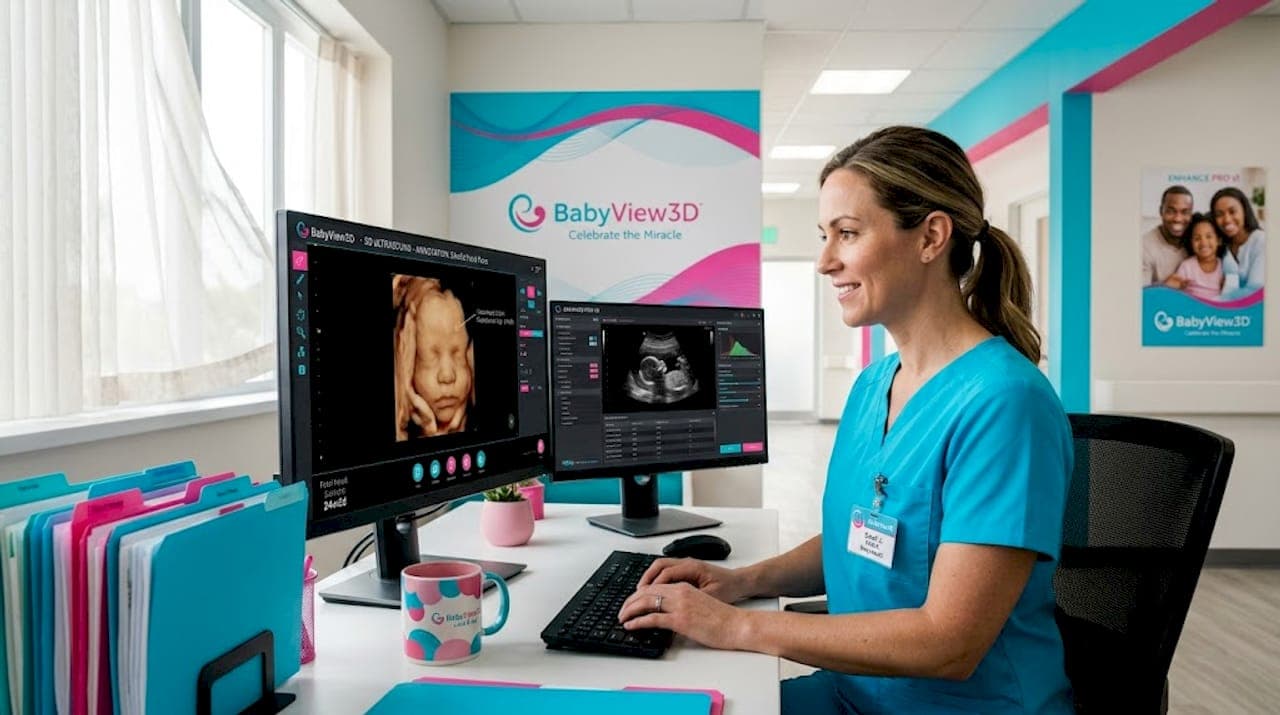
Blurry ultrasound photos can be genuinely disappointing. You have waited weeks for this appointment, and the image you get back looks grainy, hard to read, and nothing like the vivid previews you have seen online. What is ultrasound image enhancement, and can it actually make a difference? The short answer is yes, and the technology behind it has advanced so far that the improvement in your baby's photo can be dramatic. This guide breaks down exactly how it works, what it means for your experience as a parent, and how to get the clearest possible images at your next session.
Table of Contents
- Key Takeaways
- What ultrasound image enhancement is and how it works
- The real benefits for expecting parents
- Comparing the main enhancement techniques
- How to prepare for the best possible images
- My take on what enhancement actually means for families
- See the difference at Bbview3d
- FAQ
Key Takeaways
| Point | Details |
|---|---|
| Enhancement reveals, not invents | Good ultrasound enhancement reveals existing detail by reducing noise and improving contrast, never fabricating image data. |
| AI has raised the bar significantly | Deep learning tools can nearly double the proportion of ultrasound images rated optimal in quality. |
| Clearer does not always mean more medical | Enhancement for parental viewing prioritizes visual clarity, which can differ from what clinicians need diagnostically. |
| Your stillness matters most | Physical stillness during the scan is the single biggest factor you can control for sharper raw images. |
| Technique type changes the outcome | Different methods, from noise suppression to AI super-resolution, produce noticeably different results in detail and texture. |
What ultrasound image enhancement is and how it works
Ultrasound image enhancement is the process of applying digital techniques to a raw ultrasound scan to reduce visual noise, improve contrast, and bring out finer detail. Think of it like the difference between a photo taken on a cloudy day and the same photo after color correction and sharpening in editing software. The scene was always there. The enhancement just makes it visible.
There are two broad stages where this happens. The first is preprocessing, which happens before the image is fully formed. This stage focuses on filtering out the electronic noise that naturally comes from converting sound waves into pixel data. The second is postprocessing, which happens after the image is captured. This is where spatial filtering techniques like linear contrast stretching and edge sharpening come into play. Low-pass filters smooth out graininess. High-pass filters bring boundaries and edges into sharper relief.
Modern enhancement goes well beyond those classical filters. AI and deep learning have changed what is possible. Trained neural networks analyze noisy ultrasound data and reconstruct realistic details by learning from millions of example images. The model does not simply filter the image. It predicts what a clean version of that image should look like, preserving textures and restoring edges in a way that feels natural rather than processed.
At the most advanced level, Super-Resolution techniques push the physical limits of what ultrasound can show. By combining information across multiple frames, SR CEUS achieves resolutions as fine as 10 microns, compared to the roughly 150 microns possible with standard methods. That level of detail is primarily used in research and clinical diagnostics, but the underlying principles are trickling into the technology available at specialized prenatal studios.
Pro Tip: Ask your sonographer whether the studio uses AI-based postprocessing or traditional filtering. The distinction directly affects how much detail you will see in your final images.
Key enhancement techniques and what they target:
- Noise reduction filters: Remove electronic graininess from the raw signal
- Contrast stretching: Expands the range of brightness so dark and light areas are both more visible
- Edge-aware sharpening: Defines outlines of features like fingers, lips, and eyes without distorting surrounding tissue
- AI super-resolution: Predicts and reconstructs fine detail from incomplete signal data
- Structure-aware enhancement: Adapts to local anatomy rather than applying a fixed brightness formula
The real benefits for expecting parents
The most immediate benefit of improved ultrasound images is emotional. When you can clearly see your baby's profile, the curve of a nose, the flutter of fingers, something shifts. You move from knowing there is a baby to truly seeing your baby. Clearer 3D and 4D fetal images have a measurable effect on prenatal bonding, giving parents a more vivid and personal connection before birth.
Beyond the emotional experience, there are practical benefits:
- More usable keepsake photos: Enhanced images look better printed, framed, or shared. Grainy images lose detail; enhanced ones hold up.
- Clearer feature recognition: Parents can actually identify facial features, limb positions, and expressions in a way that standard 2D scans rarely allow.
- Better video quality: For 4D sessions where movement is recorded, enhancement makes the footage far more watchable and emotionally resonant.
- Reduced re-scan frustration: Better enhancement means more information is extracted from a single scan, reducing the likelihood of a disappointing session.
One distinction worth understanding is the difference between enhancement designed for parental viewing and enhancement designed for clinical diagnosis. Enhancement for parent viewing often removes visual clutter that clinicians might actually need. A cleaner-looking image is not automatically a more medically informative one. For bonding and keepsake purposes, that trade-off is usually fine. For medical decisions, you want your OB's clinical scan.
Seeing your baby's face clearly for the first time, even before birth, is one of the most profound moments expectant parents describe. Enhancement makes that moment possible in ways that weren't available even ten years ago.
Comparing the main enhancement techniques
Not all enhancement is equal, and the technique used directly determines what your final image looks and feels like. Here is a clear breakdown of the most common methods, how they work, and what that means for the images you see as a parent.
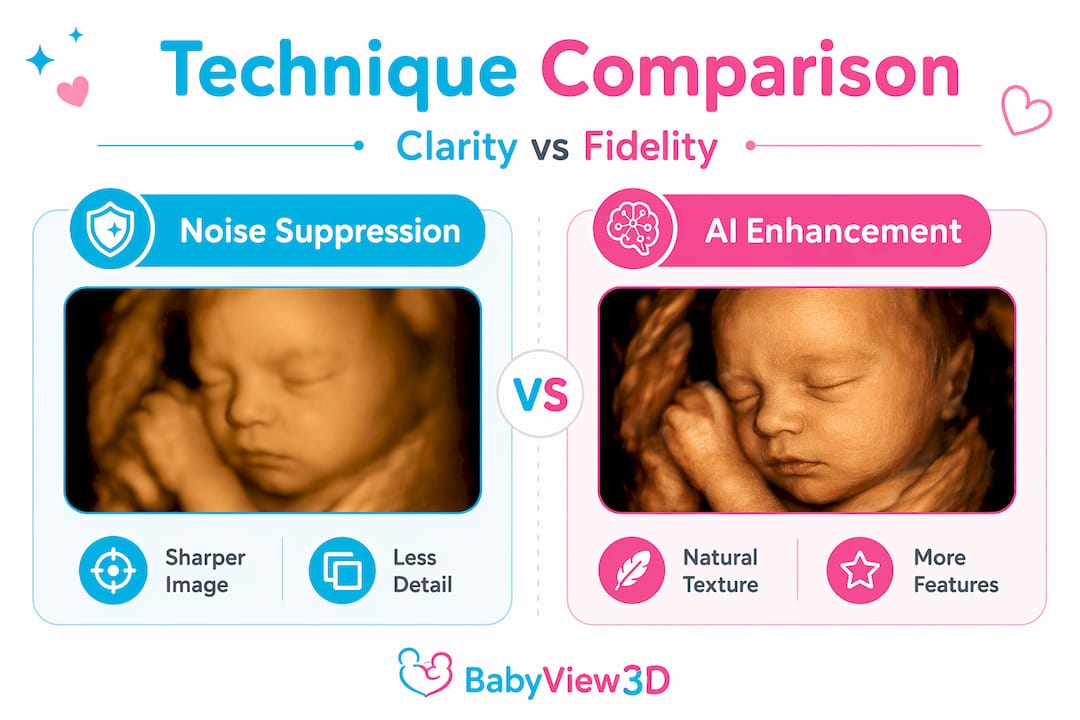
| Technique | How it works | Best for | Trade-off |
|---|---|---|---|
| Noise suppression | Filters out electronic interference in the raw signal | Cleaner, less grainy baseline images | Can soften fine structural edges |
| Contrast enhancement | Stretches brightness range to reveal dark and light areas | Making features stand out visually | May reduce nuanced mid-tone detail |
| Edge sharpening | Amplifies boundaries between tissue structures | Defining facial features and limbs | Over-sharpening can create artificial halos |
| AI super-resolution | Neural network reconstructs detail from noisy data | Maximum clarity in fine features | Computationally intensive; results depend on model quality |
| Structure-aware methods | Adapts processing to local anatomy, not fixed formulas | Preserving natural texture and authenticity | Requires more sophisticated software |
The trade-off that matters most for families is clarity versus structural fidelity. Over-enhancement can create visually impressive but misleading images, where the picture looks beautiful but does not accurately represent what is really there. Reputable studios and clinicians prioritize methods that reveal existing detail without fabricating new features. The standard in responsible enhancement is that structure-aware techniques are preferred over fixed mapping formulas precisely because they adapt to the real anatomy rather than imposing a one-size-fits-all correction.

For expecting parents, the practical implication is this: AI-enhanced sessions at a quality prenatal studio will give you noticeably better images than a basic 2D scan with standard filtering. But a session that chases visual drama at all costs is not one you should trust.
Pro Tip: When comparing ultrasound studios, ask to see sample gallery images. Look for natural-looking skin texture and anatomical detail. Images that look artificially smooth or overly bright are a sign of aggressive over-processing.
How to prepare for the best possible images
Getting great ultrasound images is partly about the technology used and partly about what you do before and during the session. The good news is that you have more influence over the outcome than most parents realize.
- Stay as still as possible during the scan. Physical movement causes speckling artifacts that enhancement software must then try to correct. The cleaner the raw capture, the less work enhancement has to do, and the more accurate the final image will be.
- Stay hydrated in the days before your appointment. Higher amniotic fluid levels generally produce better image conditions. Drink plenty of water in the 24 to 48 hours before your session.
- Schedule at the right gestational age. For 3D and 4D sessions, the window between 26 and 32 weeks tends to yield the best images. The baby has developed enough fat under the skin to show facial features clearly, but still has enough room to move into a good position.
- Ask about enhancement options before booking. Not all studios offer the same level of processing. Look for studios that explicitly mention AI-based enhancement or HD Live technology when you research your ultrasound packages.
- Follow the technician's instructions during the session. This includes breathing adjustments, position changes, and timing cues. Technicians are managing multiple factors at once, and cooperating closely with them makes a real difference.
- Set realistic expectations. Enhancement can dramatically improve a good raw image, but it cannot fully rescue a scan taken through difficult positioning, excessive movement, or suboptimal conditions. Understanding this ahead of time reduces disappointment.
Pro Tip: If your baby is not in an ideal position during your session, ask if there is time to walk around for a few minutes. Light movement often shifts the baby into a more photogenic position, giving enhancement technology better raw material to work with.
You can also explore what to expect at your 3D ultrasound appointment to go into your session with a clearer picture of how everything unfolds.
My take on what enhancement actually means for families
I have seen the reaction parents have when they first see a truly enhanced 3D image of their baby. There is a moment of genuine disbelief. They expected something vague and technical. They got something that looked like a photograph of a person they already love.
What I have learned over the years is that enhancement is far more complex than simply running an image through a sharpening filter. The real challenge, as anyone working with these systems knows, is that you are preserving subtle anatomical textures while improving clarity. Adaptive methods do that. Blunt filtering does not. Too many people outside the field assume enhancement means making pictures prettier. The serious version of it means making pictures truer to what is actually there.
I also think there is an important boundary families should hold onto. Enhanced images for keepsake sessions are not a substitute for your clinical anatomy scan. They serve a different purpose, and the best studios are transparent about that difference. Using enhancement to create beautiful memories is a legitimate and meaningful thing. Confusing it with diagnostic imaging is where things go wrong.
My honest opinion is that the AI-assisted enhancement available now has genuinely changed what prenatal experiences can look like. But the technology works best when it is applied responsibly, with technicians who understand both the emotional value to families and the integrity required in representing what the scan actually shows. That combination is what makes an enhanced session worth booking.
— LENIER
See the difference at Bbview3d

Bbview3d has spent over 15 years helping expectant families get the clearest, most meaningful looks at their babies before birth. Using advanced 3D, 4D, and 8K HD Live technology combined with AI-assisted enhancement, Bbview3d delivers images that go far beyond what a standard scan produces. Every session is led by certified sonographers who know how to capture and enhance images while keeping the experience warm, personal, and memorable. Browse Bbview3d's ultrasound services to see the packages available, or visit the image gallery to see exactly what enhanced fetal imaging looks like in practice. Your first appointment comes with a special introductory discount, making it the right time to book the session your family deserves.
FAQ
What is ultrasound image enhancement exactly?
Ultrasound image enhancement is the application of digital processing techniques to a raw scan to reduce noise, improve contrast, and reveal finer anatomical detail. It does not create new information but makes existing detail more visible.
Is ultrasound image enhancement effective for seeing fetal features?
Yes. Deep learning tools have been shown to raise optimal image quality rates from 38% to 65% in diagnostic settings, and the same principles apply to prenatal viewing sessions where facial features and limb detail become much clearer.
How does ultrasound enhancement work without distorting the image?
Responsible enhancement uses structure-aware methods that adapt to local anatomy rather than applying fixed filters. The goal is to reveal details that exist in the raw data without fabricating features that are not there.
Does a clearer ultrasound image mean more medical information?
Not necessarily. Enhancement for parental viewing often removes visual complexity that clinicians rely on, so a more attractive image is not automatically a more diagnostically useful one. Clinical scans and keepsake sessions serve different purposes.
What can I do to improve my ultrasound image quality?
Staying physically still during your scan is the most impactful factor you control. Staying hydrated beforehand, scheduling at the right gestational stage, and choosing a studio with advanced enhancement technology all contribute to a better outcome.