

Live streaming ultrasound is the process of broadcasting real-time ultrasound images and audio from a prenatal session over the internet so that family and friends can watch from anywhere. The industry term for the clinical version of this technology is tele-ultrasound, though consumer-focused services use the phrase "live streaming ultrasound" to describe the same core idea applied to elective, family-centered scans. Technologies like Sonostream and platforms built around 4D ultrasound streaming have made this experience widely accessible. Sessions are protected by encryption and require patient consent, making the process both personal and private. For families separated by distance, this is one of the most meaningful ways to share a pregnancy milestone together.
What is live streaming ultrasound and how does it work?
Live streaming ultrasound works by capturing ultrasound images and audio in real time, compressing that data, and transmitting it over the internet to remote viewers. The process happens in four stages: capture, compression, distribution through a content delivery network, and decoding on the viewer's device. Each stage adds a small amount of delay. Streaming latency can range from under one second to over 30 seconds depending on the protocol used and the quality of the internet connection. That means a grandparent watching from another state may see the baby's movements a few seconds after they happen, which is still a remarkable experience.
The technology behind the stream varies by provider. Some services use dedicated web platforms that viewers access through a private link. Others rely on mobile apps. The Draminski iScan app, for example, allows compatible ultrasound devices to stream live images directly to Android and iOS phones or tablets. That kind of mobile integration shows how accessible the technology has become for both providers and families.
Security is built into every legitimate live streaming ultrasound service. Encrypted broadcasts are the standard in clinical settings, and reputable consumer services follow the same model. Viewers receive a private link rather than a public broadcast URL, and recording by remote viewers is typically restricted or prohibited.
There is also an important distinction between consumer live streaming and clinical tele-ultrasound. Tele-ultrasound combines real-time imaging with remote expert guidance for diagnostic purposes. Consumer live streaming is designed for family viewing and bonding, not remote diagnosis. Both use the same core transmission technology, but their purposes are completely different.
- Capture: The ultrasound probe sends data to the imaging machine, which renders it as a visual image.
- Compression: The image and audio are compressed into a streamable format to reduce file size without losing too much quality.
- Transmission: The compressed stream travels through the internet via a content delivery network to reach remote viewers.
- Decoding: The viewer's device decodes the stream and displays the image in near real time.
Pro Tip: Ask your provider what streaming platform they use and whether it works on your family members' devices before booking. A quick compatibility check prevents technical problems on the day of the scan.
What are the benefits of live streaming ultrasound for families?
The most direct benefit of live streaming ultrasound is inclusion. A grandparent in Florida, a sibling stationed overseas, or a close friend who cannot take time off work can all watch the scan as it happens. That shared experience creates a real emotional connection to the baby before birth. Consumer live streaming services are specifically designed to prioritize this kind of bonding and shared viewing rather than clinical interpretation.

Beyond the live moment, many services offer video-on-demand replay. This means the family can rewatch the session after the appointment, share it with people who missed the live stream, or save it as a keepsake. That replay feature turns a single appointment into a lasting memory.
Live streaming also has a practical educational dimension. Watching the scan in real time allows remote family members to ask questions through a chat feature or phone call alongside the stream. They see the same images the parents see, which builds a shared understanding of the baby's development.
Privacy and consent are non-negotiable parts of this experience. Families should understand that consent and data handling are minimum standards in any legitimate service. Sharing the viewing link responsibly, and not posting it publicly, protects both the baby's privacy and the family's data.
Key benefits at a glance:
- Remote family and friends join the session in real time regardless of location
- Video replay lets families relive the moment and share it with others afterward
- Early bonding begins before birth through shared visual and emotional experience
- Educational value increases when all viewers see the same images simultaneously
- Inclusive experience for family members with mobility issues or travel limitations
How does live streaming ultrasound compare to traditional sessions?
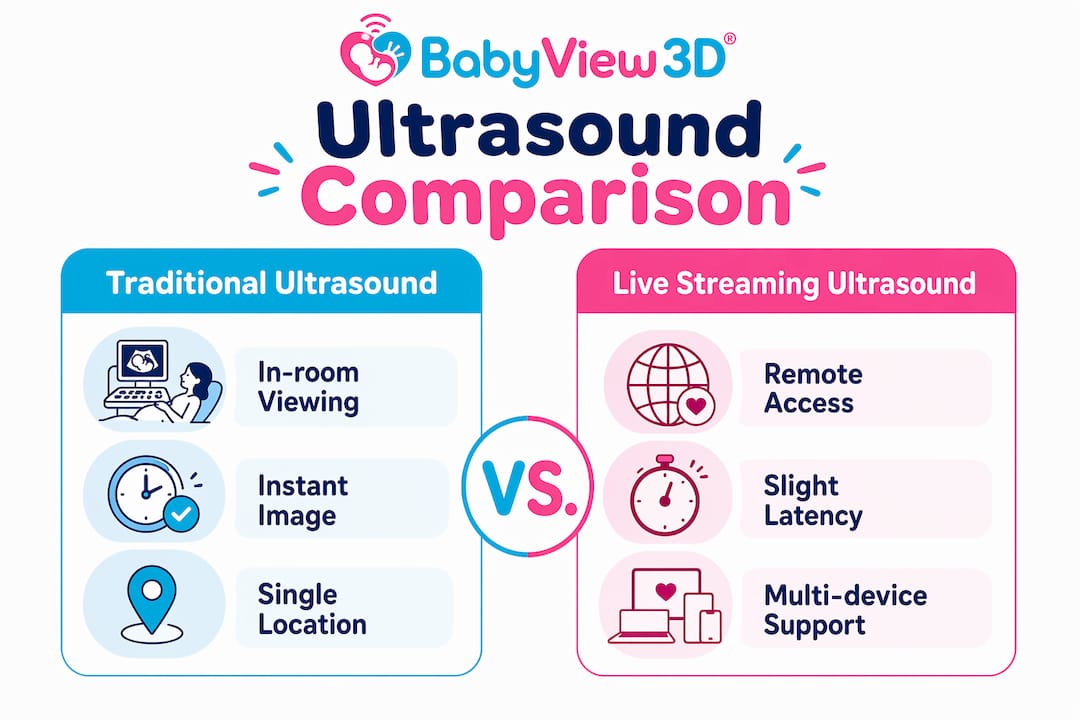
Both live streaming and traditional in-person ultrasound sessions use the exact same imaging technology. The ultrasound probe, the frequency of sound waves, and the way images are generated do not change. What changes is who can see the images and when. Traditional sessions limit viewing to whoever is physically in the room. Live streaming removes that limit entirely.
Visual rendering formats like 3D, 4D, and HD Live affect how the image looks on screen, but rendering formats change visualization, not the underlying ultrasound emission. A 4D stream shows movement over time, while a standard 2D image is a static cross-section. The choice of format shapes the emotional experience of the session, which is why many families opt for HD Live technology when streaming to remote viewers. The richer the image, the more meaningful the shared experience.
| Feature | Traditional Ultrasound | Live Streaming Ultrasound |
|---|---|---|
| Viewing audience | In-room only | Remote viewers included |
| Image quality | Full resolution, no compression | Slight compression depending on stream |
| Latency | None | Under 1 second to 30+ seconds |
| Replay option | Rarely available | Often included with service |
| Diagnostic use | Yes | Consumer version: no |
| Privacy controls | Physical room access | Encrypted link, consent required |
The one area where traditional sessions have a clear advantage is latency. In-person viewers see the image the instant it renders. Remote viewers experience a delay. For a family bonding session, that delay is barely noticeable. For clinical diagnosis, it matters more, which is why diagnostic tele-ultrasound involves additional expert oversight and specialized protocols.
Pro Tip: If image quality matters most to your remote family members, ask your provider whether they offer 4D or HD Live streaming specifically. Not all packages include the highest resolution formats.
What should families look for in a live streaming ultrasound service?
Choosing the right provider comes down to five practical factors. Work through each one before booking.
- Encryption and privacy policy. Confirm that the stream is fully encrypted and that the provider has a written policy on data storage and viewer access. Encrypted transmission and restricted recording are the baseline standards.
- Live versus on-demand options. Some services offer only a live stream. Others include a recorded replay for on-demand viewing after the appointment. If your family spans multiple time zones, on-demand access is worth the extra cost.
- Platform compatibility. Verify that the streaming platform works on smartphones, tablets, and computers. Ask whether viewers need to download an app or whether a browser link is sufficient.
- Image quality and visual format. Look for services that offer 3D, 4D, or HD Live streaming rather than basic 2D. The visual richness of the stream directly affects how much remote viewers connect with the experience.
- Consent and data handling. Read the consent form carefully. Understand what the provider stores, for how long, and who has access to the recorded footage.
Cost and package structure also matter. Many providers bundle live streaming with printed photos, digital keepsakes, and gender reveal options. Compare what each package includes rather than just the base price.
Pro Tip: Request a test link before your appointment day. Sending it to one remote family member in advance confirms the platform works on their device and avoids scrambling during the actual session.
Tips for getting the most out of your live streaming session
Preparation makes the difference between a smooth shared experience and a frustrating one. Follow these steps before and during your session.
- Test your internet connection. A stable connection at the ultrasound center matters, but so does the connection at each remote viewer's location. Ask viewers to use Wi-Fi rather than mobile data if possible.
- Schedule with time zones in mind. If family members are in different time zones, confirm the appointment time in their local time to avoid missed connections.
- Complete consent forms in advance. Most providers send paperwork ahead of the appointment. Finishing it early means you spend the session focused on the baby, not on forms.
- Share the viewing link only with intended viewers. Treat the link like a private invitation. Posting it publicly or forwarding it widely creates privacy risks.
- Download or save the recording promptly. If the provider offers a replay video, download it as soon as it becomes available. Some platforms delete recordings after a set number of days.
- Set up a group call alongside the stream. Many families run a video call on a separate device while watching the stream together. It adds a layer of shared reaction that makes the moment feel even more connected.
The prenatal ultrasound innovations available today make it genuinely possible for an entire family to experience a scan together, regardless of where everyone lives.
Key takeaways
Live streaming ultrasound delivers the same imaging quality as a traditional scan while extending the experience to remote family members through encrypted, real-time internet transmission.
| Point | Details |
|---|---|
| Core definition | Live streaming ultrasound broadcasts real-time prenatal images over the internet to remote viewers. |
| Latency is real but minor | Streams can lag from under 1 second to 30+ seconds; plan for it and set expectations with viewers. |
| Consumer vs. clinical use | Family-focused streaming is for bonding; tele-ultrasound with expert oversight is for diagnostics. |
| Privacy is non-negotiable | Confirm encryption, consent policies, and recording restrictions before booking any service. |
| Preparation matters | Test devices, share links carefully, and download recordings promptly to protect and preserve the experience. |
Why live streaming ultrasound is more than a tech feature
I have spent years watching families navigate the gap between what technology promises and what it actually delivers in emotional terms. Live streaming ultrasound is one of the few cases where the technology genuinely closes a real human distance. A grandmother who cannot fly across the country still gets to see her grandchild move for the first time. That is not a small thing.
The misconception I hear most often is that live streaming changes the scan itself. It does not. The ultrasound exposure, the imaging process, and the clinical data are identical to a standard session. The stream is just a window that more people can look through at the same time.
Where I urge families to be thoughtful is privacy. The excitement of sharing the moment can lead to careless link sharing or public posting. A live ultrasound stream contains sensitive personal and medical information. Treat it with the same care you would give any private medical record. Choose providers who take encryption seriously, read the consent forms, and share the viewing link only with people you trust completely.
The technology works best when families treat it as a deliberate, planned experience rather than an afterthought. Book the session with remote viewers in mind, test the platform in advance, and give everyone the chance to be fully present. When it works well, it is genuinely one of the most memorable moments a family can share during a pregnancy.
— LENIER
Experience live streaming ultrasound with Bbview3d
Bbview3d has offered premium prenatal ultrasound experiences for over 15 years, with certified sonographers and centers across the United States. Their service packages include live streaming options alongside 3D, 4D, and 8K HD Live imaging, so your entire family can share the moment in stunning detail regardless of where they are.
Every session includes encrypted streaming, on-demand video replay, and digital keepsakes designed to turn a prenatal appointment into a lasting family memory. First-time visitors can access a limited introductory discount on their first appointment. Explore the full range of ultrasound service packages at Bbview3d and find the option that fits your family's needs.
FAQ
What is live streaming ultrasound in simple terms?
Live streaming ultrasound is the process of broadcasting real-time prenatal scan images and audio over the internet so that remote family members can watch the session as it happens.
Is live streaming ultrasound safe for the baby?
Yes. The streaming process does not change the ultrasound scan itself. The imaging technology, sound wave exposure, and clinical procedure remain identical to a standard prenatal session.
How much delay should remote viewers expect?
Streaming latency typically ranges from under one second to over 30 seconds depending on the streaming protocol and internet connection quality at both ends.
Is the live stream private and secure?
Reputable providers use fully encrypted streams and restrict recording by viewers. Always confirm the provider's encryption and data handling policies before booking.
What is the difference between live streaming ultrasound and tele-ultrasound?
Consumer live streaming ultrasound is designed for family bonding and shared viewing. Tele-ultrasound is a clinical application that combines real-time imaging with remote expert guidance for diagnostic purposes.