

An enhanced ultrasound viewing workflow is defined as an AI and augmented reality driven process that speeds up image acquisition, reduces sonographer workload, and delivers clearer, more emotionally meaningful prenatal images to families. The standard clinical term for this approach is "workflow optimization ultrasound," and it covers everything from automated measurements to real-time 3D visualization. For expectant parents, this matters because the technology directly shapes what you see on screen, how long you wait, and how connected you feel to your baby during the session. Providers using platforms like Philips EPIQ Elite with Elevate Plus and Samsung's Live ViewAssist™ now offer experiences that were unimaginable just a few years ago.
What tools enable an enhanced ultrasound viewing workflow?
The foundation of any strong prenatal ultrasound experience is the hardware and software running behind the scenes. Families rarely see these tools, but they determine image sharpness, scan speed, and the range of views available during a session.
The most significant platforms in use today include:
- Philips EPIQ Elite with Elevate Plus: An AI-integrated system that automates measurements and decision support during live scanning, reducing operator variability and improving consistency across sessions.
- Samsung Live ViewAssist™: A guided AI tool that assists sonographers in capturing standard planes automatically, cutting the steps required to complete a full scan.
- Auto Measure Abdomen: An AI feature that measures fetal abdominal circumference without manual input, removing one of the most time-consuming steps in a mid-trimester exam.
- AR-VIU (Augmented Reality Visualization in Ultrasound): A system that overlays 3D spatial data onto the live scan view, giving both the sonographer and the family a richer, more intuitive picture of fetal anatomy.
- HD Live and 8K imaging formats: High-resolution rendering modes that produce the detailed, lifelike images used in keepsake packages at elective ultrasound centers.
| Tool | Primary benefit for families |
|---|---|
| Philips Elevate Plus | Consistent image quality, fewer repeat scans |
| Samsung Live ViewAssist™ | Faster sessions, more time for engagement |
| Auto Measure Abdomen | Accurate measurements without delays |
| AR-VIU system | Immersive 3D views, better comprehension |
| HD Live / 8K imaging | Sharper keepsake images and video |
Pro Tip: Before booking a prenatal ultrasound session, ask the provider directly: "What imaging platform do you use, and does it include AI-assisted measurement tools?" A provider who can name their system is a provider who invests in quality.
How does AI improve ultrasound imaging efficiency for families?
AI is the single biggest driver of change in prenatal ultrasound right now. Its impact is not subtle.
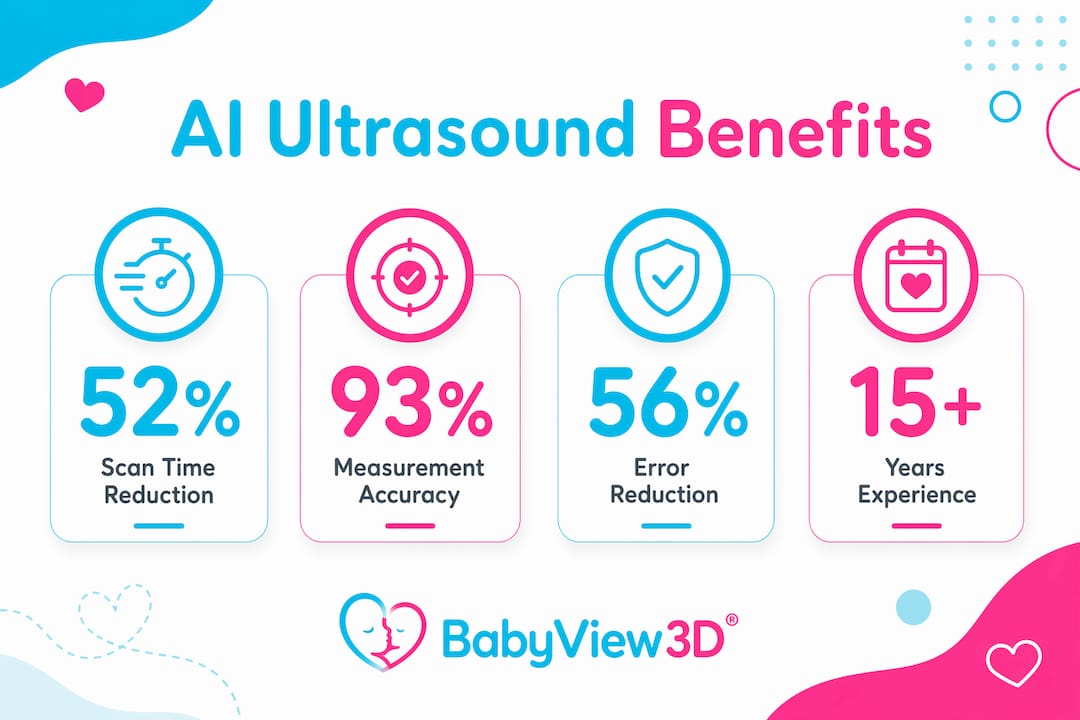
AI-assisted workflow tools reduce scan time by 52% in routine mid-trimester ultrasounds, cutting median session duration from 21 minutes to 10 minutes. That is not just a convenience. A shorter scan means less time lying still, less discomfort, and more time for the sonographer to focus on you and your family rather than on technical steps.
Accuracy improves just as dramatically. AI-powered measurement tools achieve over 93% accuracy compared to manual clinical measurements. That level of reliability means the images and data your provider captures are consistent and trustworthy, session after session.
AI also closes the gap between experienced and less experienced sonographers. AI-powered systems are narrowing the quality difference between novices and experts, which means high-fidelity imaging is now accessible at more locations, not just at top-tier academic medical centers.
The practical benefits for families include:
- Fewer repeat scans due to improved reproducibility across different operators
- More consistent image quality regardless of which sonographer performs your scan
- Reduced session fatigue for both the parent and the baby
- More time for the sonographer to explain what you are seeing on screen
Pro Tip: The real emotional payoff of AI is indirect. When the system handles measurements automatically, your sonographer can turn toward you, point out your baby's face, and share the moment. That human connection is what you remember. Ask your provider if their AI tools free up time for family engagement during the scan.
How does augmented reality change what families see during a scan?
Augmented reality in ultrasound is not a gimmick. It is a genuine leap in how families experience prenatal imaging.

Traditional 2D ultrasound shows a flat, gray cross-section of fetal anatomy. Most parents need the sonographer to explain what they are looking at because the image is not intuitive. AR changes that completely. AR-enhanced ultrasound acts like X-ray vision, overlaying 3D spatial mapping onto the live view so that fetal structures appear in context, with depth and orientation that make sense to a non-medical eye.
The clinical evidence supports the value of this approach. AR systems reduce novice technician localization errors by 56% compared to traditional 2D screen imaging. That improvement in accuracy directly benefits families because it means the images captured are more likely to show exactly what the sonographer intended, with less guesswork.
| Viewing technique | What families see | Comprehension level |
|---|---|---|
| Traditional 2D ultrasound | Flat gray cross-sections | Requires explanation |
| 3D ultrasound (standard) | Surface rendering of fetal features | Moderate, recognizable faces |
| AR-enhanced 3D ultrasound | Spatially mapped, multi-angle live view | High, intuitive depth and context |
| HD Live / 8K rendering | Photorealistic surface detail | Very high, emotionally immediate |
AR integration with 3D ultrasound enables stable, multi-angle views that improve parental engagement and comprehension during the session. For families who want to understand what they are seeing and feel genuinely present in the moment, AR is the technology that makes that possible. You can learn more about how these advances shape the emotional benefits of prenatal imaging for expecting families.
How to get the most from your enhanced ultrasound session
Knowing what technology your provider uses is only half the equation. How you prepare and engage during the session shapes the experience just as much.
Before your visit:
- Choose a provider with current-gen equipment. Ask specifically about AI-assisted platforms such as Philips EPIQ Elite or Samsung systems with Live ViewAssist™. Providers using current technology deliver higher-resolution, more memorable imaging sessions compared to those using older hardware.
- Understand what you want from the session. Decide in advance whether you want keepsake images, video, or a specific view such as a face profile or hands. Knowing your priorities helps the sonographer allocate time effectively.
- Read up on ultrasound image enhancement. Resources like ultrasound image enhancement explained for parents give you the vocabulary to have a productive conversation with your provider.
During the scan:
- Ask questions in real time. A sonographer using AI tools has more bandwidth to explain what appears on screen. Use that time. Ask them to point out specific features and to describe what they are measuring.
- Request specific views for keepsakes. If you want a face-forward image or a shot of tiny fingers, say so early. AI-assisted workflows give sonographers more flexibility to capture additional views without extending the session significantly.
- Bring your partner or support person. The emotional connection ultrasound creates is strongest when shared. Having someone beside you during the scan turns a medical appointment into a family memory.
"The best prenatal ultrasound sessions are the ones where the technology disappears and what remains is just you, your family, and your baby on screen."
Pro Tip: At the end of your session, ask the sonographer to walk you through the final images before you leave. Understanding what you are looking at makes the keepsakes far more meaningful when you revisit them later.
Key takeaways
An enhanced ultrasound viewing workflow, built on AI automation and augmented reality, delivers faster scans, more accurate images, and more time for families to connect with their baby during the session.
| Point | Details |
|---|---|
| AI cuts scan time significantly | Live ViewAssist™ reduces mid-trimester scan duration from 21 to 10 minutes. |
| Accuracy exceeds 93% with AI tools | Automated measurements match manual clinical results at a rate that reduces repeat scans. |
| AR improves what families actually see | AR systems reduce localization errors by 56% and make 3D anatomy intuitive for non-medical viewers. |
| Provider choice determines image quality | Platforms like Philips EPIQ Elite with Elevate Plus deliver the consistency and resolution families deserve. |
| Preparation multiplies the emotional payoff | Knowing what to ask and what to expect turns a routine scan into a lasting memory. |
Why this technology matters more than most parents realize
I have spent years watching families walk into ultrasound sessions with high expectations and walk out feeling like they missed something. Not because the sonographer did a poor job, but because the workflow was slow, the images were grainy, and the whole appointment felt clinical rather than celebratory.
The shift to AI-assisted and AR-enhanced workflows changes that dynamic at a structural level. AI frees sonographers from repetitive tasks, and that freed attention goes directly to the family in the room. That is not a small thing. A sonographer who is not manually adjusting calipers for the fifth time is a sonographer who can look at you, explain what your baby is doing, and make you laugh.
What surprises most people is that the emotional benefit of better technology is not about the images themselves. It is about the time the technology creates. A 10-minute scan instead of a 21-minute scan means 11 extra minutes where the sonographer is present with you rather than focused on the screen. That is where the memory gets made.
My honest advice: do not settle for a provider who cannot tell you what imaging system they use. The technology gap between a current-gen AI-integrated platform and an older system is not marginal. It is the difference between a session that feels rushed and one that feels like a gift.
— LENIER
See your baby in stunning detail with Bbview3d
Bbview3d has delivered premium prenatal ultrasound experiences for over 15 years, with certified sonographers and imaging technology that includes 3D, 4D, and 8K HD Live formats. Every session is designed to give your family the clearest possible view of your baby, with keepsake packages that turn a single appointment into a lasting memory.
Bbview3d's centers across the United States use advanced imaging platforms built for the kind of detail and emotional impact that families remember. First-time appointment discounts are available for new families. Explore the full range of prenatal ultrasound packages and find the session that fits your family. Visit Bbview3d to book your appointment and see your baby like never before.
FAQ
What is an enhanced ultrasound viewing workflow?
An enhanced ultrasound viewing workflow is an AI and augmented reality driven process that automates image acquisition, reduces scan time, and delivers clearer prenatal images. It is the clinical standard for improving both diagnostic accuracy and the family experience during prenatal ultrasounds.
How much faster are AI-assisted ultrasound scans?
AI-assisted tools reduce scan time by 52%, cutting a typical mid-trimester session from 21 minutes to 10 minutes. That extra time goes toward family engagement rather than technical tasks.
What should I ask my provider about their ultrasound technology?
Ask whether they use AI-assisted platforms such as Philips EPIQ Elite with Elevate Plus or Samsung Live ViewAssist™. Providers using these systems deliver more consistent image quality and shorter sessions compared to those using older equipment.
Does augmented reality really improve what parents see during a scan?
Yes. AR systems provide a 3D spatial view that makes fetal anatomy immediately recognizable without medical training. Research shows AR reduces technician localization errors by 56%, which means the images captured are more accurate and more useful as keepsakes.
How do I choose the best provider for an enhanced prenatal ultrasound?
Choose a provider who can name their imaging platform, offers 3D or 4D viewing options, and employs certified sonographers. Centers like Bbview3d that specialize in elective prenatal imaging are built specifically to deliver the kind of advanced ultrasound features that create memorable family experiences.