

A baby name reveal ultrasound is a standard prenatal ultrasound appointment where parents combine real-time fetal imaging with announcing their baby's chosen name, turning a routine medical scan into a celebration. The term has no official medical definition, but the experience is very real. Parents schedule either a medically required anatomy scan or an elective session, view their baby on screen, and then reveal the name they have chosen. This guide explains how the process works, when to schedule it, how to make the announcement memorable, and what to realistically expect from the imaging itself.
What is a baby name reveal ultrasound, exactly?
A baby name reveal ultrasound is not a special type of scan. It is a standard prenatal ultrasound used both for fetal imaging and to frame a name announcement, creating a memorable experience around a moment that already carries deep emotional weight. The ultrasound technology itself does not change. What changes is how parents choose to use the appointment.
The scan uses high-frequency sound waves to produce images of the fetus. Ultrasound does not expose the mother or baby to ionizing radiation, making it safe when performed by trained professionals. That safety record is one reason parents feel comfortable turning this appointment into a social event, sometimes inviting family members to watch the screen in real time.

Most parents combine a baby name reveal with a baby gender reveal ultrasound, since knowing the sex often informs the name choice. The reveal itself can happen during the scan, immediately after, or days later using images and video clips from the session. The appointment is the source material. The reveal is what you build around it.
How does a baby name reveal work during the appointment?
The appointment follows the same steps as any prenatal ultrasound. A certified sonographer applies gel to the abdomen, moves a transducer across the skin, and generates real-time images of the fetus on a monitor. What makes a name reveal session different is the intentional structure parents bring to it.
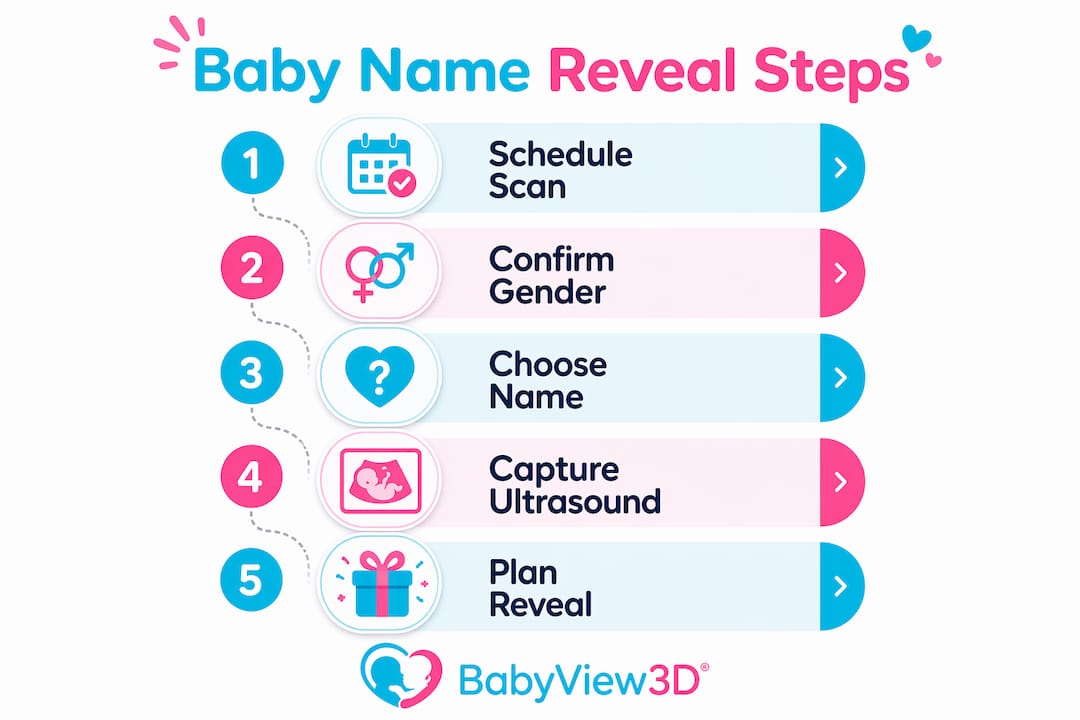
Here is how most parents organize the experience:
- Confirm the sex first. The sonographer identifies fetal anatomy and confirms the sex, which is the foundation for most name reveal plans.
- Capture the media. Parents request printed images, digital photos, or video clips of the scan for use in announcements.
- Choose a reveal moment. Some parents announce the name right in the room. Others wait until a party or social media post, using the ultrasound images as the visual centerpiece.
- Share with guests or online. Ultrasound baby name announcements work well on Instagram, in group texts, or as part of a printed card mailed to family.
The elective nature of these appointments matters. A medically required anatomy scan is scheduled by your OB or midwife. An elective session at a private studio like Bbview3d is scheduled by you, on your timeline, with more flexibility for guests, lighting, and keepsake formats.
Pro Tip: Ask your provider or studio ahead of time whether they offer digital video files, not just printed images. Video clips of the baby moving on screen are far more shareable and emotionally powerful than still prints.
When should you schedule a name reveal ultrasound?
Timing is the most practical decision you will make. Most elective gender reveal ultrasounds occur between 18 and 22 weeks because clearer genital visibility is possible during anatomy scans. That same window is the sweet spot for a name reveal, since sex confirmation is usually what determines the final name.
Here is a simple timing framework:
- Before 12 weeks: Avoid scheduling a reveal scan. External genitalia develop mostly after 13 weeks, so early scans carry real uncertainty about sex determination.
- 12–17 weeks: Some providers can make a reasonable guess, but accuracy is not reliable enough to base a name reveal on.
- 18–22 weeks: The preferred window. Fetal anatomy is developed enough for clear imaging, and sex determination is far more accurate.
- After 22 weeks: Still possible and sometimes clearer, but the baby grows larger and positioning can actually become more limiting.
Fetal position plays a significant role in every scan. Even in optimal timing windows, an uncooperative baby can block the view entirely, requiring a follow-up appointment. Build that possibility into your planning. If you are scheduling a party around the reveal, give yourself at least a week of buffer between the scan and the event.
Maternal factors such as body composition and amniotic fluid levels also affect image clarity. Your provider can advise on ideal ultrasound timing based on your specific pregnancy.
What are the best ways to announce a baby's name using ultrasound media?
Ultrasound images and video clips are the most personal visual content you will ever have. The way you use them for your announcement shapes how the moment lands for your family and friends.
| Reveal Format | Best For | What You Need |
|---|---|---|
| In-room live reveal | Intimate family moments | Guests present at the scan |
| Social media post | Wide reach, shareable | Digital image or short video clip |
| Reveal party | Group celebration | Printed image or video display |
| Mailed announcement card | Grandparents, older relatives | High-quality printed ultrasound photo |
| Synchronized online reveal | Long-distance family | Shared link or countdown timer |
The two-step reveal is one of the most emotionally effective formats. Name reveal announcements often use a sequential approach where gender comes first, then the name shortly after, creating a double wave of excitement. Platforms like RevealTogether support synchronized online links so remote family members experience the moment at the same time.
Creative baby name reveal ideas that use ultrasound media well include:
- Overlaying the baby's name in text on a 3D ultrasound image for a social post
- Creating a short video that starts with the scan footage and ends with the name on screen
- Printing a large-format ultrasound image for a party backdrop with the name revealed live
- Sending a sealed envelope with the ultrasound image and name to grandparents to open on video call
The emotional impact of these announcements increases when there is a brief, intentional delay between the gender reveal and the name reveal. That pause builds anticipation and makes the name feel like its own distinct moment.
Does ultrasound image quality affect your reveal plans?
Yes, and this is the part most parents underestimate. Ultrasound image quality depends heavily on sound wave reflections, fetal positioning, and operator skill. A technically successful scan for medical purposes can still produce images that are too blurry or obscured for a meaningful announcement photo.
The type of ultrasound technology used makes a measurable difference for keepsake purposes:
| Imaging Type | What It Shows | Best Use |
|---|---|---|
| 2D Ultrasound | Flat cross-section of fetal anatomy | Medical assessment, sex confirmation |
| 3D Ultrasound | Surface rendering of fetal features | Keepsake photos, facial detail |
| 4D Ultrasound | Real-time moving 3D images | Video keepsakes, emotional connection |
3D and 4D ultrasound imaging provide surface rendering and moving images of fetal anatomy, offering far more detailed keepsakes compared to standard 2D scans. These modes require specific equipment and a sonographer trained to optimize image composition, which is why the choice of provider matters as much as the timing.
Sonographer experience directly shapes what you walk away with. Operators need experience to optimize scan quality and image composition, particularly when creating keepsake media for personal announcements. A skilled sonographer will adjust angles, wait for the baby to shift position, and know how to capture the clearest possible frame.
Pro Tip: Ask your studio specifically about ultrasound image quality before booking. Find out what imaging modes they offer, whether they provide digital files, and what their policy is if the baby's position prevents a clear shot.
There is no official medical definition for a baby name reveal ultrasound, so providers vary widely in what they offer. Clarify upfront whether you will receive keepsake images, video clips, or both, and confirm the file formats you need for your announcement plans.
Key takeaways
A baby name reveal ultrasound works best when parents combine the 18–22 week anatomy window with a clear reveal strategy and a provider who delivers keepsake-quality media.
| Point | Details |
|---|---|
| Not a special scan | A name reveal ultrasound uses standard prenatal technology; the reveal is what you plan around it. |
| Best timing is 18–22 weeks | Sex determination is most accurate in this window, making it the right foundation for a name reveal. |
| Backup plans matter | Fetal position can block views; build flexibility into your reveal timeline to avoid disappointment. |
| Image type changes the keepsake | 3D and 4D imaging produce far more emotional and shareable media than standard 2D scans. |
| Provider skill is critical | Sonographer experience directly affects image quality and the usability of your reveal media. |
Why i think most parents plan this backward
The reveal moment deserves as much planning as the name itself
Most parents spend weeks choosing the perfect name and about 10 minutes thinking about how they will actually reveal it. That imbalance shows up in the results. I have seen families walk out of a scan with blurry 2D printouts and no video, then scramble to build an announcement around images that do not do the moment justice.
The emotional weight of seeing your baby on screen and saying their name out loud for the first time is real. That moment deserves a provider who understands what you are trying to create, not just a technician completing a checklist. Choosing a studio with certified sonographers and 3D or 4D capability is not about luxury. It is about getting media you will actually want to share and keep.
My honest advice: treat the scan appointment as the production, not just the source material. Know what file formats you need before you walk in. Have a backup date in mind if the baby is not in position. And give yourself the 18–22 week window. Early scans feel exciting, but the uncertainty they carry can unravel an entire reveal plan.
The emotional connection built through ultrasound is one of the most powerful parts of pregnancy. Do not leave it to chance.
— LENIER
How Bbview3d makes your name reveal unforgettable
Bbview3d specializes in elective prenatal ultrasound experiences designed specifically for moments like this. With over 15 years of experience, certified sonographers, and 3D, 4D, and HD Live imaging technology, Bbview3d gives you the image quality your announcement actually deserves. Sessions are scheduled on your timeline, so you can align your appointment with the 18–22 week window and plan your reveal with confidence. Multiple locations across the United States make it easy to find a center near you. Explore the full range of ultrasound packages and services at Bbview3d and book your session before the limited first-appointment discount expires.
FAQ
What exactly is a baby name reveal ultrasound?
A baby name reveal ultrasound is a standard prenatal ultrasound appointment where parents use fetal imaging to frame the announcement of their baby's chosen name. There is no difference in the scan technology itself; the reveal is a celebratory layer parents add to the experience.
When is the best time to have a name reveal ultrasound?
The 18–22 week window is the most reliable period for sex confirmation and clear fetal imaging, making it the preferred time for a name reveal ultrasound. Scans before 12 weeks carry significant uncertainty about sex determination.
Is a baby name reveal ultrasound safe?
Yes. Ultrasound uses high-frequency sound waves and does not expose the mother or fetus to ionizing radiation, making it safe when performed by trained professionals.
What is the difference between 2d, 3d, and 4d ultrasound for a reveal?
2D ultrasound is standard for medical assessment, while 3D imaging produces detailed surface images of the baby's face and body. 4D adds real-time motion, creating video keepsakes that are far more emotional and shareable for name reveal announcements.
What if the baby is not in the right position during the scan?
Fetal position can obstruct the view even during the optimal 18–22 week window, sometimes requiring a follow-up scan. Build flexibility into your reveal timeline and confirm your provider's rescan policy before booking.