

An elective ultrasound is a non-medical imaging session focused on bonding and memory-making, while a diagnostic ultrasound is a medically necessary procedure used to evaluate fetal health and development. Understanding what is elective vs diagnostic ultrasound matters because the two serve completely different purposes, follow different regulations, and require different operator qualifications. The FDA and the American Institute of Ultrasound in Medicine (AIUM) both publish guidelines that govern how each type is conducted. Expectant parents who know the difference make better decisions about their prenatal care and their keepsake experiences.
What is elective vs diagnostic ultrasound: core differences in technology
Both types of prenatal ultrasound use the same underlying physics. High-frequency sound waves travel into the body, bounce off tissue, and return as signals that a machine converts into images. The hardware is often identical. What changes is how the operator configures the machine and what they do with the results.
Diagnostic ultrasounds use settings optimized for clinical clarity. Physicians and credentialed sonographers adjust contrast, depth, and gain to identify anatomical structures, measure fetal growth, and detect abnormalities. The output is typically 2D grayscale imagery, though color Doppler is added when blood flow assessment is needed. You can learn more about how color imaging works in prenatal scans.
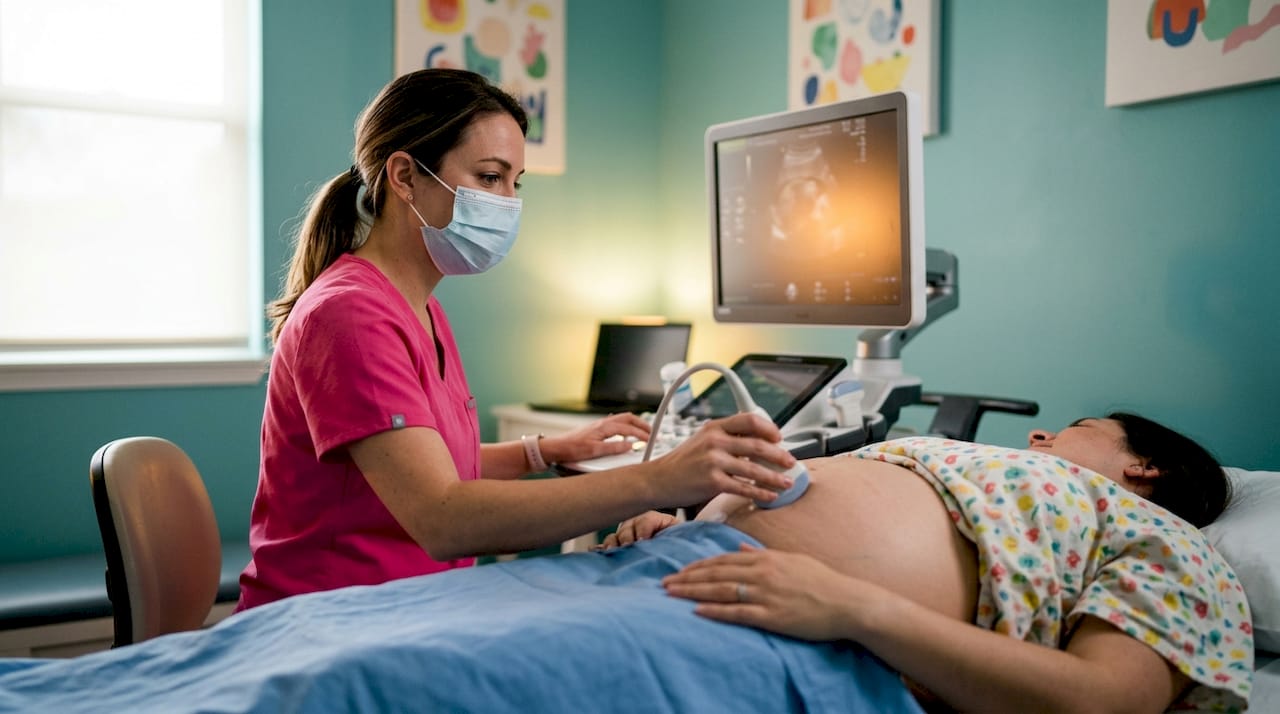
Elective ultrasounds use the same machine but optimize settings for visual appeal. Technicians prioritize 3D surface rendering and 4D real-time video to produce images that show facial features, expressions, and movement. The goal is a memorable image, not a clinical measurement. Bbview3d, for example, uses HD Live technology to produce 8K-resolution imagery that captures detail far beyond standard 2D clinical scans.
Both types must follow the ALARA principle, which stands for "As Low As Reasonably Achievable." This standard limits exposure time and energy intensity to protect the fetus. Doppler modes, which emit more energy than standard B-mode imaging, are used selectively in both settings for this reason.
| Feature | Diagnostic ultrasound | Elective ultrasound |
|---|---|---|
| Primary output | 2D grayscale clinical images | 3D/4D and HD keepsake images |
| Settings focus | Clinical accuracy and measurement | Visual detail and aesthetics |
| Doppler use | As clinically required | Minimized per ALARA |
| Operator goal | Medical assessment | Bonding and memory capture |
Pro Tip: Ask any elective studio how they apply the ALARA principle before booking. A reputable provider will explain their scan time limits and confirm they avoid unnecessary Doppler use.
How do purpose, procedure, and regulation differ between the two types?
The clearest way to separate these two types of ultrasound procedures is by asking one question: is a physician ordering this scan to answer a clinical question? If yes, it is diagnostic. If no, it is elective.
Diagnostic ultrasounds answer specific medical questions. Common examples include:
- First-trimester dating scans that confirm gestational age and check for chromosomal markers
- Anatomy scans at 18–20 weeks that evaluate organ development, limb structure, and placental position
- Growth scans in the third trimester that track fetal weight and amniotic fluid levels
- Biophysical profiles that assess fetal breathing, movement, and tone when a pregnancy is considered high risk
Elective ultrasounds serve a different purpose entirely. They focus on emotional bonding and capturing memories. Elective sessions last longer and are conducted in relaxed environments that favor connection over clinical measurement. They do not replace any of the diagnostic scans listed above.
Regulatory frameworks reflect this distinction. Diagnostic scans are subject to standards set by the AIUM and the FDA, must be ordered by a licensed medical professional, and require formal interpretation by a qualified provider. Elective scans follow safety guidelines but carry no diagnostic mandate.
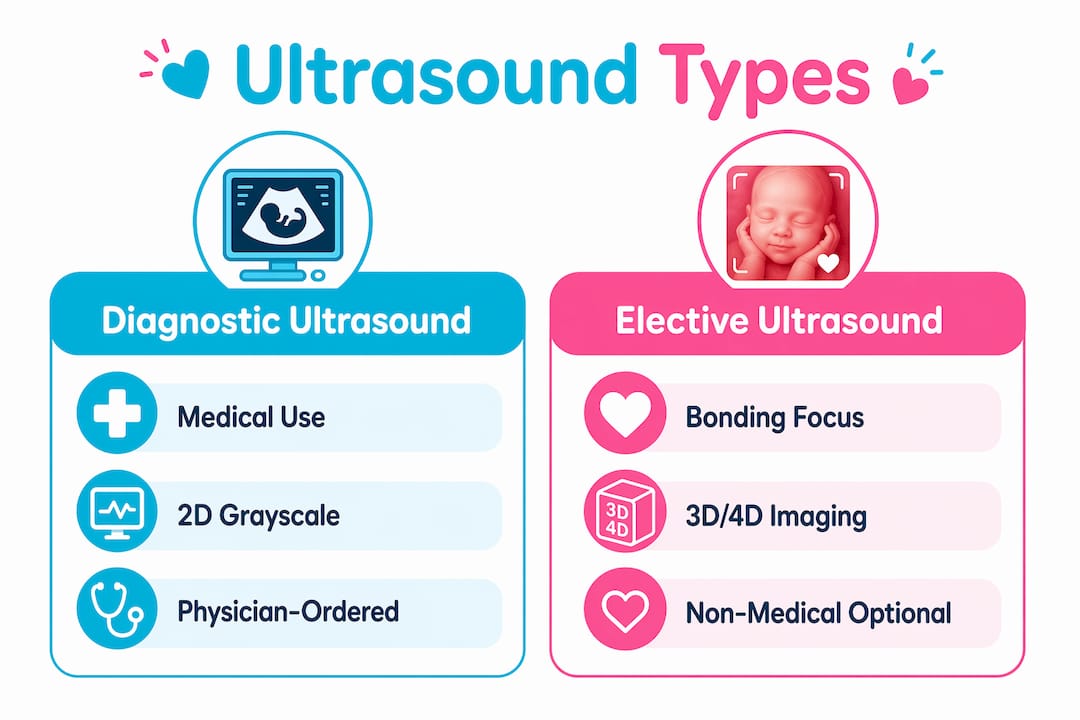
Insurance coverage follows the same logic. Diagnostic ultrasounds ordered by a physician are typically covered under standard prenatal benefits. Elective ultrasounds are considered non-medical and are paid out of pocket. That distinction is not a flaw in the system. It reflects the honest difference in clinical necessity between the two.
Who performs elective vs diagnostic ultrasounds?
Operator qualifications represent one of the most important differences between these two modalities. The credentials required, and the legal boundaries that come with them, are not interchangeable.
Diagnostic ultrasound operators typically hold certification from the American Registry for Diagnostic Medical Sonography (ARDMS) or an equivalent credentialing body. Credentialed sonographers work under physician oversight in clinical settings and are trained to recognize pathology, measure anatomy, and document findings for medical records. Their training includes formal coursework in anatomy, physiology, and image interpretation.
Elective ultrasound technicians follow a different educational path. Specialized training programs teach 3D and 4D image optimization, client communication, and non-diagnostic best practices. These programs do not train technicians to diagnose conditions. That boundary is both legal and ethical.
Key points about elective technician boundaries:
- No medical interpretation: Elective technicians cannot tell a client that a fetus looks healthy, that a measurement is normal, or that a finding is concerning.
- Mandatory referral: If a technician notices something unusual during a session, ethical standards require them to advise the client to follow up with their healthcare provider. They do not diagnose.
- Safety compliance: Elective technicians must apply ALARA guidelines just as rigorously as clinical sonographers, even though the session has no medical purpose.
- Scope of practice: Elective technicians operate within a defined scope that prioritizes image quality and client experience, not clinical assessment.
Bbview3d employs certified sonographers with over 15 years of experience in prenatal imaging. That level of expertise matters even in a non-diagnostic setting, because proper technique directly affects image quality and safety.
Pro Tip: Before booking an elective session, ask whether the technician holds any formal sonography training or certification. A well-trained operator produces better images and follows safety protocols more reliably.
What can parents expect during each type of session?
The atmosphere of a diagnostic ultrasound is clinical by design. The room is typically dim, the equipment is medical-grade, and the sonographer works methodically through a checklist of measurements. The session lasts 20–45 minutes depending on the scan type. Conversation is limited because the operator is focused on documentation. Parents often see the screen but may not receive much real-time explanation.
Elective ultrasound studios are built around a completely different experience. Family-friendly environments include plush seating, large display screens, and sometimes live streaming so relatives in other cities can watch in real time. Sessions run longer to allow for image capture, family reactions, and multiple viewing angles. The technician narrates what is visible on screen, pointing out features like the baby's hands, facial expressions, or yawning movements.
The emotional impact of a well-run elective session is real. Parents who see a detailed 3D image of their baby's face often report a stronger sense of connection before birth. That bond has value, even if it carries no clinical weight.
"Elective ultrasound sessions prioritize emotional bonding, family experience, and keepsake imagery using 3D and 4D imaging technologies. Sessions last longer and are conducted in relaxed environments favoring connection over medical diagnostics."
Safety measures apply in both settings. Elective studios minimize scan time and avoid unnecessary Doppler use, consistent with ALARA. A session that runs excessively long or uses Doppler without justification is a red flag. Reputable providers set clear time limits and explain their safety approach before the session begins. You can explore prenatal ultrasound packages to understand what a well-structured elective session typically includes.
A typical elective session follows this sequence:
- Intake and consent: The technician reviews the client's gestational age, confirms the session scope, and explains what the scan will and will not provide.
- Positioning and setup: The parent lies comfortably while the technician applies gel and begins imaging.
- Live viewing: Images appear on a large screen in real time, with the technician narrating visible features.
- Image capture: The technician captures still photos and video clips at the best angles.
- Keepsake delivery: Parents receive printed photos, digital files, or video recordings to keep.
Key Takeaways
Diagnostic ultrasounds are medically necessary tools ordered by physicians, while elective ultrasounds are non-medical bonding sessions that must never replace clinical prenatal care.
| Point | Details |
|---|---|
| Core distinction | Diagnostic scans answer clinical questions; elective scans create keepsake memories. |
| Same technology, different use | Both use high-frequency sound waves but differ in settings, output, and operator goals. |
| Operator qualifications | Diagnostic sonographers hold ARDMS credentials; elective technicians specialize in 3D/4D imaging. |
| Safety applies to both | ALARA governs exposure time and Doppler use in both diagnostic and elective sessions. |
| Insurance and cost | Diagnostic scans are typically covered by insurance; elective scans are paid out of pocket. |
Why I think parents underestimate the importance of keeping these two separate
I have seen expectant parents arrive at elective sessions hoping to get reassurance that everything looks fine. That impulse is completely understandable. Seeing your baby move on a screen feels like confirmation that all is well. The problem is that an elective session cannot provide that confirmation, and a good technician will tell you so directly.
The misconception that elective scans substitute for diagnostic screening is genuinely dangerous. A 3D image of a baby's face tells you nothing about placental function, cervical length, or fetal heart structure. Those answers require a clinical scan ordered by a physician and interpreted by a credentialed professional.
What I encourage parents to do is treat elective ultrasounds as a complement to their medical care, not a replacement for it. Schedule your anatomy scan, your growth scans, and every appointment your OB recommends. Then, separately, consider an elective session as a way to bond with your baby and share the experience with family. The two serve different needs, and both can coexist without conflict.
Open communication with your healthcare provider matters here. Tell your OB or midwife if you plan to have an elective scan. Most providers support it when parents understand the distinction. The ones who raise concerns usually do so because they have seen parents skip clinical appointments after feeling reassured by a keepsake image. That is the real risk, and education is the only fix.
— LENIER
Bbview3d: elective prenatal imaging with professional standards
Bbview3d has offered elective prenatal imaging for over 15 years, with certified sonographers and HD Live technology that produces 8K-resolution 3D and 4D images. Every session follows ALARA safety guidelines, and technicians are trained to provide a warm, family-centered experience without crossing into medical interpretation.
Parents who want to see their baby's face before birth, share the moment with family, or create lasting keepsakes will find elective ultrasound services at Bbview3d designed specifically for that purpose. The gallery shows the image quality parents can expect, and the store offers keepsake products to complement the session. First-time appointments include a limited-time discount. Visit Bbview3d to view packages and book a session at a location near you.
FAQ
What is the main difference between elective and diagnostic ultrasound?
Diagnostic ultrasounds are medically necessary scans ordered by a physician to assess fetal health, while elective ultrasounds are non-medical sessions focused on bonding and keepsake imagery. The two use the same technology but serve entirely different purposes.
Is elective ultrasound safe for my baby?
Elective ultrasounds are considered safe when conducted by trained technicians who follow the ALARA principle, which limits exposure time and energy intensity. Reputable studios minimize Doppler use and set clear session time limits.
Can an elective ultrasound replace my diagnostic prenatal scans?
No. Elective ultrasounds cannot diagnose conditions, measure fetal anatomy, or assess placental health. All physician-ordered diagnostic scans remain necessary regardless of any elective sessions you schedule.
Who is qualified to perform a diagnostic ultrasound?
Diagnostic ultrasounds are performed by sonographers credentialed through bodies like the ARDMS, working under physician oversight in clinical settings. They are trained to interpret images and document findings for medical records.
Does insurance cover elective ultrasounds?
Elective ultrasounds are not covered by insurance because they lack clinical necessity. Parents pay out of pocket, unlike diagnostic scans, which are typically covered under standard prenatal benefits when ordered by a physician.